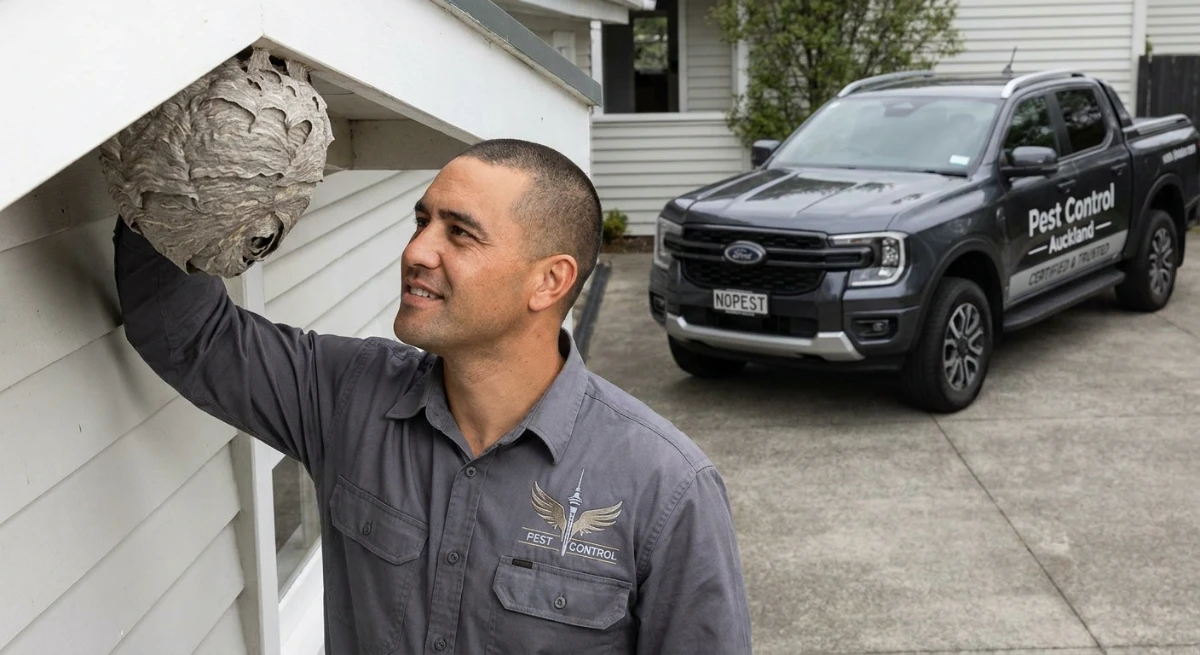
Let’s be honest, finding a wasp nest the size of a rugby ball in your eaves isn’t exactly a great start to the weekend. After the unusually mild winter and scorching summer we had last year, Auckland is currently experiencing a massive autumn pest surge in May 2026. Wasps are thriving, and they are aggressively defending their territory right in our backyards.
If you are dealing with a swarm, your first instinct might be to grab a cheap can of fly spray from the local hardware store. Trust me, that is the quickest way to end up at the A&E. Wasps do not mess around, and neither should you when it comes to protecting your family or your business.
At Pest Control Auckland, we do not just spray and walk away. We focus on scientific, root-cause eradication and structural exclusion. Whether you need urgent wasp nest removal in Auckland or advice on a swarming honey bee colony, our certified technicians have the gear and the knowledge to sort it out safely.
Key Takeaways
Professional wasp nest removal in Auckland requires Level 3 certified technicians to safely handle Class 9 ecotoxic treatments. DIY methods often provoke aggressive swarms, leading to severe stinging incidents. We guarantee complete nest eradication and offer ethical live relocation referrals for protected honey bees.
Identifying Wasp Threats in Auckland: German vs. Common Wasps
New Zealand has the unfortunate title of hosting some of the highest densities of social wasps in the world. Because our climate lacks the harsh, freezing winters of Europe, wasp colonies here can survive year-round. This allows them to grow to terrifying sizes.
To truly understand the threat, you have to look at the biology. German wasps were accidentally introduced to New Zealand in the 1940s, likely via shipping crates. Without any natural predators to keep their numbers in check, their population exploded. Today, our native forests and urban environments are teeming with them.
In Auckland, we primarily deal with two main culprits: the German wasp and the Common wasp. Both are introduced pests that wreak havoc on our native ecosystems and pose a serious threat to homeowners and commercial businesses alike. Knowing what you are up against is the first step in effective management.
The German Wasp (Vespula germanica)
German wasps are the most notorious stingers you will encounter around your Auckland property. They are highly aggressive scavengers, often found hovering around your summer BBQs looking for protein or sugary drinks. They typically build their grey, papery nests underground, in retaining walls, or tucked up high in roof voids.
Because Auckland winters are relatively mild, German wasp nests can “overwinter.” This means the colony doesn’t die off completely; instead, multiple queens can take over, and the nest continues to expand. We have pulled nests out of Auckland ceilings that were easily the size of a beanbag.
The Common Wasp (Vespula vulgaris)
The Common wasp arrived slightly later, taking hold in the 1970s. While they compete for the same resources, the sheer abundance of food in New Zealand means both species thrive side-by-side. They look very similar to the German wasp, sporting the same yellow and black warning colours.
While they might prefer the bush, we still see plenty of Common wasps setting up shop in residential gardens across the North Shore and Waitakere Ranges. They are an absolute menace to our native birds because they consume massive amounts of honeydew. They are just as aggressive when their nest is disturbed, and their stings pack the same painful punch.
| Feature | German Wasp | Common Wasp |
|---|---|---|
| Appearance | Black dots on yellow bands, completely separate from black rings. | Black dots merge with the black rings, forming an anchor shape on the face. |
| Nest Location | Often in roof voids, wall cavities, and urban structures. | Often underground, in tree stumps, and near forested areas. |
| Aggression Level | Extremely high when threatened. | High, especially in late summer/autumn. |
| Overwintering | Common in Auckland; nests can survive multiple years. | Rare, but occasionally happens in warmer microclimates. |
Health & Safety Risks: Why DIY Wasp Removal is Dangerous
We see it every summer. A homeowner spots a few wasps flying into a gap in their brickwork, buys a can of bug spray, and empties it into the hole. This is what we call the “DIY Cycle of Despair.”
When you spray a nest with a consumer-grade aerosol, you only kill the few workers guarding the entrance. The thousands of wasps deeper inside the cavity instantly register the chemical threat and switch into hyper-defensive mode. They will swarm out, aggressively targeting anything moving within a ten-metre radius.
Unlike bees, a single wasp can sting you multiple times without dying, pumping venom into your skin with every strike. Attempting DIY wasp nest removal in Auckland often results in the wasps finding a secondary exit. If that nest is in your wall cavity, that secondary exit might just be straight through your living room ceiling.
Wasp venom contains toxins that can trigger severe allergic reactions. Even if you have never been allergic before, multiple stings from an agitated nest can induce anaphylactic shock within minutes. Always leave nest eradication to certified professionals wearing proper PPE.
Our Certified Process for Safe Wasp Nest Eradication
To do this job legally and effectively in New Zealand, you need the right credentials. Under the EPA HPC Notice 2017 and the HSNO Act 1996, handling Class 9 ecotoxic substances requires strict compliance and specialized training.
Our technicians hold the New Zealand Certificate in Pest Operations (Level 3). This means we are Qualified UPM Contractors who know exactly how to apply treatments safely. We bring a level of scientific rigor that DIY solutions simply cannot match, protecting your family, your pets, and the local environment.
Targeted, Zero-Emission Treatments
We utilize MPI-approved, highly targeted insecticidal dusts. We apply this dust directly into the entry point of the nest under pressure. As the worker wasps return from foraging, they carry the dust deep into the heart of the colony, passing it directly to the queen.
This method ensures complete eradication within 24 to 48 hours. Because the treatment is confined entirely to the nest cavity, there is zero emission into your home’s breathing air or garden soil. It is a clinical approach that guarantees results without putting non-target species at risk.
For our hospitality and commercial clients, a wasp issue can shut down an outdoor dining area instantly. Our treatments are fully compliant with the Food Act 2014, ensuring your business stays open, safe, and audit-ready.
Auckland’s Peak Wasp Season: When to Be Most Vigilant
Wasp activity operates on a predictable cycle, but the sheer volume of pests fluctuates based on the weather. Queens emerge from hibernation in late spring (November) to start building their nests. However, the real danger zone hits much later in the season.
By February, March, and April, the colonies have reached their maximum size. The worker wasps shift their diet from sugars to proteins to feed the new queens. This is when they become incredibly aggressive and start invading cafes, bakeries, and school playgrounds looking for food.
As we approach the FAOPMA Pest Summit here in Auckland in July 2026, the industry is heavily focused on Predictive Integrated Pest Management (IPM). We are using weather data to forecast these autumn surges, allowing us to implement preventative baiting before the nests get out of control.
What About Honey Bees? Our Conservation & Live Relocation Referral Policy
We get frantic calls every week from people who think they have a wasp nest, only to discover it is a swarm of honey bees. It is crucial to understand that we treat bees very differently from wasps. New Zealand’s agricultural economy relies heavily on the pollination services provided by honey bees.
When a bee colony outgrows its hive, the old queen takes half the workers and leaves to find a new home. This is the swarm you see resting on your property. They are usually full of honey, remarkably calm, and just looking for a permanent place to settle.
Our Ethical Relocation Policy
As a rule, Pest Control Auckland does not exterminate honey bees. If you have a swarm on your property, we will assess the situation and refer you to a registered local beekeeper or Apiculture New Zealand for safe, live relocation.
The only exception to this rule is if the bees have established a hive deep within a structural cavity where extraction is impossible, and they pose an immediate, severe health risk to the occupants. Even then, extermination is our absolute last resort.
If the insects are fuzzy, golden-brown, and clustered in a tight ball, they are likely bees. If they are smooth, bright yellow and black, and flying in and out of a specific hole in the ground or a wall, they are wasps. When in doubt, take a photo from a safe distance and send it to us.
Preventing Future Infestations with Structural Exclusion
Eradicating the current nest is only half the battle. Wasps are highly opportunistic. If a queen found your property attractive this year, another one will likely find it attractive next year. That is why our service goes beyond just killing the bugs.
We conduct a thorough property inspection to identify structural vulnerabilities. Old brickwork, damaged weatherboards, and gaps around plumbing penetrations are prime real estate for a queen looking to establish a new colony.
Our comprehensive property audit focuses on several key areas:
- Roof Voids and Eaves: Checking for gaps in soffits and missing fascia boards where queens love to hide.
- Wall Cavities: Inspecting weep holes in brickwork and ensuring proper mesh covers are installed.
- Retaining Walls: Looking for subterranean entry points that Common wasps frequently exploit.
- Garden Vegetation: Identifying overgrown shrubs that provide excessive shelter and food sources.
The Auckland Winter Defense Pack
To keep your home protected year-round, we highly recommend our “Auckland Winter Defense Pack.” As the temperatures drop, rodents and overwintering insects seek shelter indoors. This subscription-based Integrated Pest Management (IPM) plan ensures they cannot breach your home’s perimeter.
We schedule regular monitoring visits and apply preventative treatments to high-risk zones. It is a proactive approach that saves you money and stress in the long run, stopping the cycle of infestation before it begins.
Every October, walk around your home’s exterior. Look for small, golf-ball-sized grey paper nests starting to form under the eaves. Catching a queen early means we can remove the nest before it holds thousands of angry workers.
Our ‘Silver Bullet Guarantee’ for Your Peace of Mind
We know that dealing with tradespeople can sometimes be a headache. You want upfront pricing, reliable communication, and a job done right the first time. That is exactly what we deliver.
Every wasp nest removal in Auckland we perform is backed by our “Silver Bullet Guarantee.” If the treated nest shows any signs of life after 48 hours, we will return and re-treat it entirely free of charge. No arguments, no hidden call-out fees.
We are a local, family-owned crew. We treat your home with the exact same respect and safety protocols we use in our own. If you have got a wasp problem that needs sorting safely and permanently, give us a call today. Let’s reclaim your backyard.
People Also Ask (FAQs)

About the Author: Ronnie
Founder, Pest Control Auckland · Commercial & Residential Pest Expert · Certified Urban Pest Management Specialist
With years of hands-on experience navigating New Zealand’s strict HSNO Act regulations, Ronnie is a leading authority on handling Class 9 ecotoxic treatments. Having successfully eradicated hundreds of overwintering German wasp nests across the Auckland region, he provides safe, scientifically backed solutions that protect families without harming native ecosystems.