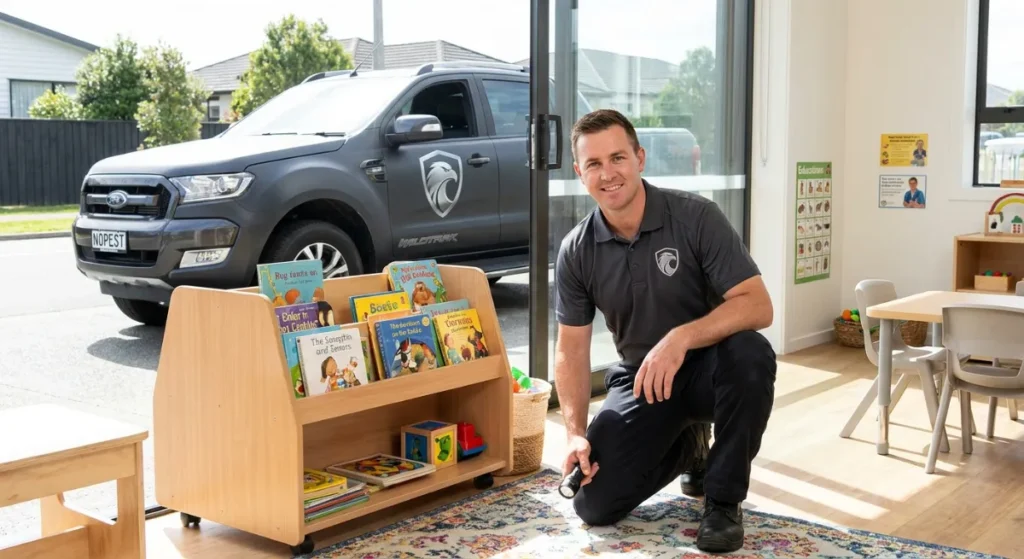
PMANZ certified pest control technician inspecting a childcare centre in Auckland

PMANZ Certified Childcare Pest Control

Running a childcare centre means juggling a hundred different responsibilities every single day, but nothing is more important than the safety of the children in your care. Imagine the sudden panic of a teacher discovering a wasp nest hidden near the sandpit, or the health risks posed by a rodent scurrying through the kitchen where toddler meals are prepared. In an Early Childhood Education (ECE) environment, pests are not just a nuisance; they are a severe health and safety hazard.

However, eradicating these pests introduces a secondary challenge: the chemicals used to remove them. Young children have developing immune systems, and they spend a significant amount of time crawling on floors, touching surfaces, and putting their hands in their mouths. You cannot simply spray toxic chemicals around a daycare and hope for the best. This is exactly why finding PMANZ certified pest control in Auckland is an absolute necessity for any educational facility.

At Pest Control Auckland, we understand that treating a daycare requires a vastly different approach than treating a standard warehouse. We utilise strict Integrated Pest Management (IPM) protocols to ensure that pests are eradicated at the source without leaving harmful residues behind. In this comprehensive guide, we will explain exactly why certification matters, how we tailor our treatments for childcare centres, and what your staff can do to maintain a completely pest-free learning environment.

Key Takeaways

To ensure absolute safety in early childhood centres, hiring a PMANZ certified professional is critical. Certified experts use child-safe, EPA-approved methods, schedule treatments strictly after hours to prevent exposure, and provide the mandatory documentation required for Ministry of Education health and safety audits.

Why PMANZ Certification is Non-Negotiable for Childcare

The Pest Management Association of New Zealand (PMANZ) is the leading regulatory body for the pest control industry in our country. When an operator holds this certification, it means they have undergone rigorous, formal training in urban pest management. For a childcare centre, this is not just a “nice to have” credential; it is a fundamental requirement to ensure legal compliance and child safety.

Under the Health and Safety at Work Act 2015, ECE managers and school boards have a legal duty of care to ensure their environment is free from recognized hazards. Hiring an uncertified, “budget” exterminator who uses generic, highly toxic agricultural sprays puts your centre at immense legal and ethical risk. The chemicals they use can linger on carpets, toys, and high-touch surfaces for weeks.

By partnering with a provider of PMANZ certified pest control in Auckland, you eliminate this risk entirely. Certified technicians are trained to prioritise non-chemical interventions first, using targeted baits and exclusion tactics rather than blanket surface sprays. When sprays are necessary, they use only EPA-approved, low-toxicity formulations that dry quickly and safely.

⚠️

Warning: The Dangers of Uncertified Operators

Unlicensed exterminators often rely on cheap, highly toxic solvent-based sprays that can trigger asthma and severe allergic reactions in young children. Never allow an uncertified technician to treat a childcare facility.

Guaranteed Adherence to Urban Pest Management Standards

New Zealand has strict environmental and health regulations regarding the application of pest control products, particularly in areas where food is prepared or consumed. Early childhood centres contain commercial-grade kitchens that must adhere to Ministry for Primary Industries (MPI) food safety standards. Any chemical contamination in these areas can lead to immediate facility closure.

PMANZ technicians are trained specifically in these compliance standards. We understand exactly which products can be used safely in a kitchen environment and which must be avoided entirely. Our targeted gel baits for cockroaches and ants, for example, are placed discreetly inside wall voids, behind heavy appliances, and inside tamper-proof stations where no child or staff member can ever access them.

PMANZ certified pest control technician inspecting a childcare centre in Auckland

This level of precision is what separates professionals from amateurs. We don’t just spray baseboards and walk away; we conduct a thorough environmental assessment to identify exactly how pests are entering the building. By sealing entry points and addressing moisture issues, we provide long-term eradication rather than a temporary fix.

Fully Insured and Police-Vetted Technicians

Security is a paramount concern for any childcare facility manager. You cannot simply allow unknown contractors to wander through your centre without proper vetting. When you hire a professional team, you need absolute assurance that the individuals entering your property are trustworthy, professional, and safe to be around your staff and children.

Every technician at Pest Control Auckland undergoes comprehensive Ministry of Justice police vetting before they are ever allowed on a commercial site. Furthermore, our PMANZ certification requires us to carry extensive public liability insurance. This protects your business, your staff, and your property in the highly unlikely event of an accident.

We also ensure our technicians operate with total discretion. We arrive in clean, professional uniforms and drive well-maintained vehicles. We understand that seeing a pest control truck parked outside a daycare can cause unnecessary alarm for parents during drop-off, which is why we schedule our visits strategically.

Tailored Pest Management Plans for Daycares

No two childcare centres are exactly alike. A boutique daycare in a converted residential villa in Ponsonby will face entirely different pest pressures than a large, purpose-built early learning centre bordering a native bush reserve in Titirangi. Because of these unique variables, a “one size fits all” approach to pest control is guaranteed to fail.

We provide highly customised PMANZ certified pest control for Auckland daycares. Our first step is always a comprehensive site audit. We examine the playground equipment, the sandpits, the sleep rooms, the kitchen, and the perimeter fencing. We look for wasp nesting sites, rodent burrowing paths, and areas where moisture might be attracting ants and cockroaches.

During our initial site audit, our certified technicians pay special attention to the high-risk zones unique to educational facilities, including:

  • Kitchens and Pantries: Checking behind commercial refrigerators and inside dry-goods cupboards for cockroach activity.
  • Outdoor Play Areas: Inspecting wooden playground equipment, eaves, and fencing for aggressive wasp nests.
  • Sleep Rooms: Ensuring dark, quiet corners are free from spiders and crawling insects that could bite resting infants.
  • Waste Management Zones: Evaluating the placement and cleanliness of outdoor skips to prevent rodent attraction.

Based on this audit, we design an Integrated Pest Management (IPM) plan that focuses on prevention and exclusion. We install tamper-proof rodent bait stations in locked utility areas away from children, and we apply targeted treatments only where pest activity is confirmed. This minimises chemical use while maximizing effectiveness.

Chart showing common pest callouts in New Zealand educational facilities

Weekend and Evening Treatment Schedules

The most critical logistical challenge of treating an early childhood centre is timing. You cannot safely apply pest control treatments while children are actively playing, sleeping, or eating nearby. Even low-toxicity, child-safe products require a specific drying time before the area can be safely re-entered by vulnerable toddlers.

💡

Tip: Schedule Smartly

Always schedule routine pest maintenance for a Friday evening. This allows the treatment a full 48 hours to settle, dry, and ventilate over the weekend before children return on Monday morning.

To accommodate this, Pest Control Auckland offers flexible, after-hours scheduling specifically for our educational clients. We can dispatch our technicians late in the evening or over the weekend to ensure zero disruption to your daily operations. By the time your staff and children arrive the next morning, the treatment is fully dry, completely safe, and actively working.

The only exception to this rule is an acute emergency, such as the sudden discovery of an active wasp nest near a playground. In these high-risk scenarios, we provide priority rapid-response dispatch. We will work with your centre manager to safely cordon off the area, neutralize the nest immediately, and remove the hazard so the children can return to play safely.

Detailed Reporting for Health and Safety Audits

Compliance documentation is a massive part of running an ECE. The Ministry of Education requires strict record-keeping for all health and safety procedures, and pest control is no exception. If an inspector arrives for an audit, you must be able to prove exactly what pest control measures have been taken, what products were used, and when they were applied.

When you choose PMANZ certified pest control in Auckland, you receive comprehensive, audit-ready reporting after every single visit. We provide detailed logbooks that outline the exact locations treated, the specific EPA-approved products applied, the active ingredients, and any safety data sheets (SDS) required for your compliance files.

Service Feature PMANZ Certified Professionals Uncertified Budget Operators
Chemical Safety EPA-approved, low-toxicity IPM methods Generic, highly toxic surface sprays
MoE Audit Documentation Full logbooks and Safety Data Sheets provided Rarely provide written compliance records
Technician Vetting Police-vetted and fully insured Unknown background, often uninsured
Treatment Timing Strictly after-hours and weekends Often spray during operating hours

We also use these reports to track pest trends over time. If we notice an ongoing spike in rodent activity near your outdoor bins, we will document this and provide actionable recommendations for your property manager to improve waste storage. This proactive approach stops infestations before they start.

Educating Staff on Pest Prevention

Professional treatments are only one half of the equation. The other half relies on the daily habits of your childcare staff. Daycares are naturally attractive to pests because they are warm, sheltered, and constantly filled with food crumbs. Without proper daily hygiene practices, even the best pest control treatments will eventually be overwhelmed.

We view our relationship with childcare centres as a true partnership. When we implement a PMANZ certified pest control plan in Auckland, we take the time to educate your centre manager and teaching staff on practical prevention techniques. We explain what signs to look for, such as rodent droppings in the kitchen or ant trails near the art sink.

📝

Note: The Power of Observation

Staff are your first line of defense. Encourage teachers to report any signs of pest activity immediately in a centralized logbook. Catching a single mouse early prevents a full-blown infestation later.

Proper Food Storage and Waste Management

The vast majority of pest issues in ECE environments originate from food sources. Toddlers are notoriously messy eaters, and spilled milk, dropped crackers, and sticky fruit juices are a daily occurrence. If these spills are not cleaned up promptly and thoroughly, they act as a massive attractant for ants, cockroaches, and rodents.

We recommend implementing strict protocols for food storage and waste management. All dry goods in the kitchen must be transferred from cardboard boxes into heavy-duty, airtight plastic containers. Mice can chew through cardboard and plastic bags with ease, contaminating food supplies and causing expensive waste.

Check/Action: Daily Hygiene Checklist

Ensure all indoor rubbish bins are emptied into the external skips before closing each day. Sweep and mop all dining areas, and ensure no food is left overnight in children’s cubbies or lockers.

External waste management is equally critical. Outdoor wheelie bins should be kept as far away from the main building as possible. Ensure the lids fit tightly and are closed at all times to prevent wasps from foraging for sugary scraps and rodents from climbing inside. Regularly washing out the bins prevents foul odours that attract flies.

Clean childcare kitchen demonstrating proper food storage to prevent pests

Contact Us for a Certified Childcare Pest Plan

Protecting the health and safety of the children in your care is a tremendous responsibility, but you do not have to handle pest management on your own. Relying on store-bought insect sprays or uncertified operators is simply not worth the risk to your reputation or the wellbeing of your students.

At Pest Control Auckland, we make commercial pest management simple, safe, and fully compliant. Our targeted, family-friendly approach ensures that your centre remains a clean, hygienic environment where children can learn and play without the threat of dangerous pests or toxic chemical exposure.

If you are ready to upgrade your facility’s safety standards, contact us today. We will arrange a free, no-obligation site audit and provide a transparent quote for ongoing, PMANZ certified pest control in Auckland. Let our local experts handle the pests so you can focus entirely on providing exceptional early childhood education.

People Also Ask (FAQ)

Are the pest control products safe for crawling babies?
Yes. As PMANZ certified professionals, we use only EPA-approved, low-toxicity products designed specifically for sensitive environments. We prioritise non-chemical baits placed in tamper-proof stations or hidden wall voids. Any necessary surface treatments are applied after hours, ensuring they are completely dry and safe before any children return to crawl or play on the floors.
How often should a daycare have pest control treatments?
For commercial childcare facilities, we strongly recommend a quarterly maintenance plan (every 3 months). This proactive schedule allows us to maintain a consistent protective barrier around the property, adapting our treatments to seasonal pest threats like summer wasps or winter rodents, ensuring year-round compliance and safety.
Do we need to close the childcare centre during treatment?
No, you do not need to interrupt your normal operating hours. We schedule our routine maintenance services for evenings or weekends when the centre is completely empty. This ensures maximum safety for the children and zero disruption to your staff and parents.
What happens if a wasp nest is found near the playground?
Wasps pose a severe anaphylaxis risk to children and require immediate attention. If a nest is discovered, cordon off the area immediately and keep children indoors. Contact us for priority rapid-response dispatch. We will arrive promptly to neutralize and remove the nest safely, allowing normal outdoor play to resume as quickly as possible.
How do you handle rodents without risking secondary poisoning to children?
We exclusively use heavy-duty, lockable, tamper-proof bait stations that are physically impossible for a child or pet to open. These stations are strategically placed in hidden areas, such as locked utility cupboards, roof voids, or secure external perimeters, ensuring children never come into contact with the rodenticide.
Will your technicians provide documentation for our MoE audit?
Absolutely. Comprehensive reporting is a cornerstone of our commercial service. After every treatment, we provide detailed logbooks outlining the areas treated, the specific products used, and the relevant Safety Data Sheets (SDS). This documentation is fully compliant with Ministry of Education and Ministry of Health audit requirements.

About the Author: Ronnie

Ronnie is the founder and lead technician at Pest Control Auckland, helping Auckland homes, rentals and businesses with safe, practical pest control.

With over a decade of experience in urban pest management, Ronnie has specifically consulted for dozens of Auckland early childhood centres to develop child-safe, compliant pest strategies. His deep understanding of Ministry of Education health and safety requirements ensures every treatment is both highly effective and completely hazard-free for vulnerable children.

Leave a Comment

Your email address will not be published. Required fields are marked *

Scroll to Top