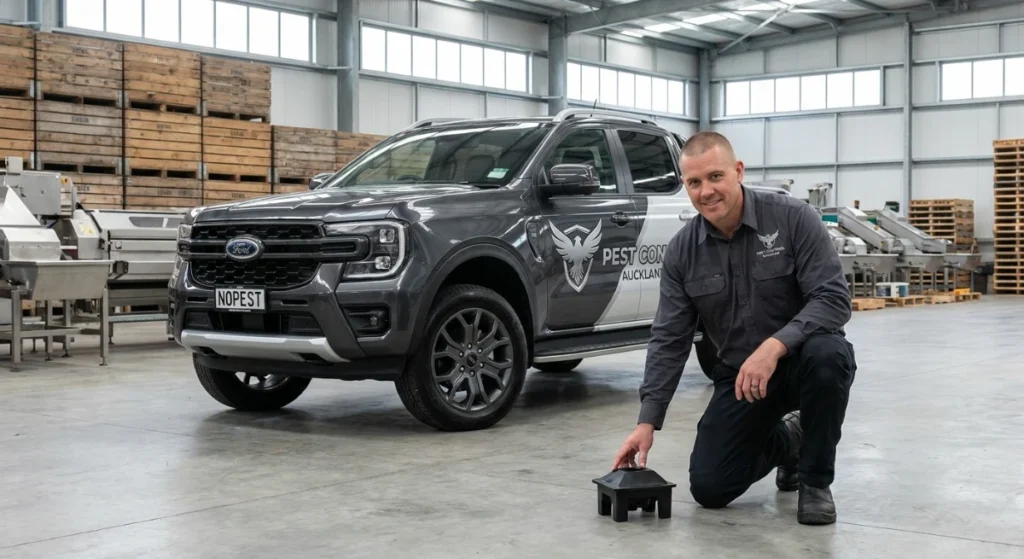
Kia ora. If you’ve been paying attention to the agricultural scene around Auckland’s rural fringes—places like Pukekohe, Kumeu, or Clevedon—you’ll know the old “spray and pray” days are officially behind us. Whether you’re running a commercial packhouse, a greenhouse, or a sustainable lifestyle block, the pressure from global markets and local regulations is immense.
Back in South Africa, dealing with agricultural pests meant checking the grain silos for venomous snakes and scorpions. Here in New Zealand, the threats might not bite back quite as hard, but a rat infestation in a commercial packhouse can shut your export operation down just as fast [1]. Failing a food safety audit because of a cockroach sighting isn’t an option when livelihoods are on the line.
That’s why the industry is shifting rapidly. The focus is no longer on reactive extermination. Instead, Integrated Pest Management (IPM) for Sustainable NZ Farming is the gold standard for keeping our crops safe, our warehouses compliant, and our environment protected.
Key Takeaways
Integrated Pest Management (IPM) for Sustainable NZ Farming is a science-based strategy that prioritises biological, cultural, and physical pest controls over routine chemical spraying. By focusing on root-cause prevention, strict monitoring, and targeted exclusion, NZ farms and agricultural storage facilities ensure long-term environmental sustainability and strict export compliance.
The Shift Away from “Spray and Pray” in NZ Agriculture
New Zealand’s agricultural sector is under the microscope. Between strict freshwater regulations, the Food Act 2014, and international export standards, growers simply can’t afford to drench their crops or storage facilities in broad-spectrum pesticides anymore. The global market demands sustainability, and local authorities demand compliance [2].
We saw this massive industry shift highlighted heavily leading up to the FAOPMA Pest Summit 2026 right here in Auckland. The entire theme was about future-proofing pest solutions. It’s clear that the old reactive methods are dead. Today, successful pest management is about predictive data, smart monitoring, and ecological balance.

Just look at the recent conservation successes around Auckland in early 2026. The massive reductions in rat tracking out in the Hūnua Ranges, and the thermal drone eradications on Kawau Island, prove that highly targeted, strategic pest control works. We are applying those exact same high-level strategies to commercial agricultural environments.
The FAOPMA Pest Summit 2026 hosted in Auckland heavily emphasized “FutureProofing” our industry. The transition toward zero-emission treatments and digital IoT monitoring in commercial environments is no longer optional—it’s the new standard.
What Actually is Integrated Pest Management (IPM)?
At its core, Integrated Pest Management (IPM) for Sustainable NZ Farming is about outsmarting the pest rather than just poisoning it. It is an entomological, science-based approach that looks at the entire ecosystem of your property. We figure out why the pests are there, how they are getting in, and what they are feeding on.
Instead of reaching for the chemical spray as a first resort, an IPM strategy uses it as the absolute last resort [2]. It combines biological controls, physical barriers, and cultural farming practices to keep pest populations below the threshold where they cause economic damage.
For our team providing pest control in Auckland, this means we don’t just turn up and spray your commercial warehouse. We identify the structural entry points, seal them up, remove the food sources, and set up non-toxic monitoring stations. We fix the root cause so the problem doesn’t come back.
The Four Pillars of IPM on a Sustainable Farm
Implementing a proper IPM strategy requires a multi-layered approach. You can’t rely on just one method if you want to keep the creepy crawlies out of your crops and storage bins long-term. Here is how the four pillars break down in a practical, Kiwi farming context.

1. Cultural Controls
Cultural controls are all about changing the environment to make it less hospitable for pests. Out in the paddocks, this means crop rotation, adjusting planting times, and managing irrigation to avoid waterlogged soils that attract root diseases. A great recent example was the 2024 Pukekohe Research Farm pumpkin crop, which successfully used flowering strips to boost biodiversity and naturally lower pest pressure [2].
2. Physical and Mechanical Controls
This is where we roll our sleeves up. Physical controls involve actively blocking or trapping the pests. On a farm, this might be netting over crops. In a commercial packhouse, it means installing robust door seals, bird-proofing the rafters, and setting up mechanical traps for rodents.
Under the Animal Welfare Act 1999, if you are using live-capture traps around your farm or storage facility, they must be physically inspected within 12 hours after sunrise every single day. Ignorance of this law is not an excuse.
3. Biological Controls
Why do all the hard work when nature can do it for you? Biological control involves introducing or encouraging natural predators. Releasing parasitic wasps to deal with aphids, or encouraging native birds that feed on specific insects, are fantastic ways to keep pest numbers down without touching a single chemical.
4. Chemical Controls (The Last Resort)
When all else fails, targeted chemical interventions are used. But under an IPM framework, these aren’t broad-spectrum sprays that kill the good bugs with the bad. We use highly specific, MPI-approved, zero-emission treatments. I’m Class 9 qualified, which means I’m certified to handle these ecotoxic substances safely, ensuring your staff, your crops, and the local waterways are fully protected.
Where the Farm Meets the Packhouse: Commercial Storage IPM
If you’ve got a problem with feral animals like stoats, rabbits, or possums out in the deep rural paddocks, that’s a job for a rural contractor or the Department of Conservation. We assess these enquiries case by case, and if we cannot help directly, we will guide you toward the right authority so you are not left guessing.
But when those rodents leave the paddock and try to set up shop in your commercial storage silos or packhouse? That’s exactly when you give us a buzz. The transition zone between the field and the warehouse is the most critical vulnerability for any agricultural business.

Running a commercial packhouse means you are strictly bound by the Food Act 2014 and HACCP guidelines. You simply cannot have toxic rodenticide bait scattered around sensitive food prep or storage areas. We utilise non-toxic monitoring blocks and mechanical exclusion tactics to ensure your facility stays compliant and pest-free.
Mice only need a gap the width of a pencil to get inside your packhouse. Walk the perimeter of your storage facility at night with a bright torch. Wherever you see light bleeding through the walls or under doors, you have a structural entry point that needs sealing.
The Cost-Benefit of IPM for Kiwi Growers
Some folks worry that transitioning to Integrated Pest Management (IPM) for Sustainable NZ Farming will be too expensive. The reality is quite the opposite. While the initial setup of monitoring stations and structural exclusion might require an upfront investment, the long-term savings are massive.
You stop wasting money on routine chemical sprays that pests are rapidly building resistance to. More importantly, you protect your export contracts. A single rejected shipment due to pest contamination costs infinitely more than a solid, year-round IPM subscription.
| Comparison Metric | Traditional Pest Control | Integrated Pest Management (IPM) |
|---|---|---|
| Primary Focus | Reactive eradication (spraying after pests appear). | Proactive prevention and root-cause exclusion. |
| Chemical Reliance | High. Broad-spectrum pesticides used routinely. | Low. Targeted treatments used only as a last resort. |
| Food Act 2014 Compliance | High risk of failing audits due to toxic bait placement. | Fully compliant. Uses non-toxic monitoring in sensitive zones. |
| Long-Term Cost | Expensive due to recurring infestations and resistance. | Highly cost-effective. Fixes the problem once and maintains it. |
The data speaks for itself. Over the last few years, we’ve seen a massive industry-wide drop in the reliance on harsh chemical sprays, directly correlating with the rise of smarter, predictive IPM strategies across New Zealand.
Navigating NZ’s Strict Biosecurity and Pest Laws
We take our environment seriously here in Aotearoa, and the legislation reflects that. If you are applying treatments or managing pests on a commercial scale, you have to operate within the bounds of the EPA HPC Notice 2017 and the HSNO Act 1996 [3].
This is exactly why you need a certified professional. I hold a Level 3 New Zealand Certificate in Pest Operations, which means I’m fully qualified to handle Class 9 substances safely. We provide you with comprehensive written treatment reports for every visit, so when the auditors come knocking, your paperwork is bulletproof.

It’s also crucial to remember that we operate under the Auckland Regional Pest Management Plan (RPMP). If you’re transporting agricultural goods near the Hauraki Gulf Controlled Area, strict pathway management rules apply to prevent accidental pest introductions.
If you ever spot an unusual, exotic bug around your imported machinery or storage pallets (like a suspected Yellow-Legged Hornet or Brown Marmorated Stink Bug), do not try to sort it out yourself. Catch it, snap a photo, and report it immediately to the MPI Biosecurity hotline on 0800 80 99 66.
Need a pest control partner who’ll turn up, document the job, and keep your commercial agricultural site compliant? Send through the site details and we’ll come back with a quote within the day. We’ll sort out the unwanted houseguests so you can focus on running your business.


