The best cockroach treatment NZ homeowners can utilize depends on the specific nature of the infestation. Generally, cockroach gel baits are superior for eradicating established colonies of German cockroaches due to their ability to trigger a lethal cascade effect within the nest. Conversely, residual sprays are most effective as perimeter barriers to stop Gisborne and American cockroaches from entering the property. For severe infestations, a hybrid approach is mandatory.
The Verdict: Gel vs. Spray for NZ Homes
When searching for the best cockroach treatment in NZ, residents are often bombarded with two distinct options: aerosol/liquid sprays and syringe-style gel baits. Understanding the fundamental difference between these two delivery systems is critical for effective pest management in the unique climate of Auckland and the wider New Zealand region.
The debate isn’t necessarily about which product is “stronger,” but rather which mechanism suits the biological behavior of the pest you are facing. In the context of Auckland pest control, we see a distinct split in efficacy based on whether the cockroaches are breeding indoors (like the German cockroach) or invading from the outdoors (like the Gisborne or American cockroach).
To make an informed commercial decision, one must look beyond the marketing on the bottle and understand the entomology at play. A spray kills what it touches and creates a “no-go” zone. A gel invites the pest in, using their own social behaviors against them to destroy the entire population from the inside out.
Understanding New Zealand’s Cockroach Enemies
Before selecting a chemical weapon, you must identify the target. New Zealand has a unique mix of native and introduced species that respond differently to treatments.
The German Cockroach (Blattella germanica)
This is the public enemy number one for Auckland kitchens and hot water cupboards. They are small, light brown, and carry two dark stripes on their pronotum. Crucially, they breed indoors. If you see one, there are likely hundreds hidden in cracks and crevices. Because they nest in tight, inaccessible spaces (like inside the motor of your fridge), sprays often fail to reach the core population. This is where gels shine.
The Gisborne Cockroach (Drymaplaneta semivitta)
Specific to our region, the Gisborne cockroach is a large, dark, wingless species often found around wood chips and gardens. Unlike the German variety, they usually prefer to live outside but wander indoors seeking moisture or warmth. Because they don’t typically colonize the kitchen pantry in the same way, perimeter sprays are often highly effective against them.
The American Cockroach (Periplaneta americana)
The largest of the common pests, these are often found in drains and basements. They are aggressive scavengers. While gels work on them, their sheer size and entry points often make barrier sprays a necessary component of defense.

Deep Dive: How Cockroach Gel Baits Work
Gel baits represent the most significant advancement in pest control technology over the last three decades. They are formulated with a non-repellent active ingredient (such as Indoxacarb or Fipronil) mixed with a highly palatable food attractant matrix.
The Mechanics of the “Cascade Effect”
The true power of gel bait lies in a phenomenon known as the “Cascade Effect” or “Domino Effect.” This process exploits the gruesome natural behaviors of cockroaches: necrophagy (eating their dead) and coprophagy (eating the feces of others).
- Primary Poisoning: A foraging cockroach consumes the lethal gel. The poison is slow-acting, allowing the roach to return to the harborage (nest) before dying.
- Secondary Poisoning: Once the roach dies in the nest, other cockroaches consume the carcass. Because the active ingredient remains potent even after digestion, the scavenging roaches are also poisoned.
- Tertiary Poisoning: Cockroach nymphs (babies) often feed on the feces of adult roaches. The poisoned adult excretes lethal waste before dying, which the nymphs consume, wiping out the next generation.
This transmission chain allows a single gram of gel to kill many times its weight in cockroaches. For the German cockroach, which hides deep in electronics and wall voids, this is often the only way to achieve total colony collapse.
The Role of Residual Sprays in Pest Control
While gels are offensive weapons, sprays are defensive fortifications. Residual sprays generally utilize synthetic pyrethroids (like Deltamethrin or Bifenthrin) to create a crystalline layer on surfaces.
The Barrier Method
When a liquid spray dries, it leaves behind microscopic crystals of the insecticide. When an insect crawls over this treated surface, the crystals adhere to their cuticle (shell) and are absorbed into their system, causing nervous system failure.
The primary advantage of sprays is speed and coverage. If you are dealing with Gisborne cockroaches entering from the garden, spraying the exterior foundation, window sills, and door frames creates a “line of death” that kills invaders before they can establish themselves indoors. According to authoritative sources like Te Ara – The Encyclopedia of New Zealand, understanding the habitat of these insects is key to controlling them, and sprays effectively target the transition zones between outdoor habitats and indoor living spaces.
Repellency Issues
One critical downside to many consumer-grade sprays is that they can be repellent. If you spray a nest directly with a repellent, the survivors may scatter, spreading the infestation to other rooms (a process known as “budding”). This is why professionals rarely spray a German cockroach nest directly with a repellent pyrethroid.
Comparative Analysis: Gel vs. Spray
To determine the best cockroach treatment NZ homes require, we must compare these methods across several metrics relevant to Auckland living conditions.
| Feature | Cockroach Gel Bait | Residual Spray |
|---|---|---|
| Action Speed | Slow (Days to Weeks) | Fast (Minutes to Hours) |
| Target Species | Nesting species (German) | Invading species (Gisborne/American) |
| Reach | Deep into nests via transfer | Surface only |
| Preparation | Minimal | Requires clearing surfaces/ventilation |
The Hybrid Strategy: Combining Methods for Maximum Effect
For the definitive Auckland pest control solution, relying on a single mode of attack is often insufficient. Professional exterminators utilize an Integrated Pest Management (IPM) strategy that combines both gels and sprays, but they must be applied correctly to avoid canceling each other out.
The Golden Rule: Never spray over the gel.
If you spray a liquid insecticide over your gel dots, you contaminate the bait. The cockroaches will detect the chemical repellent and refuse to eat the gel, rendering your most powerful weapon useless. Instead, follow this spatial strategy:
- Apply Gel in High-Activity Zones: Place small dots of gel (size of a grain of rice) in cracks near the dishwasher, fridge motor, microwave vents, and inside cupboard hinges. These are the “safe zones” where roaches hide.
- Apply Spray in Transit Zones: Use the residual spray along the skirting boards (baseboards), under the sink, and around the perimeter of the room. This catches roaches that are traveling between hideouts or entering from outside.
- Dusting for Voids: In addition to gel and spray, consider using insecticidal dust (diatomaceous earth or synthetic dust) for wall voids and behind power sockets where neither gel nor spray can easily reach.
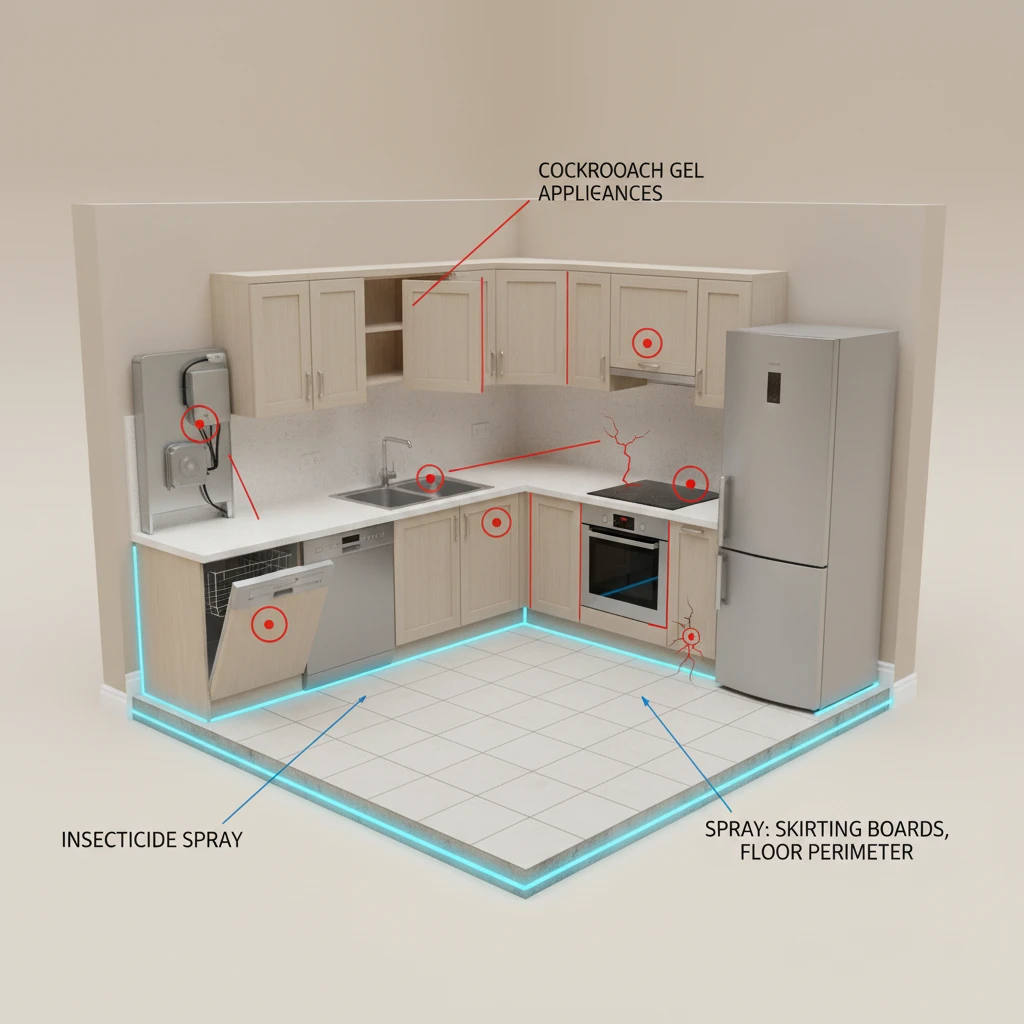
Safety Protocols for Indoor Application
When applying the best cockroach treatment NZ offers, safety is paramount, especially in homes with children and pets (the “whanau”).
Gel Bait Safety
Gel baits are generally considered safer for indoor use because the active ingredient is contained within a matrix that is not volatile (it doesn’t release fumes). Furthermore, the quantity of poison is extremely low. However, to ensure safety:
- Place gel dots in cracks and crevices where little fingers and paws cannot reach.
- Avoid placing gel on surfaces where food is prepared.
- Clean up old, dried gel before applying fresh bait.
Spray Safety
Sprays carry a higher risk of inhalation and surface contamination. When using residual sprays:
- Ventilation: Open all windows and doors during and after application.
- Evacuation: It is standard practice to vacate the room for at least 2-4 hours until the spray is completely dry. Once dry, the risk of transfer is significantly reduced.
- Aquatic Life: Most sprays are highly toxic to fish. Cover tanks and turn off air pumps before spraying.
For detailed information on the toxicity of specific chemical compounds found in these treatments, the Environmental Protection Authority (EPA) New Zealand provides comprehensive datasheets and consumer advice.
Frequently Asked Questions (PAA)
Is gel better than spray for German cockroaches?
Yes, gel is significantly better for German cockroaches. Because German roaches nest in tight, inaccessible areas, sprays often cannot reach the population core. Gel baits utilize the “cascade effect,” allowing poisoned roaches to return to the nest and kill the rest of the colony through secondary poisoning.
How long does cockroach gel take to work?
Cockroach gel is not instant. You will typically see a reduction in the population within 3 to 7 days. Complete elimination of a large nest can take 2 to 3 weeks as the poison cycles through the various generations of the colony.
Can I use spray and gel together?
Yes, but do not spray directly on the gel. Spraying the gel will contaminate the bait and make it repellent to cockroaches. Use spray for skirting boards and perimeter barriers, and use gel in cracks, crevices, and cupboard hinges.
What is the best cockroach killer in NZ for outside roaches?
For outdoor roaches like the Gisborne cockroach, a residual barrier spray containing a synthetic pyrethroid (like Bifenthrin) is best. Spraying the foundation of the house, window frames, and door thresholds prevents them from entering.
Are cockroach gels safe for dogs and cats?
When applied correctly in cracks and crevices, cockroach gels are generally low-risk for pets due to the low concentration of active ingredients and small application size. However, always read the label and ensure the bait is placed out of reach of curious pets.
Why do I still see cockroaches after spraying?
Seeing roaches after spraying is common. Many sprays are slow-acting to ensure the roach spreads the poison. Additionally, sprays often flush roaches out of hiding spots. If activity persists after 2-3 weeks, re-treatment or switching to gel bait may be necessary.