Termites in your Auckland roof? We will find exactly how they are getting in, isolate the infested timber, and clear them out—usually without needing to tear your house apart. That is the reality of effective drywood termite eradication in Auckland.
Most people think New Zealand does not have termites. They are dead wrong. While we do not have the massive subterranean termite mounds you see in Australia, we absolutely have drywood termites.
Some are native, and others are highly destructive exotics that hitch a ride on imported boats and timber. If you are finding tiny hexagonal wood pellets near your windows, you do not have time for hardware store bug bombs.
Key Takeaways
Effective drywood termite eradication in Auckland requires precise species identification. DIY sprays fail because they cannot penetrate the timber heartwood. Professional, MPI-compliant treatments like thermal remediation or targeted fumigation are the only guaranteed ways to eliminate the colony and protect your property.
The Reality of Drywood Termites in Auckland (May 2026 Update)
We are currently seeing an autumn surge in urban wood-boring pests following a mild winter and a hot summer. In Auckland, you are generally dealing with one of two distinct termite scenarios.
First, there is the native New Zealand drywood termite, known scientifically as Kalotermes brouni. They usually stick to dead trees and rotting stumps out in the bush. However, if your home has damp, untreated timber, they will happily move into your framing.
Then, there is the serious stuff. Exotic invaders like the West Indian drywood termite (Cryptotermes brevis) are internationally recognized as some of the most destructive pests on the planet. These exotics regularly hitch a ride into New Zealand on imported yachts and timber.
In July 2025, the Minister for Biosecurity declared a special emergency for Cryptotermes brevis found in Auckland. If you suspect an exotic termite infestation, it must be reported to MPI immediately. We assess these enquiries case by case and will guide you to the right authority.
Why They Are Hard to Spot
Drywood termites do not need contact with the soil. They do not build obvious mud tubes up your foundation walls like subterranean termites do.
Instead, they live entirely inside the wood they are eating. They extract all the moisture they need directly from the timber itself.
You can walk past an infested structural beam for five years and never know they are there. Usually, it is not until mature winged termites (alates) emerge to start a new colony that homeowners realize they have a massive problem.
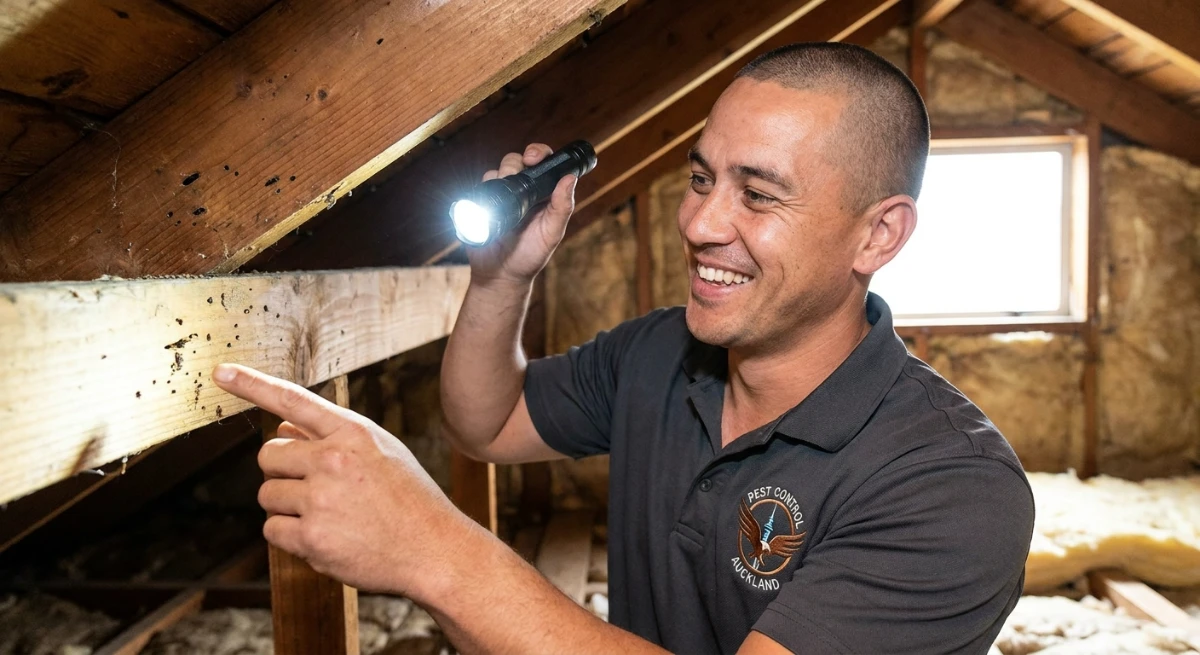
Identifying the Problem: Borer or Termite?
Aucklanders constantly confuse drywood termites with the common wood borer. The treatment for each is entirely different, so getting the identification right is step one.
Look closely at the frass (the dust they kick out of the holes). Borer dust looks like fine, white baking flour. Drywood termite droppings are distinct, hard, hexagonal pellets about 1mm long.
- Frass (Droppings): Drywood termites push their fecal matter out of small kick-out holes. It looks like tiny, hard, hexagonal seeds.
- Swarmers (Alates): During the warm Auckland summer, mature colonies release winged reproductive termites. If you find piles of discarded wings near your windows, a colony has likely established itself nearby.
- Hollow Sounding Timber: Tap your skirting boards or exposed framing with the handle of a screwdriver. If it sounds papery or hollow, the heartwood may be compromised.
Place a sheet of black paper under the suspected timber holes and leave it for a week. If you see tiny, seed-like pellets accumulating, you likely need professional drywood termite eradication in Auckland.
The “Silver Bullet” Approach to Drywood Termite Eradication in Auckland
We do not just spray the surface of your skirting boards and walk away. That is a waste of your money and our time.
Our approach focuses on scientific, root-cause eradication. We track the frass kick-out holes back to the central galleries. Once we know the extent of the colony, we deploy treatments that actually penetrate the timber.
Thermal Remediation (Heat Treatment)
For localized infestations, especially in furniture or isolated structural beams, heat is highly effective. In fact, Biosecurity New Zealand successfully utilizes thermal remediation for exotic termites on imported yachts.
We raise the core temperature of the infested wood to a lethal threshold, usually around 55 degrees Celsius, and hold it there. This bakes the colony, killing eggs, nymphs, and adults with zero chemical residue.
Targeted Chemical Injection and Fumigation
When the infestation is widespread or inaccessible, we use advanced, MPI-approved treatments. This involves drilling directly into the termite galleries and injecting non-repellent termiticides.
For severe, structural-level exotic infestations, whole-structure fumigation may be required under strict Environmental Protection Authority (EPA) oversight. This provides absolute certainty that the colony is wiped out.
The DIY Cycle of Despair
I see it every single week. A homeowner spots a few holes, buys a cheap spray can from the hardware store, and blasts the surface of the wood.
The termites near the surface die immediately. The thousands of termites deep inside the heartwood just retreat further in, bypass the treated area, and keep eating your house.
The Auckland housing market is stressful enough without throwing money away on ineffective treatments. Hardware store bug bombs release a fine aerosol mist that settles on surfaces. It does absolutely nothing to the termites safely sealed inside the timber.
Worse, these DIY chemicals often contain broad-spectrum pyrethroids. When you use them incorrectly, you are simply exposing your family and pets to unnecessary toxins without solving the root cause of the infestation.
This reactionary approach costs you significantly more in the long run. You end up paying for multiple failed DIY treatments, and eventually, you have to pay a licensed builder to replace compromised structural timber.
| Treatment Method | Target Zone | Effectiveness | Long-Term Value |
|---|---|---|---|
| Hardware Store Bug Bombs | Airspace & Surfaces | Very Low | Poor (Does not penetrate wood) |
| Surface Sprays | Exterior Timber | Low | Poor (Colony survives inside) |
| Thermal Remediation | Core Heartwood | High | Excellent (Zero chemical residue) |
| Targeted Gallery Injection | Internal Nests | Very High | Excellent (Destroys the root cause) |
Strict Legal and Safety Constraints
Pest control in New Zealand is heavily regulated, and rightly so. You do not want uncertified cowboys spraying toxic chemicals in your ceiling cavity where your family sleeps.
Under the EPA’s Hazardous Property Controls (HPC) Notice 2017, anyone handling Class 9 ecotoxic substances must be a Qualified Urban Pest Management Contractor. We hold the New Zealand Certificate in Pest Operations (Level 3).
This means we know exactly how to apply treatments safely. We protect your children, your pets, and the local Auckland environment from unnecessary chemical exposure.
Furthermore, if a termite problem overlaps with other pests like rodents, we strictly follow the Animal Welfare Act 1999. We do not use illegal glue boards, and any mechanical traps are monitored daily.
For commercial properties, particularly in the hospitality sector, the Food Act 2014 dictates zero tolerance for pests. We provide transparent documentation, HACCP-compliant monitoring, and Integrated Pest Management (IPM) plans to keep your business fully compliant.
For landlords, ignoring a tenant’s report of wood-boring insects violates the Residential Tenancies Act. We provide transparent documentation to satisfy Tenancy Tribunal requirements and keep you legally compliant.
Long-Term Prevention and Protection
Eradicating the current colony is only half the job. If you do not fix the environmental conditions that attracted them in the first place, a new colony will just move in next summer.
Drywood termites, especially native ones, love damp wood. We will tell you exactly what structural issues need fixing. You need to clear your gutters, improve your sub-floor ventilation, and remove rotting tree stumps from your property.
We conduct a full perimeter assessment of your property. If you have untreated timber in direct contact with damp soil, we will point it out. If your sub-floor lacks a moisture barrier, we will advise you on how to install one.
Our preventative approach is why we are trusted for drywood termite eradication in Auckland. We offer seasonal protection plans like our Auckland Winter Defense package to stop pests before they enter.
We stand by our work. Our thorough, technician-led approach ensures customer peace of mind. We fix it once, rather than locking you into the ongoing cost of failed DIY attempts.

Why Choose a Local Expert?
You do not need a faceless corporate franchise treating you like a number. You need straight answers and highly effective solutions.
With the upcoming FAOPMA Pest Summit 2026 being hosted right here in Auckland, the industry is shifting toward smarter, Predictive Integrated Pest Management (IPM). We are already leading that charge.
When you call us for drywood termite eradication in Auckland, you get hands-on expertise from real locals. We know the climate, we understand the seasonal pest cycles, and we know how to secure your property.
Frequently Asked Questions

About the Author: Ronnie
Founder, Pest Control Auckland · Commercial & Residential Pest Expert · Certified Urban Pest Management Specialist
With years of experience handling Auckland’s strict MPI biosecurity protocols and resolving complex structural infestations, Ronnie is the definitive expert on drywood termite eradication in Auckland. Having consulted for local property managers and navigated the EPA’s Class 9 regulations, he knows exactly what works, what fails, and how to protect your property permanently.