You have a damp spot in the corner of your ceiling, and now you are seeing silverfish darting across the skirting board. It is not a coincidence. Water is life for insects. When your West Auckland home has condensation issues, leaking pipes, or poor ventilation, you are actively creating a microclimate that bugs love.
We see it every day. A slow leak under the kitchen sink or a poorly ventilated bathroom provides everything an insect needs to thrive. Pests need water more than they need food. When you provide a humid environment, you are rolling out the red carpet for a full-blown infestation.
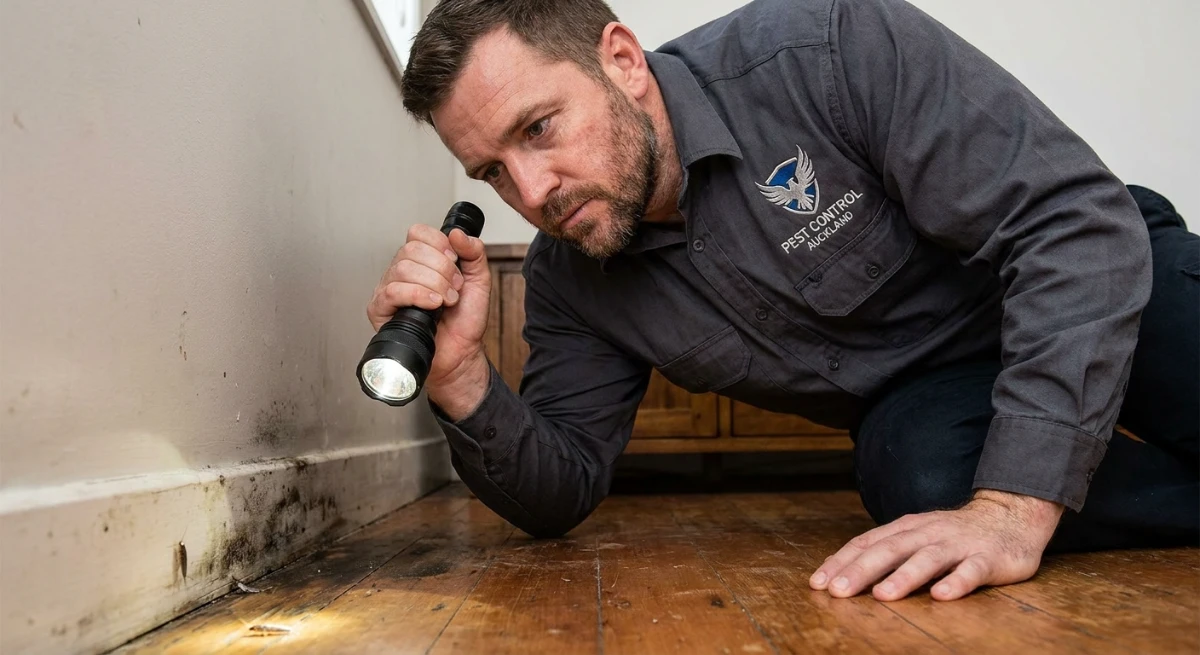
Understanding the direct link between mould & mildew from dampness attracting pests is how we actually solve the problem. We do not just spray chemicals on the wall and walk away. We find the moisture source, eradicate the nest, and give you the straight facts on how to keep them out for good.
Key Takeaways
Damp homes create microclimates that breed booklice, silverfish, and cockroaches. To stop mould & mildew from dampness attracting pests, you must fix the moisture source and use professional structural exclusion. DIY bombs fail because they ignore the root cause and deep-seated nests.
The Science Behind Moisture and Pest Invasions
Insects lose moisture rapidly through their exoskeletons. To survive, they constantly seek out humid environments where they will not dry out. When your home has poor airflow, condensation builds up heavily on windows, walls, and subfloors.
This trapped moisture feeds microscopic fungal growth. That is exactly what triggers mould & mildew from dampness attracting pests right into your living spaces. The pests are not just looking for shelter; they are actively following a food source.
The Micro-Mould Food Chain
Many homeowners do not realize that insects like booklice (psocids) actually feed directly on microscopic mould spores. You might not even see the mould yet, but the bugs can smell it.
Once the smaller insects establish a colony, they attract larger predators. Spiders move in to eat the booklice. Then, rodents move into the subfloor to hunt the larger insects and take advantage of the softened, damp timber. It is a cascading ecosystem right inside your walls.
Always run your bathroom and kitchen extractor fans for at least 10 minutes after use. Reducing ambient humidity is the cheapest and most effective preventative pest control method available.
The Core Pests Thriving in West Auckland Dampness
If your house smells musty, you are ringing the dinner bell for a very specific set of insects. The autumn 2026 pest surge has been brutal across Auckland, driven by a mild winter and a hot, humid summer. The dampness left behind is breeding grounds for the worst offenders.
Booklice (Psocids): The Wall Grazers
Booklice are tiny, almost translucent insects that look like walking dust specks. They do not bite, but they breed by the thousands in damp conditions. They feed exclusively on the microscopic mould growing on damp plasterboard, old books, and cardboard storage boxes.
If you see these on your walls, it is an absolute guarantee that your home has a humidity problem. Spraying them is pointless if you do not dry out the room first.
Silverfish: The Fabric Destroyers
Silverfish are notorious for thriving in damp bathrooms, laundries, and roof cavities. They require high humidity to survive and breed. They chew through paper, wallpaper paste, natural fabrics, and even your expensive clothing.
They hide during the day and forage at night. If you flick on the bathroom light at 2 AM and see them scatter, you have a deep-seated nest somewhere behind the gib board.
Cockroaches: The Disease Carriers
Cockroaches are a massive problem in damp environments. They need a constant water source to breed and digest their food. If you have a slow, unnoticed leak under your kitchen sink, you will almost certainly find roaches nesting in the cabinetry nearby.
They drag bacteria from your drains straight across your food prep surfaces. Their shed skins and droppings are also major asthma triggers for young children.
The Financial and Legal Risks of Ignoring Damp Homes
Living with mould and pests is not just a nuisance; it is a serious financial and legal liability. The rules in New Zealand have tightened significantly, and ignorance is no longer an excuse.
Tenancy Tribunal Realities
Under the Residential Tenancies Act and the Healthy Homes standards, landlords are legally required to provide a dry, well-ventilated property. If a tenant complains about pests, and the root cause is structural dampness, the landlord is liable.
Ignoring dampness that leads to pest infestations routinely results in heavy fines and lost disputes at the Tenancy Tribunal. You cannot just blame the tenant for a roach problem if the subfloor is flooded.
Landlords must fix the structural moisture issues causing the infestation. Attempting to charge tenants for pest control when the house fails Healthy Homes ventilation standards will result in severe penalties.
Commercial Compliance Under the Food Act 2014
For cafes and restaurants in West Auckland, dampness is a fast track to a failed health inspection. The Food Act 2014 requires strict HACCP compliance. You simply cannot afford to have roaches breeding near your dishwashers.
Commercial kitchens generate massive amounts of steam and moisture. Without proper extraction, mould forms rapidly, drawing in pests. We provide commercial biosecurity auditing to keep you entirely compliant and operational.
Why Hardware Store Bug Bombs Fail
Most folks panic and buy a bunch of bug bombs from the local hardware store. Here is the straight truth: they do not work. We call this the DIY Cycle of Despair.
Bug bombs just push the insects deeper into your wall cavities. They do absolutely nothing to address the mould & mildew from dampness attracting pests in the first place. You are just wasting money, delaying the inevitable, and exposing your family to airborne toxins.
Greenwashing and Fake Eco-Friendly Sprays
Many off-the-shelf products claim to be “eco-friendly” but lack any real scientific backing. They use greenwashing to sell weak essential oil mixtures that do not penetrate the nests.
True pest control requires regulated, targeted applications. As Level 3 Qualified UPM Contractors, we use MPI-approved, zero-emission treatments that actually break the breeding cycle without harming your pets or the environment.
Our Predictive Integrated Pest Management System
We do not just treat the symptoms. We look at the structure of your home. If a leaking downpipe is soaking your subfloor, we will tell you to fix it. That is the core of Integrated Pest Management (IPM).
We operate under the strict guidelines of the EPA HPC Notice 2017 and the HSNO Act 1996. This means every treatment is calculated, safe, and legally compliant. We find the entry point, we block it, and we clear them out.
The Auckland Winter Defense Pack
Our Auckland Winter Defense Pack is designed specifically for proactive homeowners. We do a full structural sweep, identify moisture traps, and lay down a protective barrier before the winter rains drive rodents and insects indoors.
We back our work with the Silver Bullet Guarantee. We do not do half-measures. If the pests come back between scheduled treatments, so do we, at no extra cost.
We strictly adhere to the Animal Welfare Act. If rodents are drawn to your damp subfloor, we use humane, compliant eradication methods. Unchecked live traps and illegal glue boards are never part of our process.
Real Data: The State of Auckland Housing
Let’s look at the hard numbers. According to Stats NZ’s 2023 Census data, a significant portion of New Zealand homes still suffer from chronic moisture issues. This data proves why pests remain such a massive issue in our communities.
While overall housing quality has slightly improved since 2018, over 18% of private occupied dwellings still experience dampness. Renters are hit the hardest, often dealing with structural issues they cannot legally fix themselves.
Pest Comparison: Moisture Sources and Eradication Methods
Different moisture levels attract different invaders. Here is a breakdown of what you might be facing in your home and exactly how we handle it.
| Pest Type | Primary Moisture Source | Damage Caused | Our Treatment Method |
|---|---|---|---|
| Booklice (Psocids) | Microscopic mould on walls/books | Nuisance, contamination of dry goods | Humidity reduction advice + targeted surface treatment |
| Silverfish | Leaky roofs, damp bathrooms | Destroys paper, photos, and clothing | Crack/crevice dusting and structural exclusion |
| Cockroaches | Under sinks, leaking pipes, subfloors | Spreads bacteria, triggers asthma | Gel baiting, non-toxic monitoring, root-cause fix |
| Rodents (Rats/Mice) | Flooded subfloors, damp insulation | Chewed wiring, structural damage, disease | Baiting, entry-point blocking, subfloor clearance |
The Future of Pest Control in 2026
The pest control industry is evolving rapidly. The era of reactive, toxic spraying is dead. Today, we rely on smart technology and predictive analytics to stop infestations before they start.
At the upcoming FAOPMA Pest Summit 2026 in Auckland, the entire focus is on “FutureProof” solutions. We are already implementing these strategies locally, using IoT-enabled monitoring and highly targeted exclusion techniques to keep your home safe.
Look at the recent success in the Hūnua Ranges. Massive, coordinated efforts dropped rat tracking down to 1.3%. That is the level of precision we bring to your residential property. No half-measures, just results.

Actionable Steps to Protect Your Property
To protect your home from pests, you need to take proactive steps today. Do not wait for the insects to show up before you fix the house.
- Check under all sinks and behind washing machines for slow drips or condensation.
- Ensure your clothes dryer is vented to the outside, not directly into the roof cavity.
- Clear your gutters regularly so water does not overflow into the eaves and wall cavities.
- Call a Level 3 Qualified UPM Contractor the moment you see persistent insect activity.
Book an Auckland Winter Defense assessment today. We will locate the hidden moisture traps in your home and eradicate the pests before they multiply.
Frequently Asked Questions

About the Author: Ronnie
Founder, Pest Control Auckland · Commercial & Residential Pest Expert · Certified Urban Pest Management Specialist
With years of hands-on experience navigating Auckland’s strict biosecurity laws and the HSNO Act, Ronnie is the definitive expert on mould & mildew from dampness attracting pests. Having consulted for both residential homeowners and major commercial hospitality venues across West Auckland, he specializes in identifying structural moisture failures and implementing long-term, zero-emission Integrated Pest Management solutions.