Autumn in Auckland always brings a few unwelcome guests indoors. Right now, in May 2026, we are seeing a massive surge in spider activity across the region following last year’s hot summer. If you are sick of walking into webs or finding creepy crawlies in your laundry, you are in the right place.
Welcome to your definitive Auckland Spider Control & Identification Guide. As local experts, we know that dealing with spiders requires more than just a quick blast from a hardware store aerosol. You need a targeted, scientific approach.
In this Auckland Spider Control & Identification Guide, we will walk you through exactly what is crawling around your home. We will separate the dangerous from the harmless, and show you exactly how we keep your property completely pest-free.
Key Takeaways
Our Auckland Spider Control & Identification Guide reveals that while most local spiders are harmless, White-Tails can cause painful bites. Effective control requires professional structural exclusion and targeted Level 3 certified treatments, rather than toxic DIY bombs, to ensure long-term eradication and family safety.
Identifying Auckland’s Most Common Spiders
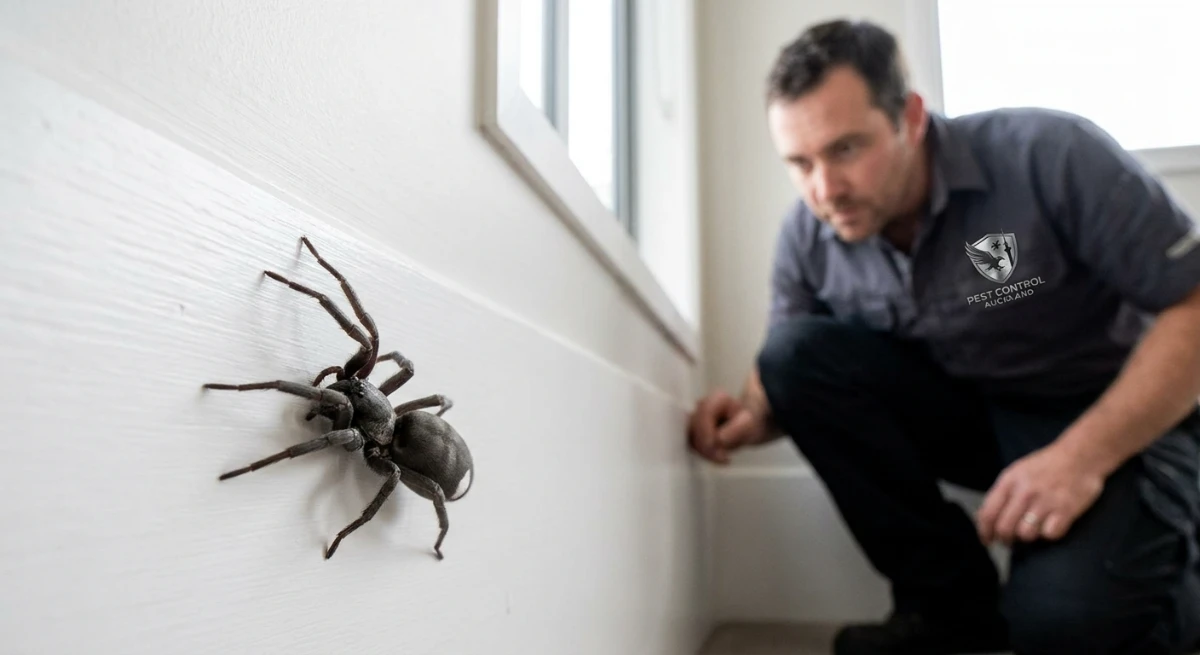
When you are staring down a massive eight-legged freak on your living room wall, it is easy to panic. But knowledge is power, mate. Part of our comprehensive Auckland Spider Control & Identification Guide is helping you know your enemy.
Most spiders in New Zealand are completely harmless to humans. However, a few specific species cause the bulk of our residential callouts across the region. Let us break down the main culprits you will find hiding in your shoes, roof spaces, and garden sheds.
The Notorious White-Tail Spider
The White-Tail is easily the most feared spider in Kiwi homes. They have a dark, elongated body with a distinct white patch at the tip of their abdomen. They do not build webs; instead, they actively hunt other spiders at night.
They were accidentally introduced from Australia in the late 1800s and have since made themselves very comfortable across both the North and South Islands. They are particularly active during the warmer months, but the mild Auckland winters mean we get callouts for them year-round.
For years, urban legends claimed their bites caused human flesh to rot. Recent medical studies of over 130 confirmed bites have completely busted this myth. There is zero evidence of necrosis from a White-Tail.
While they won’t cause your skin to rot, a bite will still give you a nasty, painful red welt that can last for days. Keep clothes off the floor to avoid nasty surprises.
One of the reasons White-Tails are so frustrating to control is their nomadic nature. Because they don’t spin webs and wait for food to come to them, they are constantly on the move. They roam your skirting boards, scale your walls, and slip under your doors in search of their next meal.
The Avondale Spider (Huntsman)
If you live out West, you have probably had the fright of your life courtesy of the Avondale spider. These are Australian Huntsman spiders that accidentally arrived in Auckland back in 1924. They are massive, incredibly fast, and look absolutely terrifying.
These spiders actually gained international fame when they were used in the 1990 Hollywood movie Arachnophobia. Because Australian regulations prohibited the export of their native wildlife, the filmmakers sourced the spiders directly from the established population right here in Avondale!
Despite their size, they are completely harmless to humans. They are actually quite timid and prefer to hide under the loose bark of wattle trees or in the dark corners of your garage. They do not spin webs, relying purely on their speed to ambush insects.
Unlike the solitary White-Tail, the Avondale spider is highly unusual because it is a social species. They can live in large colonies of up to 300 individuals under the bark of dead trees. Finding one in your home usually means it wandered in by mistake while hunting.
The Endangered Katipō
The Katipō is New Zealand’s only native venomous spider, and it is a close relative of the Australian Redback. The adult females are black with a striking red stripe down their back. They are incredibly rare to see in Auckland these days.
Katipō spiders are coastal sand dune specialists. Sadly, due to habitat loss and competition from the South African False Katipō, they are now classified as an endangered species in serious decline.
If you or your child are bitten by a Katipō or a Redback, seek urgent medical attention at your nearest hospital immediately. Safe and effective antivenom is available.
The Truth About Spider Bites in New Zealand
We get frantic phone calls every week from parents worried about a mystery bite on their child. The truth is, most “spider bites” diagnosed in New Zealand are actually just minor skin infections or bites from fleas and other insects.
In fact, the Ministry of Health and local medical professionals frequently confirm that true spider envenomation in New Zealand is incredibly rare. The vast majority of necrotic ulcers or festering wounds blamed on spiders are actually caused by entirely different bacterial infections.
When a White-Tail does bite, it feels similar to a bee sting. You will experience immediate localized pain, followed by redness and a swelling that can last for a few days. The best first aid is simple: wash the area with warm soapy water, apply an ice pack to reduce swelling, and monitor it.
To give you a clear picture of what we are dealing with this season, here is a breakdown of our recent residential callouts across the Auckland region.
How to Prevent Spiders from Entering Your Auckland Home
Prevention is always better than a cure. If you want to stop spiders from setting up shop in your bedroom, you need to make your home as unappealing to them as possible.
Spiders come inside for two main reasons: shelter from extreme weather, and a reliable food source. By cutting off these two lifelines, you can drastically reduce the number of eight-legged intruders.
Here are the top preventative measures we recommend to all our Auckland clients:
- Clear the Perimeter: Keep firewood, compost bins, and dense vegetation at least a metre away from your exterior walls. Spiders use these as stepping stones to enter your weep holes.
- Eliminate the Food Source: Spiders eat other bugs. If you have flies, ants, or moths constantly buzzing around your home, spiders will follow. Keep your house clean and use fly screens.
- Seal the Gaps: Grab a tube of silicone sealant from Bunnings or Mitre 10. Go around your windows, doors, and skirting boards, sealing up any obvious cracks where spiders can squeeze through.
- Declutter Your Floors: White-Tails love hiding in dark, temporary shelters like clothing or towels left on the floor. Keep your rooms tidy to eliminate their favourite ambush spots.
DIY vs Professional Spider Control: The Cycle of Despair
Aucklanders love a bit of DIY, but hardware store bug bombs are a waste of your hard-earned cash. These aerosols just coat your surfaces in cheap, toxic chemicals while completely missing the spiders hiding deep in the cracks.
When you set off a bug bomb, the chemical mist settles on the horizontal surfaces of your rooms. But where do spiders live? They live underneath furniture, deep inside wall cavities, and tucked into the upper corners of your roof void. The mist simply does not reach them.
Furthermore, the chemicals used in cheap DIY bombs are often highly repellent. Instead of killing the spiders, the harsh smell simply drives them deeper into the structure of your home. They will stay hidden for a few weeks until the chemical dissipates, and then they come right back out.
Worse still, bug bombs often kill off the harmless Daddy Long Legs, which are the natural predators of the White-Tail. This creates a massive ecological imbalance in your home, leading to a much worse infestation a few weeks later. We call this the “Cycle of Despair.”
Our Auckland Spider Control & Identification Guide strongly advocates for Predictive Integrated Pest Management (IPM). We do not just spray and walk away. We find the structural entry points and fix the root cause.
Clear away dense vegetation touching your exterior walls, keep firewood stacked away from the house, and ensure window screens are intact to drastically reduce spider entry points.
The “Silver Bullet” Approach
At Pest Control Auckland, we use highly targeted, MPI-approved treatments. As Level 3 Qualified Urban Pest Management contractors, we handle Class 9 ecotoxic substances safely and legally.
We focus on exterior exclusion, treating the weep holes, roof voids, and subfloors where spiders breed. Our zero-emission treatments are completely safe for your kids and pets once dry.
This is why we offer our famous “Silver Bullet Guarantee.” We fix the problem right the first time, giving you total peace of mind to sleep soundly.
Auckland Spider Eradication Costs & Methods
We believe in straight-up, honest pricing. No hidden fees, no dodgy bait-and-switch tactics. Whether you are a landlord dealing with a Tenancy Tribunal issue or a homeowner wanting a safe sanctuary, we have you covered.
Here is how our transparent pricing and treatment methods stack up for a standard 3-bedroom Auckland home in 2026.
| Service Type | Treatment Method | Estimated Cost | Best For |
|---|---|---|---|
| Basic Exterior Spray (DIY) | Hardware store aerosols, surface level only. | $40 – $80 | Short-term knockdown; highly ineffective long-term. |
| Targeted Spider Eradication | Interior/Exterior crack & crevice treatment, roof void dusting. | $180 – $250 | Homes with active White-Tail or Huntsman populations. |
| Auckland Winter Defense Plan | Comprehensive IPM, structural exclusion, multi-pest barrier. | $295+ | Ultimate peace of mind for families and landlords. |
Under the Residential Tenancies Act, providing a pest-free home at the start of a tenancy is your responsibility. Booking an annual treatment saves you from costly tribunal disputes later on.
Why Trust Pest Control Auckland?
The pest control industry is changing fast. With the FAOPMA Pest Summit hitting Auckland in July 2026, the focus is shifting to smarter, eco-conscious solutions. We are already well ahead of the curve.
We are a local, family-owned business led by certified experts. You get hands-on experience from real locals, not a faceless corporate franchise. We understand the Auckland climate, the local housing stock, and exactly how pests behave here.
If you are ready to reclaim your home from eight-legged intruders, give us a call. We will sort it out safely, efficiently, and permanently.