
Understanding Termite Baiting Systems in Auckland: The Scientific Guide to Colony Eradication
How does a termite baiting system work?
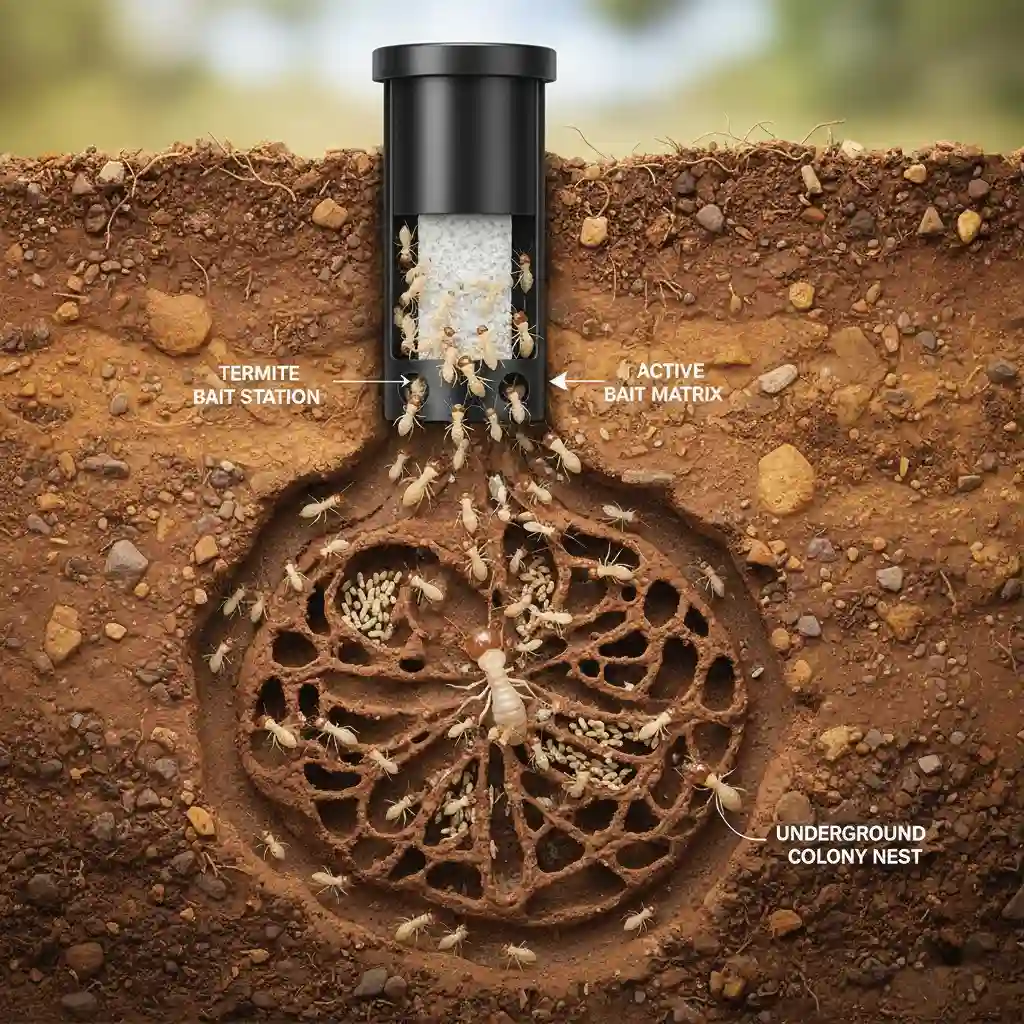
A termite baiting system works by establishing a perimeter of monitoring stations in the soil to intercept foraging subterranean termites. These stations contain high-cellulose bait matrices infused with Insect Growth Regulators (IGRs). Termites consume the bait and share it with the entire colony, including the queen, via trophallaxis. This scientifically interrupts the molting process, leading to total colony elimination. Unlike chemical barriers, baiting systems address the root cause by destroying the nest rather than just blocking entry.
While termites are often perceived as a problem exclusive to our neighbors in Australia, the presence of subterranean termites in Auckland is an escalating structural threat. From the Hibiscus Coast down to the North Shore and South Auckland, these pests work in silence, often causing thousands of dollars in damage before they are discovered. At Pest Control Auckland, we move beyond the “spray and pray” mentality. Our approach is grounded in scientific exclusion and the systematic eradication of the central colony.
1. The Science of Colony Elimination
To provide lasting protection for an Auckland property, we must target the colony biology. Traditional surface sprays might kill a few hundred foragers, but the queen remains deep in the soil, producing thousands of new offspring daily. This creates a cycle of recurring infestations.
The Mechanism of Trophallaxis
Termites are highly social insects that rely on mutual feeding, a biological process known as trophallaxis. Our baiting systems capitalize on this social structure. We use a slow-acting active ingredient that worker termites cannot detect. They consume the bait and transport it back to the heart of the nest, feeding the soldiers, the larvae, and ultimately the queen. By the time the colony realizes the bait is lethal, the entire population has already ingested it.
Chitin Synthesis Inhibitors (CSIs)
The baits we utilize contain Chitin Synthesis Inhibitors. Termites must periodically molt—shedding their hard outer shell—to grow. CSIs prevent the formation of a new exoskeleton. When the molting phase begins, the termite fails to develop properly and expires. Because this process is delayed, it allows the toxicant to spread through the entire Auckland colony without raising “alarm” signals among the foragers.
2. The Installation & Monitoring Lifecycle
Proper termite management is a process, not a one-time event. Our certified technicians follow a rigorous protocol to ensure your home remains a fortress against subterranean invaders.
- Structural Audit: We identify high-risk moisture zones, structural contact points, and current activity levels across your property.
- Station Strategic Placement: Stations are installed at specific intervals around the perimeter, targeting the most likely foraging paths in the soil.
- Active Monitoring: Our team performs regular inspections. If activity is detected, the monitoring wood is replaced with high-potency bait.
- Verification of Elimination: Once bait consumption ceases and secondary inspections show no live activity, we confirm colony elimination.
3. Baiting vs. Liquid Chemical Barriers
Homeowners often ask why we recommend baiting over traditional liquid soil treatments. While both have their place, baiting offers distinct advantages in the modern Auckland landscape.
| Feature | Termite Baiting Systems | Liquid Chemical Barriers |
|---|---|---|
| Goal | Total Colony Eradication | Exclusion/Repelling |
| Disruption | Minimal (No digging/drilling) | High (Trenching & Drilling) |
| Safety | Targeted, low-toxicity to non-pests | Large volumes of liquid chemical |
| Efficacy | Active search & destroy | Passive (relies on termites hitting barrier) |
4. Auckland Soil & Local Species Risks
Auckland’s unique geography presents specific challenges. Our heavy clay soils can cause liquid chemical barriers to migrate or break down unevenly. Furthermore, the Coptotermes acinaciformis (Subterranean Termite) is highly aggressive. Baiting systems are particularly effective in Auckland’s damp, clay-rich environment because the moisture levels actually assist in the palatability and discovery of the bait stations by foraging workers.
We focus our protection efforts across the region, including Orewa, the Hibiscus Coast, and the North Shore, where older timber-framed homes and established gardens provide ideal conditions for termite nesting.
5. Safety: Children, Pets & Soil Health
One of the primary concerns for Auckland families is the use of harsh chemicals. Our baiting systems utilize MPI-approved treatments that are specifically designed to target the unique biology of insects (chitin synthesis). Because mammals, birds, and fish do not produce chitin, the bait has an extremely low toxicity profile for non-target species. This makes it the safest choice for homes with children and pets.
6. Frequently Asked Questions
How long does it take for a baiting system to kill the colony?
Typically, it takes between 60 to 90 days once the termites begin feeding on the active bait. This timeline allows the IGR to spread through the entire social hierarchy of the nest, ensuring the queen is eliminated.
Will the bait attract MORE termites to my house?
No. Baiting stations do not “lure” termites from long distances. They are designed to intercept termites that are already foraging in the soil around your foundation. Once they find the station, they stop looking for your house and start feeding on the bait.
Is a baiting system better than DIY termite treatments?
Hardware store sprays are surface-level only. They fail to reach the colony and often cause termites to diverge into other areas of the home, potentially making the problem worse. Professional baiting provides a guaranteed, scientific solution that DIY products simply cannot match.
How often do the stations need to be checked?
At Pest Control Auckland, we typically perform quarterly inspections. However, in high-activity zones or during Auckland’s humid summer months, we may increase the frequency to ensure bait is always available to the foraging colony.