Got spiders webbing up your cornices or whitetails lurking in the laundry? We will find exactly where they are breeding, physically remove the nests, and apply a targeted exterior barrier to stop them coming back—usually in one visit.
I’ve spent years crawling through West Auckland roof cavities and subfloors. The truth is, most homeowners waste time and money on hardware store bug bombs that barely scratch the surface of a real infestation.
To actually solve the problem, you need to stop them at the source. That means identifying the species, clearing the egg sacs, and sealing up the structural entry points. Let’s walk through exactly how we handle this, minus the corporate fluff.
Key Takeaways
The most effective spider nest removal techniques for Auckland properties involve structural entry-point exclusion, physical vacuuming of webs and egg sacs, and targeted exterior treatments by Class 9 certified technicians. Avoid toxic DIY bombs and focus on root-cause eradication to keep your home safe and spider-free.
The 2026 Autumn Spider Surge in Auckland
Right now, in May 2026, we are dealing with a massive autumn pest surge across the Auckland region. Last year’s exceptionally mild winter, followed by a scorching summer, created the perfect breeding conditions for insects. With temperatures now dropping rapidly, spiders are aggressively moving indoors to seek warmth and establish winter nests.
This isn’t just a minor inconvenience for homeowners in West Auckland and the North Shore. We are seeing record numbers of callouts for heavy infestations in residential roof cavities and commercial properties. The sheer volume of egg sacs hidden in weep holes and subfloors is completely unprecedented.
If you operate a commercial business, ignoring this surge is a massive financial risk. The hospitality sector is facing intense scrutiny under the Food Act 2014, and a single spider nest dropping debris into a food prep area can trigger a failed audit. We are preparing to discuss these exact climate-driven pest shifts at the upcoming FAOPMA Pest Summit 2026 right here in Auckland.
Identifying Common Auckland Spiders and Their Nests
Before we apply any effective spider nest removal techniques for Auckland properties, we have to know exactly what we are dealing with. Different spiders build different nests in entirely different parts of your home. Treating a web-spinning spider the same way as a hunting spider is a rookie mistake.
The most notorious intruder is the Whitetail spider. They don’t spin traditional webs to catch prey; instead, they actively hunt other spiders around your home. You will typically find their temporary nests and egg sacs tucked away in dark, dry places like folded laundry, behind curtains, or deep inside your wardrobe.
Black House spiders, on the other hand, are the ones creating those messy, lacy webs around your window frames and eaves. Their nests are usually funnel-like, anchored securely into the corners of brickwork or timber framing. If you see thick, grey webbing accumulating dust outside, that is your primary target.
We also frequently encounter native Sheetweb spiders and the common Daddy Long Legs. While mostly harmless, a massive buildup of their webs makes a property look derelict and traps dead insects. This creates a secondary food source that attracts more aggressive pests, including rodents and cockroaches.
If you spot an unusual, highly aggressive spider or an exotic-looking egg sac that doesn’t match local species, do not disturb it. Exotic pests are a severe biosecurity threat to New Zealand. Report it immediately to MPI on 0800 80 99 66.
The Hidden Dangers of Leaving Spider Nests Untreated
Many Aucklanders assume that a few spider webs around the garage are harmless. However, ignoring a breeding population allows the infestation to scale rapidly out of control. A single female spider can produce multiple egg sacs, each containing hundreds of spiderlings ready to scatter through your wall cavities.
Once these spiderlings hatch, they infiltrate your living spaces through microscopic gaps in your architraves, downlights, and ventilation ducts. This constant influx of pests leads to increased bite risks for your family and pets. It also creates a highly stressful living environment where you are constantly looking over your shoulder.
Common areas where spiders establish hidden nests include:
- Deep within roof cavities and thermal insulation.
- Inside subfloor ventilation grates and exterior weep holes.
- Behind external weatherboards and blocked guttering.
- Tucked into the folds of undisturbed laundry or stored boxes.
For landlords, untreated spider infestations can lead to serious legal headaches. Tenants have the right to a clean, pest-free home under the Residential Tenancies Act. Failing to implement proactive spider nest removal in Auckland can result in costly Tenancy Tribunal disputes and lost rental income.
Effective Spider Nest Removal Techniques
When it comes to professional eradication, a quick spray with a supermarket aerosol won’t cut it. Those cans just scatter the spiders deeper into your wall cavities and contaminate your indoor air. We rely on a strict, scientific process to eradicate the problem at its structural root.
First, we conduct a comprehensive property inspection. We get up into the roof void, check the subfloor, and examine every single window frame. Identifying the primary breeding zones is the only way to ensure we wipe out the next generation before they hatch.

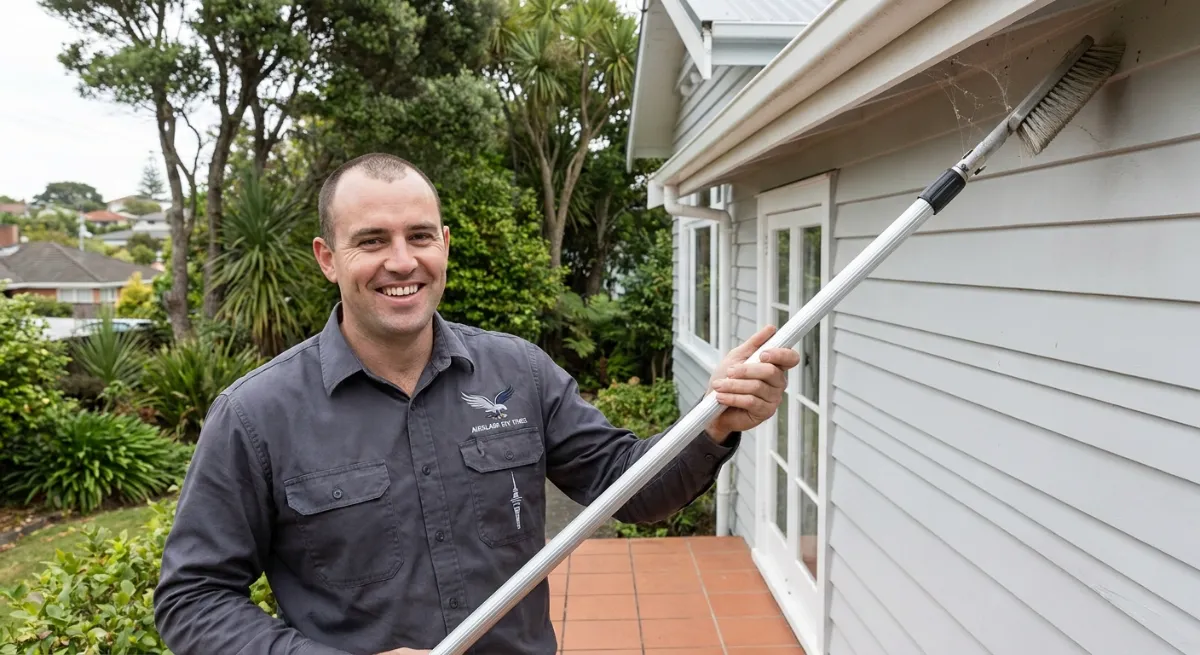
Next is the mechanical exclusion and removal phase. We physically brush down and vacuum the webs, taking special care to extract the egg sacs intact. Leaving the sacs behind guarantees a re-infestation within weeks, which is why physical removal is non-negotiable.
Once the physical nests are gone, we advise on sealing up the micro-gaps around your windows and doors. Denying them future entry points is a critical step in our Integrated Pest Management (IPM) strategy. We don’t just treat the symptoms; we fix the structural vulnerabilities.
Our systematic approach includes the following critical steps:
- Comprehensive structural inspection of the interior and exterior perimeters.
- Physical vacuuming of all visible webs and egg sacs to prevent hatching.
- Application of an MPI-approved, micro-encapsulated residual barrier.
- Ongoing environmental management and structural exclusion advice.
Finally, we apply a targeted, zero-emission chemical treatment. As Level 3 Qualified UPM Contractors, we use MPI-approved, Class 9 ecotoxic substances that are highly effective against spiders but strictly safe for your family. We treat the perimeter, weep holes, and roof cavities to create an invisible residual barrier.
We don’t just spray and walk away. Our treatments focus on root-cause eradication, structural entry-point exclusion, and long-term prevention. If the spiders return, so do we.
DIY Cycle of Despair vs. Professional Eradication
I see it every week: homeowners spending hundreds of dollars on DIY bug bombs, only to call us a month later when the spiders return. We call this the Cycle of Despair. DIY treatments are highly toxic, airborne, and completely fail to penetrate the deep structural voids where spiders actually breed.
Professional pest control in West Auckland is entirely different. We use targeted micro-encapsulated formulations that bind tightly to surfaces. When a spider walks across the treated zone, it absorbs the active ingredient and dies shortly after.
This professional approach is precise, heavily regulated, and vastly superior to flooding your living room with toxic aerosol gas. It also provides months of residual protection, rather than just killing the bugs that happen to be in the room at the time.
| Feature | DIY Hardware Store Sprays | Professional Pest Control Auckland |
|---|---|---|
| Targeting | Surface level only; completely misses hidden nests. | Root-cause eradication in deep structural voids. |
| Safety | High airborne toxicity; risky for pets and children. | MPI-approved, targeted, zero-emission applications. |
| Longevity | Breaks down rapidly in sunlight and rain. | Micro-encapsulated for months of lasting protection. |
| Nest Removal | Leaves egg sacs completely intact to hatch later. | Physical extraction of webs and egg sacs. |
Long-Term Prevention and Our Winter Defense Program
Removing the current infestation is only half the job. To keep your property secure year-round, you need a proactive defense strategy. Waiting until your house is overrun with Whitetails is a stressful and inefficient way to manage your property.
Under the Residential Tenancies Act, landlords must provide a clean, pest-free property at the start of a tenancy. Our documented treatments provide the exact proof you need to protect your investment.
We highly recommend our Auckland Winter Defense program for both residential and commercial clients. Instead of waiting for the spiders to take over your home, we apply preventative exterior barriers in late autumn. We treat the fence lines, subfloors, and eaves before the heavy rains drive the pests indoors.
You can also help by maintaining your property’s exterior environment. Keep firewood stacked well away from the house, trim back vegetation touching the exterior walls, and reduce outdoor lighting that attracts the flying insects spiders feed on.
Simple environmental management goes a long way in supporting our effective spider nest removal techniques for Auckland properties. By removing their food sources and natural hiding spots, you make your property highly unappealing to migrating spiders.
Environmental and Legal Considerations
Operating a pest control business in New Zealand means adhering to strict environmental and legal frameworks. We don’t just blast chemicals indiscriminately around your property. Our work is heavily governed by the EPA’s HSNO Act 1996, ensuring that any Class 9 substances we deploy are handled with absolute precision.
We also have a profound respect for Auckland’s native wildlife. While we relentlessly target invasive pests, we are extremely careful not to harm non-target species. We routinely assess properties to ensure our treatments do not impact native fauna.
Native skinks and geckos, for example, frequently live in retaining walls and gardens. They actually act as natural predators for many smaller insects. We adjust our perimeter treatment zones to ensure these protected reptiles remain completely unharmed during our operations.
If you have native skinks living in your garden retaining walls, let our technicians know. We can adjust our perimeter treatment zones to ensure these protected reptiles remain completely unharmed.
For commercial clients, our methods are fully aligned with the Food Act 2014 and HACCP standards. We provide comprehensive documentation and safety data sheets for every treatment. This ensures you remain completely audit-ready and legally compliant at all times.
Frequently Asked Questions

About the Author: Ronnie
Founder, Pest Control Auckland · Commercial & Residential Pest Expert · Certified Urban Pest Management Specialist
With years of hands-on experience navigating Auckland’s unique climate and strict biosecurity laws, Ronnie is the definitive expert on effective spider nest removal techniques for Auckland properties. Having consulted for both residential homeowners and complex commercial facilities facing Food Act 2014 audits, his scientific, root-cause approach ensures long-term eradication over quick fixes.