Seeing spiders inside? We’ll find exactly where they’re breaching your walls, block the entry points, and clear them out—usually in one visit.
That’s the reality of effective Seasonal Spider Control: Auckland’s Year-Round Prevention Plan. You don’t need fear-mongering or toxic hardware store bombs; you just need a straight-talking Auckland pest tech who understands building structures.
Right now, in May 2026, Auckland is experiencing a massive autumn pest surge. A mild winter followed by a hot summer means insect populations exploded, and the spiders have followed their food right into your living room.
Key Takeaways
For effective seasonal spider control in Auckland, timing is everything. Autumn drives hunting spiders like White-tails indoors, while spring triggers breeding. True prevention requires sealing structural entry points and applying targeted, MPI-approved exterior barriers rather than relying on toxic indoor DIY bombs.
Why Auckland Homes Are Spider Magnets Right Now
Spiders don’t just wander inside by accident. They’re highly predictable predators that follow their food sources and seek shelter when the weather turns.
Our coastal humidity, combined with the dense native bush surrounding many suburbs, makes pest control in West Auckland and the wider region a constant battle. When the temperature drops in autumn, the insects move indoors to stay warm, and the spiders follow right behind them.
This year is particularly severe. Right now, in May 2026, Auckland is experiencing a massive autumn pest surge. The unusually mild winter we had last year, followed by an intensely hot summer, caused insect populations to explode across the region.
Because there’s an overabundance of prey, the spider population has scaled up to match it. Now that the cold weather is setting in, they’re looking for a warm place to hunt and nest.
This is why reactive spraying doesn’t work. If you don’t address the structural entry points—like weeping holes in brickwork, poorly sealed joinery, and gaps around plumbing—you’re leaving the front door wide open.
The “Big Four” Spiders Invading Auckland Properties
We see dozens of species, but four main culprits dominate our callouts. Knowing what you’re dealing with dictates exactly how we treat the property.
1. The White-Tail Spider
White-tails are hunting spiders. They don’t spin webs to catch food; they actively roam your house at night hunting for other spiders. Because they wander, they’re much more likely to cross paths with humans.
You’ll usually find them hiding in dark, warm places like laundry piles, shoes, or between your bedsheets. While their bite is painful, the myth that it causes flesh-eating necrosis has been thoroughly debunked by medical professionals. However, the bite can still cause severe localized pain and swelling, making them a high priority for removal.
2. The Black House Spider
If you have thick, messy, funnel-like webs around your window frames and eaves, you have Black House spiders. They’re notoriously stubborn and love the exterior of Auckland homes.
Their webs look terrible and are difficult to clean. Because these spiders rarely leave their webs, standard indoor bug bombs won’t touch them. We have to target the exterior directly with specialized equipment to break their life cycle.
3. The Avondale (Huntsman) Spider
Famous in West Auckland, the Avondale spider is a type of Huntsman. They’re massive, fast, and look terrifying when they suddenly sprint across your ceiling.
Despite their size, they’re completely harmless to humans. They’re actually excellent pest controllers themselves, but most homeowners still want them gone immediately.
4. Daddy Long Legs
These are the spindly spiders bobbing in the top corners of your rooms. They’re entirely harmless to humans and actually prey on more dangerous spiders.
However, they breed incredibly quickly and leave unsightly cobwebs everywhere. A proper Seasonal Spider Control: Auckland’s Year-Round Prevention Plan manages their numbers without drenching your ceiling in unnecessary chemicals.
Tracking the Annual Spider Cycle
Spiders operate on a strict seasonal clock. If you only spray when you see them, you’re always one step behind the infestation.
The Autumn and Winter Migration
Autumn is peak time for indoor spider sightings. As the Auckland weather cools, insects migrate inside, and hunting spiders follow the food chain.
During winter, they hunker down in your roof cavity, subfloor, and wall voids to escape the frost. They enter a state of reduced activity but don’t die off entirely.
This is why our Auckland Winter Defense program focuses heavily on treating these hidden spaces. By dusting the roof void during winter, we eliminate the dormant population before they can breed.
The Spring and Summer Breeding Phase
Spring triggers a massive hatching event. Those egg sacs hidden in your garage all winter suddenly burst, releasing hundreds of spiderlings.
Summer heat accelerates their growth. By applying a preventative barrier in early spring, we stop the breeding cycle before they ever mature into adults.
The “Cycle of Despair”: Why DIY Spider Sprays Fail
We see it every week across Auckland. A homeowner spends $100 on hardware store bug bombs, sets them off in the living room, and breathes in toxic fumes for a day.
Two weeks later, the spiders are back. Why? Because aerosol bombs only kill what’s standing directly in the open. They don’t penetrate wall voids, and they certainly don’t stop new spiders from walking through the same unsealed gaps.
Furthermore, these DIY products offer zero residual protection. Once the fog settles, the chemical breaks down rapidly, leaving your home completely unprotected against the next wave of invaders.
Over-the-counter foggers leave toxic residue on your kitchen counters and floors, posing a risk to pets and children, while completely failing to reach the spiders hiding deep in your structural cavities.
Surface Sprays vs. Root-Cause Eradication
Spiders walk on the tips of their legs. They don’t drag their bodies across the floor like cockroaches do.
This means standard DIY surface sprays rarely transfer enough active ingredient to kill them. Professional formulations use micro-encapsulated technology that sticks to their legs, ensuring root-cause eradication.
How We Execute Seasonal Spider Control: Auckland’s Year-Round Prevention Plan
At Pest Control Auckland, we don’t just “spray and walk away.” We use Predictive Integrated Pest Management (IPM).
This is the exact methodology being highlighted at the upcoming FAOPMA Pest Summit 2026 at the NZICC. It’s about working smarter, not just using harsher chemicals.
| Feature | DIY Supermarket Sprays | Our Professional IPM Strategy |
|---|---|---|
| Chemical Type | Generic repellents (short lifespan) | Micro-encapsulated, MPI-approved |
| Application Area | Skirting boards and random corners | Roof voids, subfloors, and exterior weep holes |
| Long-Term Result | Spiders return within 2-3 weeks | Year-round protection with our Silver Bullet Guarantee |
Step 1: Structural Exclusion
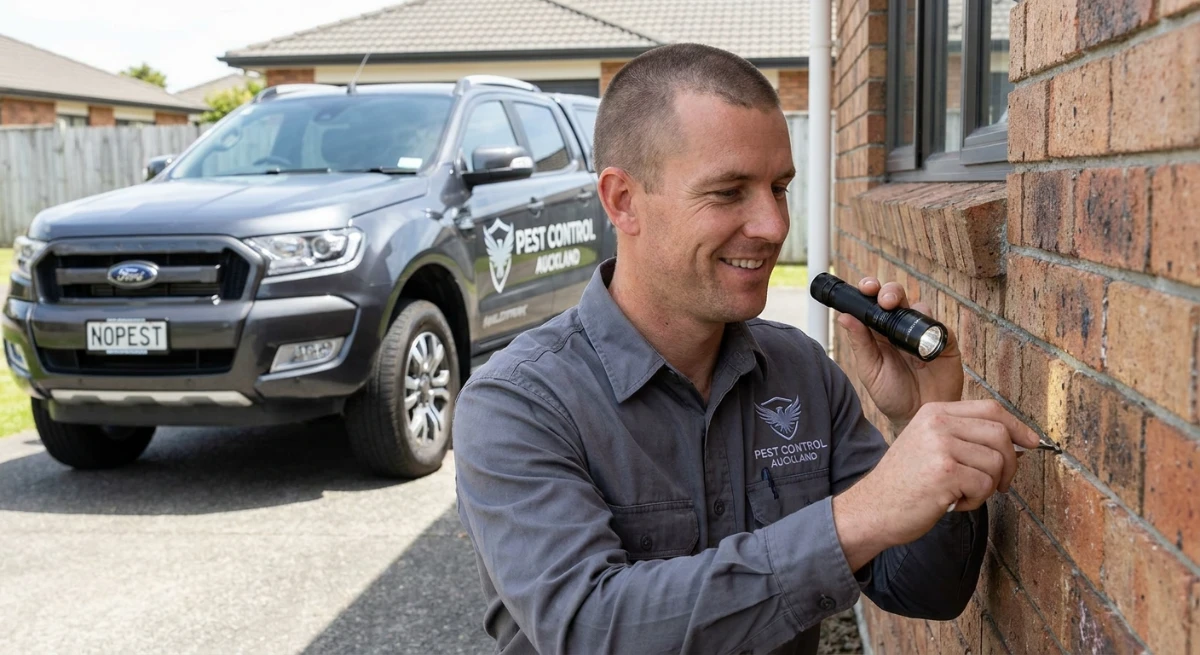
We start on the outside. We inspect your property for vulnerabilities and advise you on exactly what needs sealing. By cutting off physical access, we create the foundation of true prevention.
Common structural entry points we identify include:
- Damaged subfloor vent covers.
- Unsealed gaps around exterior plumbing pipes.
- Cracks in deteriorating window joinery.
- Overhanging tree branches acting as bridges to your roof.
Keep firewood, stacked bricks, and dense foliage at least one metre away from your exterior walls. Spiders use these as staging grounds before moving indoors.
Step 2: Targeted Exterior Barrier
Next, we apply a targeted, weather-resistant barrier around the foundation, eaves, and window frames.
This stops Black House spiders from webbing up your joinery and prevents White-tails from marching through your front door. It’s highly precise and minimizes environmental impact.
Step 3: Safe Interior Spot Treatment
Finally, we address the interior. We don’t blanket-spray your living room.
We selectively treat high-risk zones like the roof cavity, sub-aerial voids, and dark corners where spiders actually nest. This keeps your living spaces clean and safe.

Safety, Certifications, and the Law
You should never let an uncertified operator spray chemicals around your family. The pest control industry in New Zealand is strictly regulated to protect public health and the environment.
Under the EPA HPC Notice 2017 and the HSNO Act 1996, handling Class 9 ecotoxic substances requires serious training. Our technicians hold the New Zealand Certificate in Pest Operations (Level 3), ensuring every application is legally compliant and scientifically sound.
We also strictly adhere to the Animal Welfare Act 1999 and the Food Act 2014 when dealing with commercial properties. We don’t cut corners, and we don’t use cheap, unregistered chemicals.
All our interior treatments are applied using zero-emission, MPI-approved products. Once the treatment is dry (usually within 2 hours), it is completely safe for children and pets to re-enter the home.
For landlords and property managers, we provide full transparency. We supply the necessary documentation to prove compliance with the Residential Tenancies Act, preventing disputes over who is responsible for the infestation.
Don’t wait until the spiders are already in your bed. Contact us to deploy the Seasonal Spider Control: Auckland’s Year-Round Prevention Plan and claim your Silver Bullet Guarantee.
Frequently Asked Questions

About the Author: Ronnie
Founder, Pest Control Auckland · Commercial & Residential Pest Expert · Certified Urban Pest Management Specialist
With years of hands-on experience navigating Auckland’s strict biosecurity laws and unique climate challenges, Ronnie is the definitive expert to write about Seasonal Spider Control: Auckland’s Year-Round Prevention Plan. Having consulted for hundreds of local homeowners and commercial operators, he specializes in structural pest exclusion and Integrated Pest Management (IPM), ensuring safe, long-term eradication rather than temporary fixes.