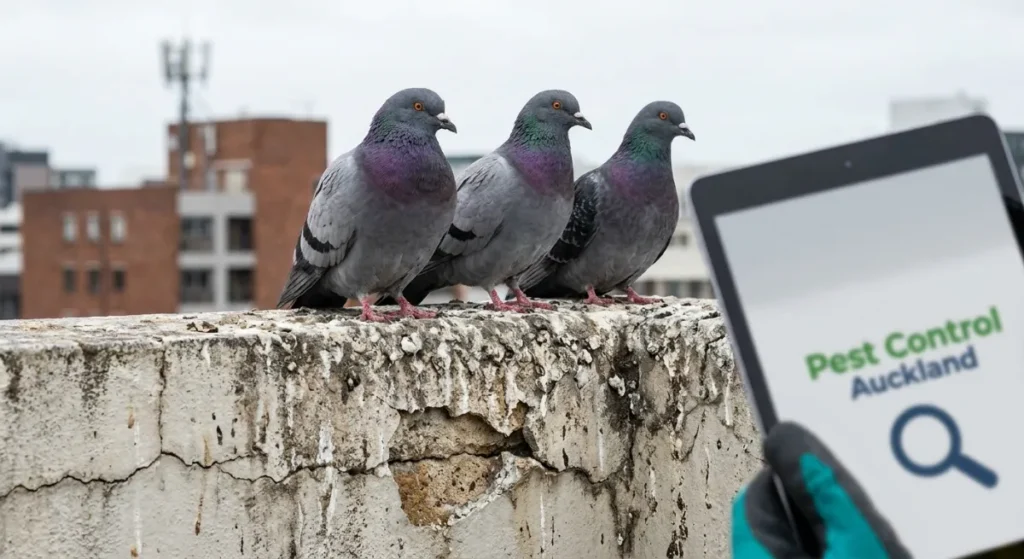
You are here because feral pigeons have decided your property is their new toilet, and you want them gone. I completely understand the frustration. These birds are relentless, and they do not care about your fresh paint job, your expensive solar panels, or the health inspector visiting your cafe.
If you are searching for the best pigeon deterrent, you have probably already seen endless online ads for plastic owls, shiny reflective tape, and ultrasonic noise boxes. Let me save you some time, money, and a lot of anger: most of that stuff belongs straight in the bin.
In Auckland, we deal with a unique mix of coastal weather and dense urban environments. Following the mild winter and hot summer we had last year, the autumn 2026 pest bird surge is hitting properties hard. Finding what actually works is not about buying magic gadgets; it is about structural exclusion and behavioral science.
Key Takeaways
The best pigeon deterrent is physical exclusion, specifically commercial-grade stainless steel bird spikes and heavy-duty polyethylene netting. Visual and sonic deterrents fail rapidly due to habituation. For Auckland properties, permanent structural modifications offer the highest ROI, stopping acidic guano damage and ensuring legal compliance.
Evaluating Popular Bird Deterrents: Myths vs. Reality
When locals ask me what the absolute best pigeon deterrent is, my answer is always the same: physical barriers. You simply cannot negotiate with a pigeon. If a ledge is flat, high up, and sheltered from the wind, they are going to land on it.
Biologically, feral pigeons are descendants of rock doves. They are naturally hardwired to seek out steep cliff faces to nest and breed. To a pigeon, an Auckland commercial warehouse or a multi-story apartment block is just a predator-free cliff. They feel entirely at home.
Let us talk about the cheap junk sold at your local hardware store. The retail pest control aisle is packed full of “miracle” bird repellents that rely heavily on fear. The fatal flaw with fear-based deterrents is habituation.
Pigeons are incredibly adaptable, intelligent scavengers. If a plastic owl does not move or physically attack them after three days, they will figure out it is completely fake. I have literally seen pigeons building their nests directly on top of plastic decoys.
Ultrasonic Devices: Do They Actually Work?
Ultrasonic devices claim to emit high-frequency noises that irritate birds without bothering humans. The marketing theory sounds fantastic, but the reality on the ground is highly disappointing.
Scientific studies and our own daily field experience in Auckland show that sonic devices have an extremely low long-term success rate. Pigeons quickly learn that the annoying sound carries no actual physical threat to their safety.
Furthermore, noise ordinances in dense Auckland suburbs mean you cannot blast loud distress calls without aggravating your neighbors. It is a massive waste of money for a structural problem that requires a physical fix.
Ultrasonic devices are largely ineffective against urban pigeons. They habituate to the noise within a week. Relying on them for commercial buildings often leads to failed health inspections under the Food Act 2014.
Visual Scares (Decoys, Reflective Tape) and Habituation
Reflective tape, old CD discs, and holographic predator eyes are another very common DIY attempt. These visual scares work by reflecting sunlight unpredictably to disorient the bird as it approaches.
Do they actually work? Yes, for about 48 hours. Once the wind dies down, or the pigeon realizes the shiny tape is not a real predator, they will fly right past it and land anyway.
Visual deterrents are only useful as a very short-term stopgap while you wait for a professional to arrive. They are never the final answer when you are looking for the best pigeon deterrent on the market.
The Scientifically Proven Methods (Predictive IPM)
If you want to know what the truly best pigeon deterrent is, look at what the certified professionals use on major commercial buildings. We rely entirely on science and structural modification.
In our industry, we call this Predictive Integrated Pest Management (IPM). Instead of reacting to the mess after it happens, we proactively predict where the birds want to roost and structurally block it.
A comprehensive 2016 study by Harris et al. confirmed that physical barriers are the most effective non-lethal method of pigeon control on building facades. They do not rely on the bird being scared; they rely on undeniable physics.
Physical Exclusion: The Undisputed Champion
Physical exclusion means altering the architecture of your building so a bird physically cannot land or nest. This is the core of our “Silver Bullet” approach to bird control.
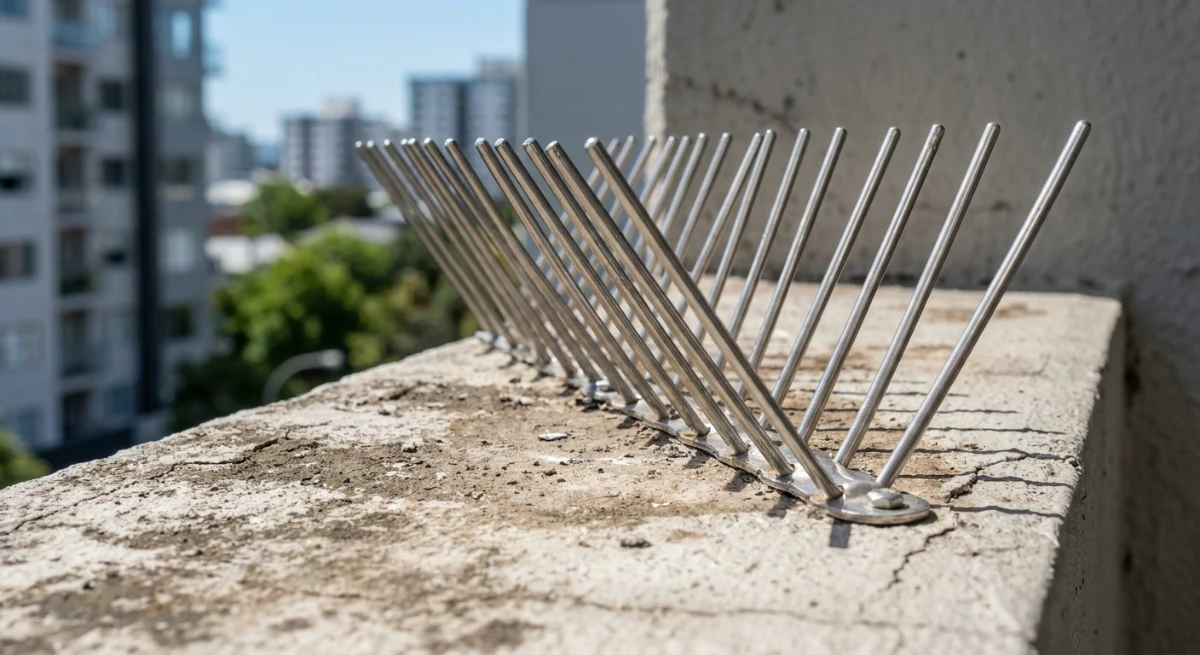
Commercial-grade stainless steel bird spikes are the industry standard for ledges, parapets, and signage. The pins are spaced closely together, making it completely impossible for a pigeon to get a solid foothold.
These spikes are completely humane. They do not impale or injure the bird; they just create an uncomfortable, uneven surface. The pigeon tries to land, fails, and moves on to an easier target down the street.
Bird spikes only work if installed correctly. If you leave a two-inch gap at the end of a ledge, a pigeon will squeeze in and nest there. Every single inch of the roosting zone must be covered.
Why Netting and Spikes Provide the Highest ROI
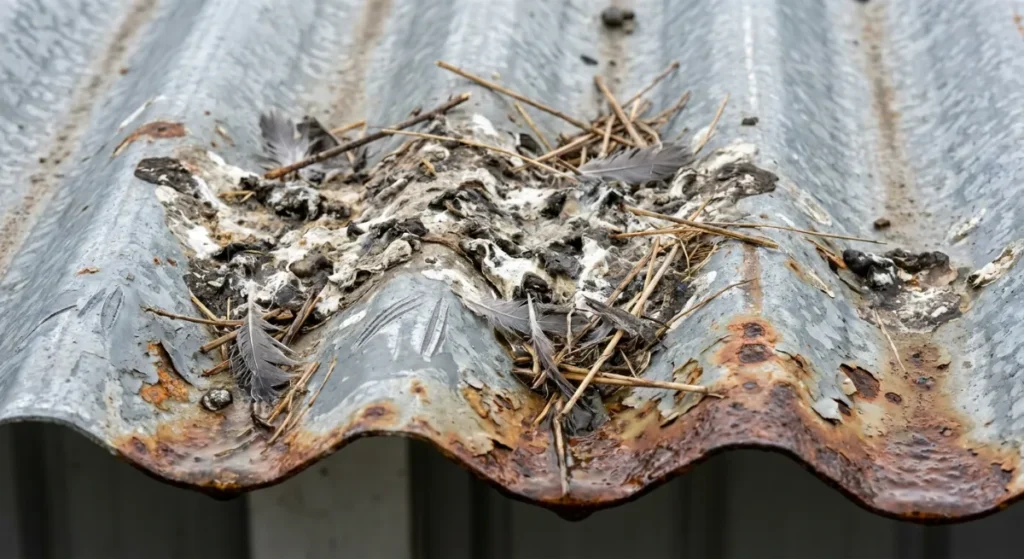
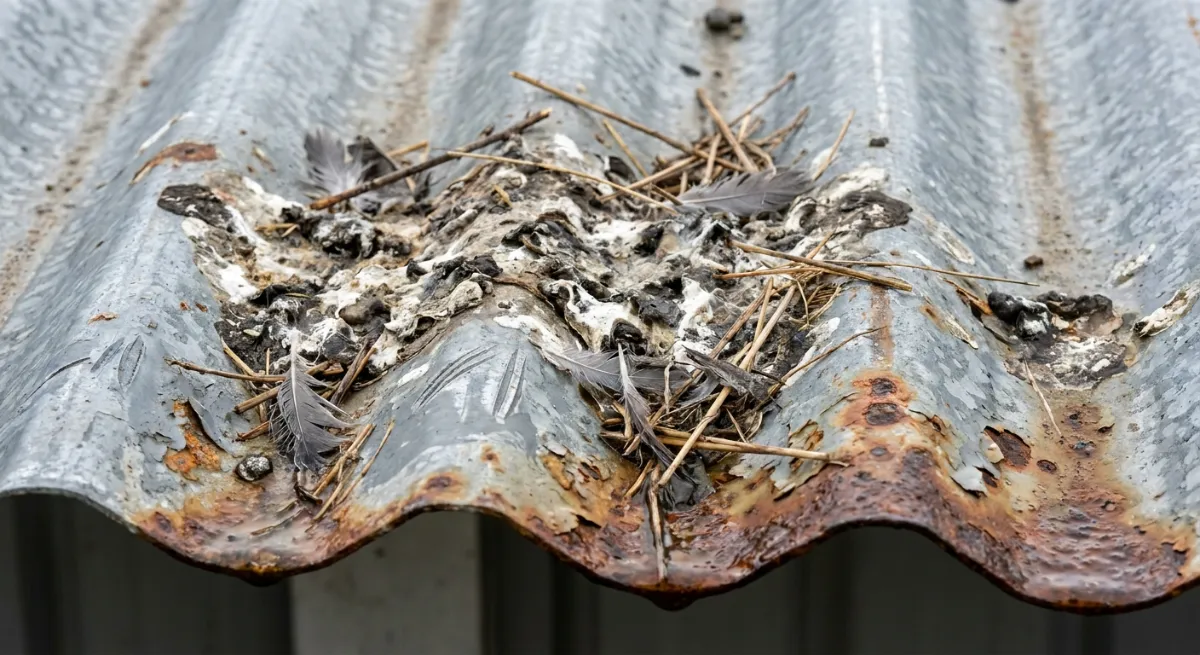
Pigeon guano is highly acidic, sitting at a pH between 3 and 4.5. Left unchecked on an Auckland warehouse or residential roof, it will literally eat through Colorsteel, corrode expensive HVAC units, and block your gutters.
When you compare the endless cost of constant gutter cleaning, roof repairs, and health hazard mitigation against the one-off cost of professional exclusion, the return on investment is massive.
Heavy-duty polyethylene netting is the undisputed king for protecting large, open areas like warehouse rafters, loading bays, and apartment balconies. Once a net is tensioned into place, the area is 100% protected for over a decade.
| Deterrent Method | Efficacy Level | Longevity | Best Application |
|---|---|---|---|
| Structural Netting | Extremely High (99%) | 10+ Years | Warehouses, Balconies, Rafters |
| Stainless Spikes | Extremely High (98%) | 10+ Years | Narrow Ledges, Signage, Parapets |
| Optical Fire Gel | High (85%) | 2-4 Years | Historical Buildings, Aesthetic Zones |
| Sonic Alarms | Very Low (15%) | Days to Weeks | Not Recommended for Urban Areas |
Matching the Deterrent to the Environment
Not every tool fits every job. The best pigeon deterrent for a residential home in Orewa looks very different from what we use on a massive industrial site in South Auckland.
Effective pest management is entirely about context. We have to carefully consider the aesthetics of the building, the severity of the infestation, and strict local Auckland Council regulations regarding animal management.
As we prepare for the FAOPMA Pest Summit here in Auckland in July 2026, the entire industry is shifting toward these smarter, eco-conscious, and highly targeted physical solutions.
Residential Roofs vs. Commercial Warehouses
For residential homes, pigeons usually target solar panels, chimney stacks, and sheltered roof valleys. Here, building aesthetics matter deeply to the homeowner.
We frequently use low-profile solar panel mesh to stop pigeons from nesting underneath the units. We also deploy optical fire gels on front-facing ledges. The gel looks like a small dish of wax to us, but appears as a burning fire to the pigeon’s ultraviolet vision.
For commercial warehouses, it is all about heavy-duty exclusion. We use tensioned wire rope netting across entire ceiling spans and commercial-grade spiking on HVAC units to protect expensive machinery.
If you manage a food business, the Food Act 2014 requires you to actively prevent pest contamination. Installing professional physical bird exclusion systems is a mandatory step to secure your MPI health and safety audit.
Consult with Auckland’s Bird Control Specialists
Feral pigeons are an unprotected species under the Wildlife Act 1953, meaning property owners have the legal right to manage them. However, the Animal Welfare Act 1999 clearly mandates that any control method used must be humane.
Getting it wrong can result in severe public backlash, hefty fines, and wasted money. That is exactly why you need a Level 3 certified Urban Pest Management specialist to handle the installation.
At Pest Control Auckland, we do not just chase birds away temporarily. We diagnose the specific structural vulnerabilities of your property, install permanent physical barriers, and guarantee the results.
If you are completely tired of cleaning up acidic guano and listening to endless cooing in your roof cavity, it is time to fix the problem permanently. Reach out to us, and we will lock them out for good.
People Also Ask

About the Author: Ronnie
Founder, Pest Control Auckland · Commercial & Residential Pest Expert · Certified Urban Pest Management Specialist
With over a decade of hands-on experience in Auckland’s unique pest landscape, Ronnie specializes in Predictive Integrated Pest Management and structural exclusion. Having consulted for major commercial facilities to ensure Food Act 2014 compliance, he is the definitive expert on identifying and installing the most effective, legally compliant bird deterrent systems.