G’day, Auckland. If there is one thing we have learned after years of crawling under villas in Ponsonby and inspecting commercial kitchens out West, it is that pests do not care about the rules.
But the council? They absolutely do. Following the mild winter and hot summer we had last year, this autumn 2026 pest surge has caught a lot of folks off guard.
We are seeing a massive spike in rodents looking for a warm roof and Argentine ants invading pantries. When panic sets in, the first instinct is often to rush to the hardware store for a cheap bug bomb.
But navigating the legal landscape of urban biosecurity is not that simple. Whether you are a landlord dealing with a Tenancy Tribunal dispute, or a cafe owner trying to pass an MPI health inspection, understanding the Auckland Council Bylaws on Pest Management is non-negotiable.
Ignorance of the law will not stop a hefty fine, and a failed DIY job just leads to an endless cycle of despair. Let us break down exactly what you need to know to stay compliant and pest-free.
Key Takeaways
The Auckland Council Bylaws on Pest Management mandate strict biosecurity rules under the RPMP 2020-2030. Live traps require 12-hour daily checks, and commercial food premises must use non-toxic monitoring. Landlords must ensure pest-free properties at tenancy start, while certified Level 3 technicians ensure safe ecotoxic applications.
The Auckland Regional Pest Management Plan (RPMP) 2020-2030
Let us talk about the big picture. When it comes to local legislation, the Auckland Council Bylaws on Pest Management are primarily guided by the RPMP 2020-2030.
This is a comprehensive, 10-year legal framework designed to protect our native biodiversity and primary industries from devastating invasive species. It is not just a polite set of suggestions; the RPMP enforces strict rules on pest plants and animals.
For example, if you are heading out to the Hauraki Gulf Controlled Area, such as Waiheke or Aotea Great Barrier, there are mandatory biosecurity checks. You cannot accidentally transport plague skinks or Argentine ants in your camping gear.
We have seen incredible successes from these council-led regulations. Following the intensive late-2025 aerial drops and thermal drone operations, rat tracking in the Hūnua Ranges has plummeted.
The Animal Welfare Act 1999: Trapping Done Right
A lot of DIYers think they can just set a trap in the ceiling and forget about it for a week. That is a fast track to breaking federal law.
Under the Animal Welfare Act 1999, trapping is heavily regulated to prevent unnecessary suffering. If you are using a live-capture trap for rodents or feral pests, the rules are incredibly strict.
By law, you are required to physically inspect any live-capture trap within 12 hours after sunrise every single day. Failing to do so is a criminal offence.
Leaving an animal to suffer in a forgotten trap is exactly why we advocate for professional, predictive Integrated Pest Management (IPM) rather than amateur DIY attempts.
Furthermore, glue boards for rodents are heavily restricted in New Zealand. You cannot just order them online and plaster them across your garage floor without facing massive fines.
Commercial Compliance: The Food Act 2014
Auckland’s hospitality sector is booming, hitting record turnovers of nearly $16 billion nationally in FY2025. But with that growth comes intense scrutiny from the Ministry for Primary Industries (MPI).
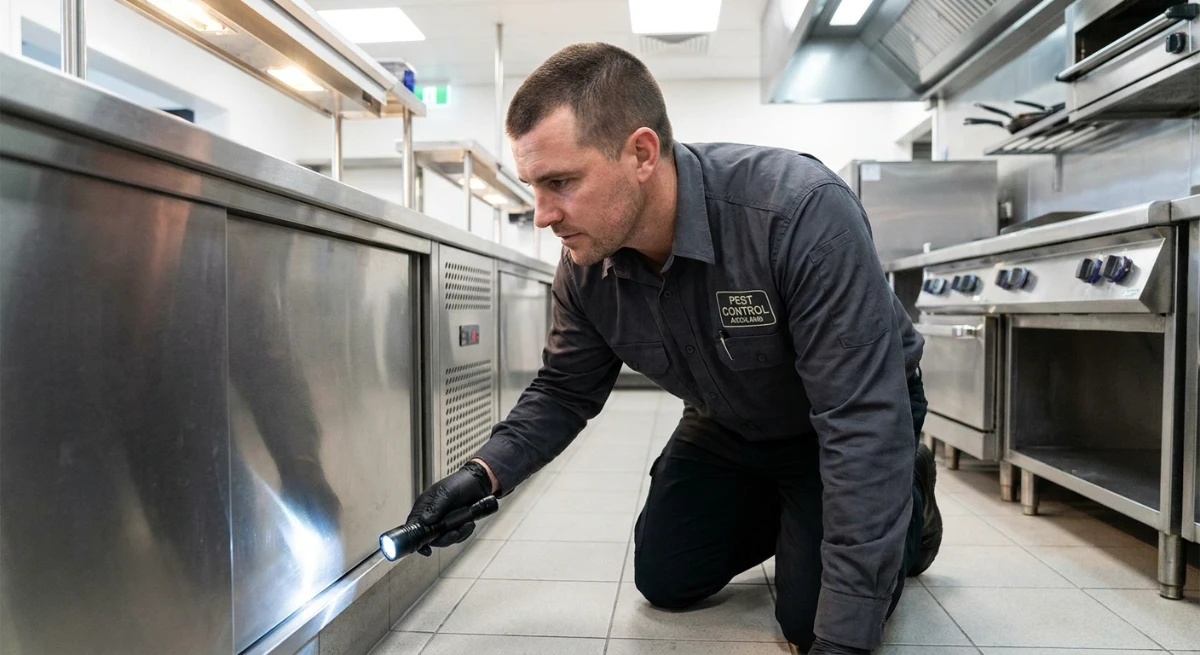
If you run a cafe, restaurant, or warehousing facility, the Auckland Council Bylaws on Pest Management overlap heavily with the Food Act 2014.
The old spray and pray approach is entirely dead in the commercial sector. You cannot place toxic rodenticide baits in food preparation areas, as it creates a massive contamination risk and results in an instant health inspection failure.
Instead, commercial operators must use non-toxic monitoring blocks, mechanical traps, and strict structural exclusion. We provide comprehensive commercial biosecurity auditing to keep your business fully compliant.
Landlord vs. Tenant: Who Foots the Bill?
The Auckland housing market is stressful enough without adding a rat infestation into the mix. Under the Residential Tenancies Act, the responsibility for pest control can sometimes feel like a grey area.
However, the baseline rule is simple: landlords must provide a clean, safe, and pest-free property at the start of any tenancy.
If a tenant moves into a rental property and immediately finds cockroaches behind the stove, the landlord is entirely responsible for the professional eradication costs.
Conversely, if the infestation is caused by the tenant’s poor hygiene, accumulated rubbish, or failure to report structural damage, the financial burden shifts directly to them.
| Infestation Scenario | Landlord Responsibility | Tenant Responsibility |
|---|---|---|
| Pests present before move-in | 100% responsible for professional eradication. | Must report sightings immediately. |
| Structural entry points (e.g., holes in roof) | Must seal gaps and maintain property structure. | None, unless damage was caused by the tenant. |
| Infestation due to poor hygiene | May arrange service but can pass costs to tenant. | Financially liable for cleanup and pest control. |
| End of tenancy flea treatment (if pets allowed) | Must stipulate requirements clearly in the lease. | Required to fund professional flea eradication. |
EPA Regulations and Ecotoxic Substances
We do not mess around with cheap, unverified chemicals. The Environmental Protection Authority (EPA) and the Hazardous Substances and New Organisms (HSNO) Act 1996 strictly govern what can be sprayed in your home.
Handling Class 9 ecotoxic substances requires serious credentials. Anyone applying these treatments commercially must be a Qualified Urban Pest Management (UPM) Contractor.
This means holding the New Zealand Certificate in Pest Operations (Level 3). When you hire us, you are getting certified experts who understand exactly how to protect your family and pets.
Always ask your pest controller for the Safety Data Sheet (SDS) of the products they use. Transparent operators will gladly provide MPI-approved, zero-emission treatment documents.
Protected Native Wildlife vs. Urban Pests
We are often called out to properties in the Waitakere Ranges by homeowners hearing loud scratching noises in the roof. Sometimes, it is a ship rat.
Other times, it is a native bird, a gecko, or a skink. Under local and national regulations, we draw a very hard line. We do not exterminate, kill, or treat protected native wildlife.
If we discover that your pest issue actually involves native species, we will assess the situation and immediately refer you to the Department of Conservation (DOC).
We also deal with feral rural animals on a case-by-case basis. If you have a feral pig or stoat issue on a lifestyle block, we will guide you toward a specialised rural contractor.
2026 Pricing Benchmarks for Auckland
One of the biggest frustrations Aucklanders face is the lack of pricing transparency. Major corporate companies still force you through high-friction quote forms just to get a basic number.
We believe in honest, upfront pricing. As of May 2026, the market benchmarks for a standard three-bedroom home are clear and established across the region.
- Ants: Professional eradication typically ranges from $160 to $200.
- Cockroaches: Comprehensive interior and exterior treatments sit between $265 and $325.
- Rodents: Roof and structural exclusion usually costs between $155 and $325, depending on severity.
- Bed Bugs: Highly specialised heat or chemical treatments generally cost $215 to $265 per room.
By publishing these tiers, we bypass the bait-and-switch tactics of the past. A cheap hardware store bomb might seem appealing, but when it fails and the pests multiply, you end up paying far more in the long run.
The FAOPMA 2026 Summit & The Future of IPM
The urban pest management industry is evolving faster than ever. In fact, Auckland is gearing up to host the prestigious FAOPMA Pest Summit in July 2026 at the NZICC.
The theme is ‘FutureProof: Smarter Pest Solutions,’ and it perfectly aligns with our scientific, root-cause approach. We are moving away from reactive treatments toward smart, predictive monitoring.
By fixing structural entry points and offering ongoing seasonal protection plans, like our Auckland Winter Defense package, we stop pests long before they cross your threshold.
When you are dealing with the Auckland Council Bylaws on Pest Management, you cannot afford to cut corners. We find the entry points, we eliminate the nest, and we back our work with our Silver Bullet Guarantee.
We call it the cycle of despair. You spot a cockroach, panic, and buy a surface spray from the supermarket. It kills the bugs you can see, but does absolutely nothing to the nest hidden inside your wall cavities.
A few weeks later, they are back in greater numbers. You have wasted time, money, and exposed your family to unnecessary chemicals. That is why our scientific eradication is so crucial.

Frequently Asked Questions

About the Author: Ronnie
Founder, Pest Control Auckland · Commercial & Residential Pest Expert · Certified Urban Pest Management Specialist
With years of experience navigating complex biosecurity frameworks, Ronnie is the definitive expert on the Auckland Council Bylaws on Pest Management. Having consulted for both residential homeowners and commercial hospitality operators across the region, he ensures all eradication strategies strictly align with MPI standards, the HSNO Act, and local council regulations.