Got rats in the roof of your café? We will find out how they are getting in, block the holes, and clear them out—usually in one visit. When you are running a business in Auckland, a pest problem is not just a nuisance; it is a direct threat to your livelihood.
The era of reactive, toxic spray-and-pray applications is dead. If you want to pass your MPI audits and keep your doors open, you need a predictive, science-based approach. We provide commercial pest management services in Auckland that focus on root-cause eradication.
We do not just spray and walk away. We identify structural entry points, implement ongoing prevention strategies, and ensure your business remains compliant with New Zealand’s strict biosecurity laws.
Key Takeaways
To comply with the Food Act 2014, Auckland businesses must implement proactive Integrated Pest Management (IPM). Toxic rodenticides are prohibited in sensitive food zones. Our Level 3 certified technicians deliver zero-emission, root-cause eradication that guarantees compliance, protects your reputation, and permanently excludes pests from your commercial property.
The Zero-Tolerance Reality for Auckland Hospitality
New Zealand’s hospitality sector reached a record $15.99 billion turnover in FY2025. With nearly 30% of these businesses located in Auckland, the pressure to maintain pristine hygiene is immense. A mild winter and a scorching summer have triggered a massive autumn pest surge in May 2026.
Rats, cockroaches, and ants are aggressively seeking shelter inside commercial kitchens. Under the Food Act 2014, a single pest sighting can result in immediate closure and hefty fines. You simply cannot afford to cut corners with cheap extermination methods.
Our commercial pest management services in Auckland guarantee your compliance with Ministry for Primary Industries (MPI) standards. We protect your brand reputation by keeping pests out of sight and out of mind.
Failing an MPI health inspection due to pest activity is a criminal liability under the Food Act 2014. Ignorance of an infestation is not a valid legal defense for commercial operators.
Navigating the Food Act 2014 & Commercial Compliance
Non-Toxic Requirements for Food Zones
Commercial food sector pest control strictly prohibits the use of toxic rodenticide bait in sensitive areas. You must use non-toxic monitoring and mechanical traps. We install and monitor these systems, ensuring you meet Hazard Analysis and Critical Control Points (HACCP) requirements without risking chemical contamination.
Surface-level DIY sprays from the hardware store will immediately void your food safety compliance. We utilize zero-emission treatments that are rigorously tested for efficacy and safety around food preparation environments.
Qualified UPM Contractors
Our technicians hold the New Zealand Certificate in Pest Operations (Level 3). This means we are legally qualified to handle Class 9 (ecotoxic) substances safely. We provide transparent Safety Data Sheets (SDS) for all treatments, so you never have to guess what is being used around your staff and customers.
Property managers and landlords also benefit from this transparency, as it provides clear documentation for Tenancy Tribunal disputes. You get a complete digital log of all inspections, trap checks, and chemical applications.
Always demand to see your technician’s Level 3 UPM certification and request a site map of all installed pest control devices to satisfy your next MPI audit.
The Financial Impact: Reactive vs. Preventative Treatment
Auckland Commercial Pest Control Pricing (Current 2026 Rates)
Stop wasting money on the DIY cycle of despair. Hardware store bombs fail because they only treat the symptoms, not the root cause. When you hire us for commercial pest management services in Auckland, you get honest, upfront pricing.
There are no hidden fees or bait-and-switch tactics. We assess the structural vulnerabilities of your commercial property and provide a clear quote for complete eradication.
| Pest Type | Standard Commercial Baseline Cost | Treatment Method |
|---|---|---|
| Ants | $160 – $200 | Targeted baiting & entry exclusion |
| Cockroaches | $265 – $325 | Crack/crevice flushing & residual gel |
| Rodents | $155 – $325 | Mechanical trapping & structural blocking |
| Bed Bugs | $215 – $265 per room | High-heat steam & targeted chemical application |
Why Subscription Models Win
Instead of paying for emergency callouts, smart businesses use our Auckland Winter Defense subscription. Predictive Integrated Pest Management (IPM) stops pests before they enter. This proactive approach saves you thousands in lost revenue and emergency fees over a three-year period.
By maintaining a continuous perimeter defense, you avoid the sudden panic of a mid-service pest sighting. Our commercial clients view our service as an essential insurance policy for their brand reputation.
Our Scientific, Root-Cause Eradication Method
Exclusion over Extermination
We do not just kill pests; we stop them from coming back. Our entomological approach focuses on structural entry-point exclusion. If rats are getting in, we find the gap in your cladding or the hole in your roof cavity and block it.
We analyze the environmental factors attracting pests to your site, such as poor waste management or moisture buildup. By fixing the environment, we permanently remove the pest’s reason for being there.
The Silver Bullet Guarantee
This is the foundation of our Silver Bullet Guarantee. We fix the problem once, saving you the ongoing cost of failed DIY treatments or recurring infestations. You get a clean, safe, pest-free commercial environment that passes any inspection.
If the pests return between scheduled IPM visits, so do we, at no extra cost. We stand by our work because we rely on science, not guesswork.
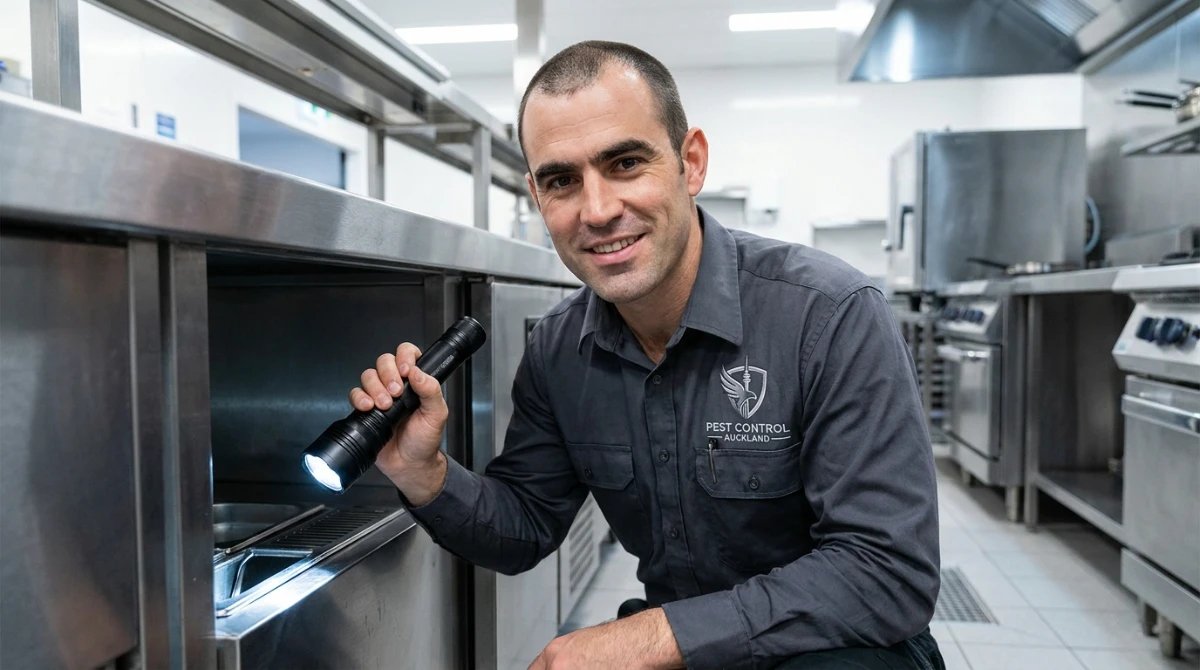
Look for grease marks along skirting boards and droppings near heat sources like commercial ovens. These are dead giveaways of structural entry points that need immediate blocking.
Industry Innovations: What is New in 2026?
FAOPMA Pest Summit 2026 & IoT Monitoring
The pest control industry is evolving rapidly. Auckland is hosting the FAOPMA Pest Summit from July 15-17, 2026, at the NZICC, themed FutureProof: Smarter Pest Solutions. We are at the forefront of this shift, integrating digital transparency and smart monitoring into our pest control in Auckland.
Internet of Things (IoT) sensors now allow us to monitor commercial rodent traps 24/7. When a trap is triggered, we get an instant alert, ensuring rapid removal before your staff even arrive for the morning shift.
Hūnua Ranges Success & Urban Implications
Recent biosecurity successes, like the massive reduction of rat tracking to 1.3% in the Hūnua Ranges following a late-2025 aerial drop, show what is possible with targeted eradication. We apply these same rigorous principles to urban commercial environments.
We use data-driven insights to predict pest movements and stop them at the perimeter. The days of blindly placing bait stations and hoping for the best are over.
Aligning with the Auckland Regional Pest Management Plan (RPMP)
Hauraki Gulf Controlled Area Restrictions
If your business operates near or services the Hauraki Gulf Controlled Area, you face additional compliance hurdles. The RPMP 2020-2030 mandates strict pathway management to prevent accidental pest introductions to islands like Waiheke and Aotea.
We provide certified inspections and clearance documentation for commercial freight and transport operators. You must ensure that your logistics chain is completely free of invasive hitchhikers like plague skinks and Argentine ants.
Managing Invasive Species Pathways
Our commercial pest management services in Auckland align perfectly with Auckland Council’s RPMP objectives. We help businesses identify and manage the risks associated with transporting goods across regional borders.
Our pathway management protocols include:
- Pre-departure freight inspections for transport operators.
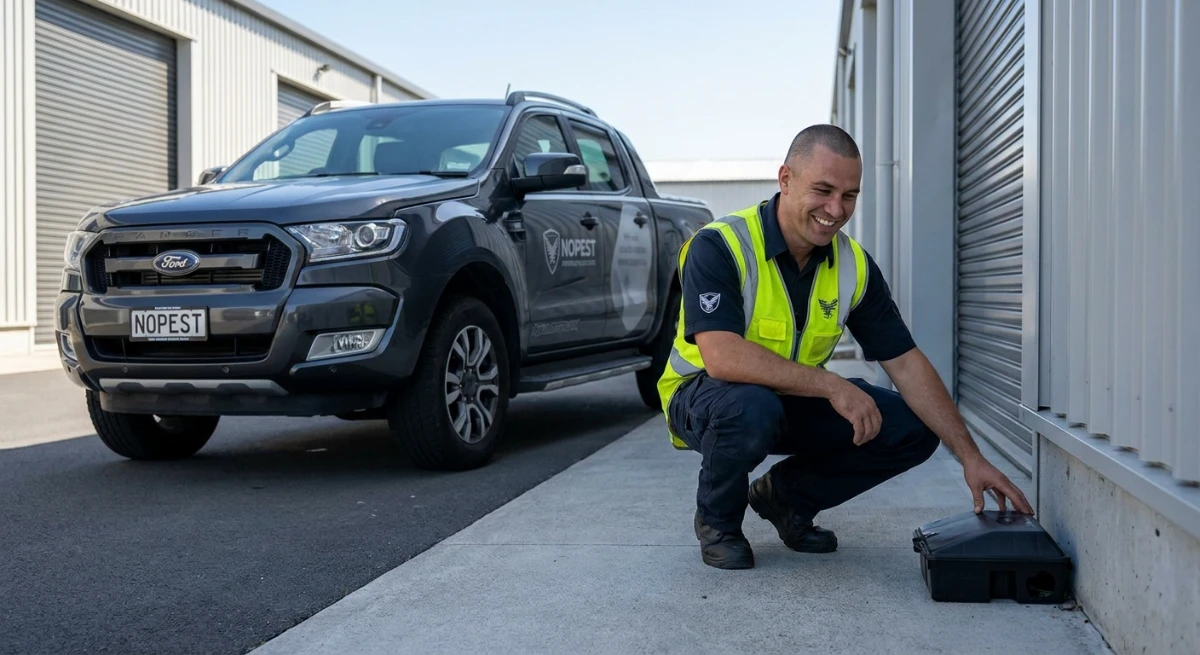
- Installation of pheromone monitoring stations in loading bays.
- Staff training on identifying high-risk biosecurity threats.
- Issuing clearance certificates for Hauraki Gulf transport.
By implementing proactive pathway management, you avoid costly delays and protect New Zealand’s vulnerable island ecosystems. We train your warehouse staff on what to look for and how to quarantine suspect shipments immediately.
The Lifecycle of Auckland Commercial Pests in Autumn
The Rodent Migration Indoors
As temperatures drop in May, rats and mice seek warmth and food sources indoors. Commercial kitchens, warehouses, and office buildings become prime targets. Rodents can squeeze through gaps as small as a 10-cent coin, making structural exclusion critical.
They will chew through electrical wiring, creating severe fire hazards in commercial properties. Our technicians identify these micro-gaps and seal them with industrial-grade, chew-proof materials.
Cockroach Breeding Cycles
German cockroaches thrive in the warm, humid environments of commercial kitchens. A single female can produce up to 30,000 offspring in a year if left unchecked. Surface sprays do not penetrate their deep hiding spots inside commercial dishwashers and espresso machines.
We use targeted gel baits and insect growth regulators to break the breeding cycle permanently. This ensures the entire colony collapses from the inside out.
Argentine Ant Invasions
Argentine ants form massive supercolonies that can quickly overrun a commercial property. They are highly aggressive and will protect aphids on your landscaping to harvest honeydew.
We use specialized non-repellent baits that the worker ants carry back to the nest. Because the bait is slow-acting, it gets distributed to the queens, destroying the colony completely. This is the only effective way to manage invasive ant species in an urban commercial setting.
Legal Constraints & Animal Welfare
Why We Say No to Illegal Traps
All our operations adhere strictly to the Animal Welfare Act 1999. Strict mandates dictate that live-capture traps must be physically inspected within 12 hours after sunrise every day. We do not use illegal glue boards or unethical methods.
We believe in humane, swift dispatch methods that respect animal welfare while protecting your business. Corporate clients appreciate this ethical approach, as it aligns with their own Environmental, Social, and Governance (ESG) policies.
Protected Wildlife & Biosecurity Alerts
We do not exterminate protected native wildlife like geckos or native birds. If you have a non-standard pest issue, we assess it case-by-case and refer you to the Department of Conservation (DOC) or MPI if necessary.
For instance, the ongoing Yellow-Legged Hornet eradication in the Bay of Plenty is a biosecurity threat handled directly by Biosecurity New Zealand. We serve as your first line of defense, identifying unusual pests and escalating them to the proper authorities so you are never left guessing.
Applying exterior commercial treatments or setting traps within 150 meters of a neighboring dwelling requires explicit permission. We handle all neighbor notifications and boundary compliance for you.
Frequently Asked Questions

About the Author: Ronnie
Founder, Pest Control Auckland · Commercial & Residential Pest Expert · Certified Urban Pest Management Specialist
With years of experience in structural pest exclusion and commercial compliance auditing, Ronnie is the definitive expert on Commercial Pest Management Services in Auckland. Having consulted for top hospitality venues and property managers across the region, he ensures businesses meet strict Food Act 2014 and MPI standards through science-based, zero-emission eradication methods.