Found chewed flour bags or roach casings near your prep station? We will find the nest, block the entry points, and clear them out so you pass your next MPI audit.
When we talk about Food Contamination by Pests: Health Hazards, we aren’t dealing in hypotheticals. A single rat in a dry store or a cockroach infestation in a commercial kitchen is a direct threat to public health. It shuts businesses down and puts people in the hospital.
Surface sprays and cheap hardware store baits will not fix a structural infestation. You need the entry points found, the breeding cycle broken, and the entire area sanitized to meet New Zealand’s strict food safety laws.
Key Takeaways
Food contamination by pests causes severe illnesses like Leptospirosis and Salmonella. The Food Act 2014 strictly prohibits toxic baits in food zones, requiring businesses to use non-toxic monitoring and structural exclusion. Professional, root-cause eradication is legally required to pass MPI audits and prevent closures.
The Real Cost of Contamination in Auckland
The hospitality sector in New Zealand is massive, hitting a record $21.4 billion in revenue for the year ending March 2025. With nearly 30% of these businesses operating in Auckland, the density of food sources is a magnet for urban pests. When you combine this economic boom with the severe autumn pest surges we see across the region, the risk of infestation skyrockets.
A single sighting of a rat or cockroach in a commercial environment is no longer just a public relations nightmare. It is a severe legal liability. The stakes are incredibly high, and understanding the scope of Food Contamination by Pests: Health Hazards is mandatory for any business owner.
More food production means more waste, and pests will exploit any weakness in your building to get to it. You cannot afford to ignore the early warning signs. Droppings, smear marks, and chewed packaging mean they are already inside and multiplying.
Breaking Down the Pathogens
Rats and mice do not just eat your stock; they ruin everything they touch. Rodents are known carriers of Leptospirosis, a severe bacterial infection transmitted through their urine. Because rodents constantly dribble urine as they travel to mark their territory, a single rat can contaminate entire shelves of dry goods overnight.
Salmonella and E. coli
Salmonellosis is another major threat. Salmonella bacteria thrive in the faeces of both rodents and cockroaches. If a staff member touches a contaminated surface and then handles food, the bacteria spreads instantly.
This is how widespread food poisoning outbreaks occur. The fallout from these incidents leads to devastating consequences for the public and immediate closure for the business.
Serving food contaminated by pest pathogens can result in immediate business closure, massive fines under the Food Act 2014, and criminal negligence charges.
Cockroaches and Airborne Allergens
Cockroaches are a different kind of headache. They breed fast, hide deep in your appliances, and drag bacteria across every surface they touch. Beyond spreading E. coli and Salmonella, their shed skin and droppings are potent allergens.
In enclosed spaces like commercial kitchens or residential pantries, these allergens become airborne. They are known to trigger severe asthma attacks in vulnerable individuals, compounding the physical health risks.
The Law: Food Act 2014 and MPI Audits
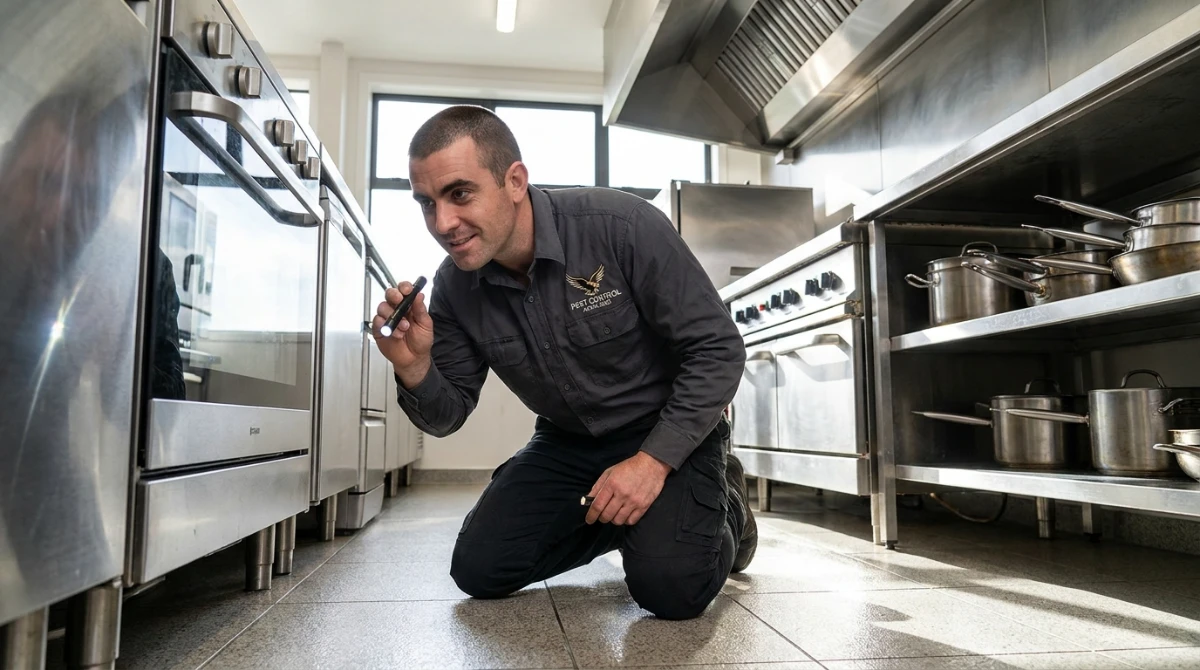
Operating a food business in New Zealand means adhering strictly to the Food Act 2014. This legislation shifted the focus from merely inspecting premises to rigorously managing the entire food production process. If you run a high-risk business, you operate under a strict Food Control Plan (FCP).
Under these rules, you cannot just throw toxic bait blocks around a kitchen. The use of Class 9 ecotoxic substances in sensitive food zones is heavily restricted. You must rely on non-toxic monitoring, mechanical traps, and structural exclusion to remain compliant.
Ministry for Primary Industries (MPI) auditors will check your pest control logs. You must prove that a qualified Level 3 Urban Pest Management technician is actively managing your site.
A failed audit is rarely kept quiet. Word gets around fast in Auckland, and rebuilding customer trust after a hygiene closure is nearly impossible. Preventative action is the only logical business choice.
How Cross-Contamination Actually Happens
Pests do not need to physically bite a human to spread disease. The mechanics of Food Contamination by Pests: Health Hazards usually involve indirect transmission. A cockroach crawls through a grease trap, picking up bacteria on its legs, and then walks across a sanitized prep bench.
Rodents are equally destructive. A mouse chewing through a plastic grain sack leaves saliva and hair behind. Even if the food looks fine, the microscopic pathogens are already multiplying rapidly.
| Pest Type | Primary Pathogen | Transmission Method | High-Risk Zone |
|---|---|---|---|
| Norway Rats | Leptospirosis | Urine trails on surfaces | Dry storage, low shelving |
| German Cockroaches | E. coli & Salmonella | Fecal matter & regurgitation | Prep benches, warm appliances |
| House Mice | Hantavirus | Airborne dust from droppings | Ceiling cavities, pantries |
| Flies | Various Bacteria | Landing on waste then food | Open food displays, bins |
Isolate contaminated stock immediately. Do not just throw away the chewed bag—discard anything on that shelf and sanitize the entire rack.
The Auckland Context: Why Our Climate Breeds Pests
Auckland’s unique geography makes it a paradise for urban pests. The high humidity, frequent rain, and dense urban sprawl create the perfect breeding ground. When the temperature drops in autumn, rodents migrate indoors seeking warmth and food.
If your business is located near the Waitakere Ranges or dense suburban bush, the pressure on your building’s exterior is relentless. Food Contamination by Pests: Health Hazards become a daily battle. You are not just fighting the pests inside; you are defending against a constant wave from the outside.
This is why local expertise matters. A generic pest control plan designed for a dry climate will fail in Auckland. We understand how the local weather patterns drive pest behaviour, allowing us to predict and intercept them before they breach your food zones.
Eradicating the Threat: Predictive IPM
The old ‘spray and walk away’ method is useless in a commercial kitchen. It doesn’t solve the problem, and it won’t pass an audit. At the upcoming FAOPMA Pest Summit 2026 in Auckland, the entire industry focus is on “FutureProof” strategies.
This means shifting to Predictive Integrated Pest Management (IPM). We find how they are getting in, block the hole, and clear out the stragglers. That is how you fix a pest problem permanently.
- Inspection: We locate the exact entry points and nesting zones.
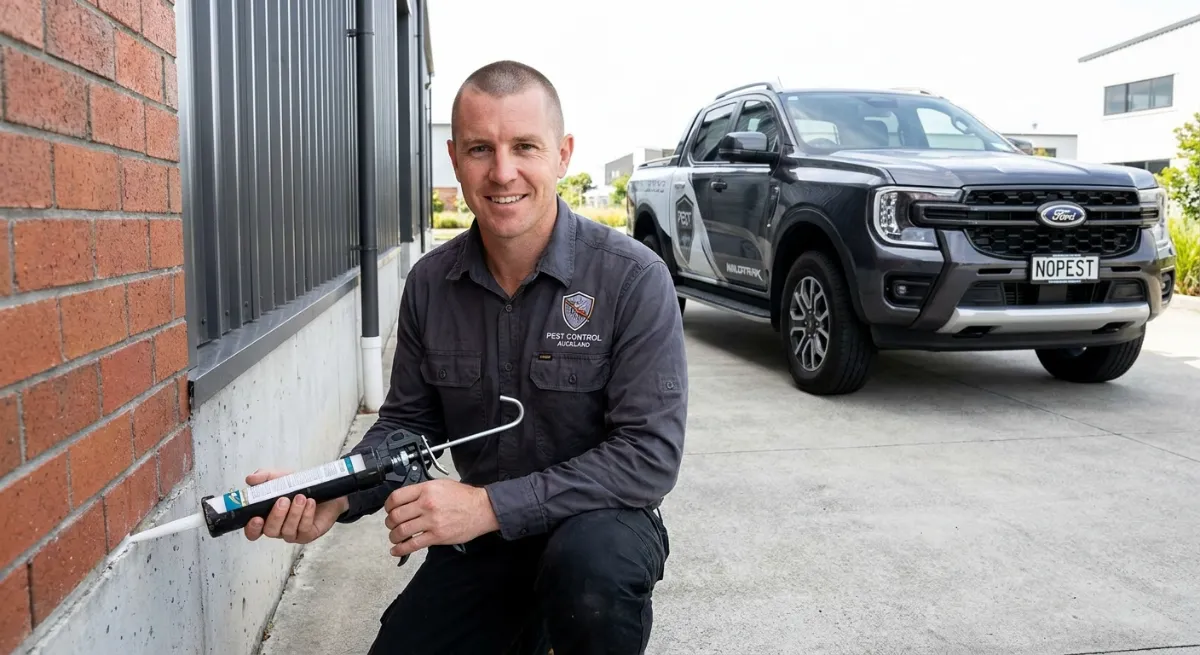
- Exclusion: We seal gaps with wire mesh, expanding foam, and bristle strips.
- Eradication: We use targeted, zero-emission treatments approved for food zones.
- Monitoring: We install non-toxic digital traps to track activity 24/7.
By focusing on the root cause, we eliminate the need for constant chemical applications. This approach protects your staff, your customers, and your reputation.
Sealing entry points with wire mesh and expanding foam is infinitely more effective than relying on continuous baiting. Fix the building, stop the pests.
Ultimately, managing Food Contamination by Pests: Health Hazards requires a scientific, methodical approach. Partnering with a certified local expert ensures you stay ahead of the problem and on the right side of the law.
Frequently Asked Questions

About the Author: Ronnie
Founder, Pest Control Auckland · Commercial & Residential Pest Expert · Certified Urban Pest Management Specialist
With years of experience in commercial biosecurity and Level 3 Urban Pest Management certification, Ronnie has helped hundreds of Auckland hospitality businesses pass strict MPI audits. Having consulted for cafes, restaurants, and food manufacturing plants, he is the definitive expert on mitigating food contamination and protecting public health from urban pests.