Rats in the roof? We’ll find how they’re getting in, block it, and clear them out — usually in one visit. You don’t need a corporate sales pitch; you just need the noise to stop and your electrical wiring left intact.
In May 2026, Auckland is seeing an aggressive autumn pest surge. A mild winter meant fewer rodents naturally died off, and a scorching summer fueled their breeding cycles. Now that the chill is hitting, they are moving indoors to find warmth.
Hardware store baits are flying off the shelves, but they only treat the symptom. We treat the root cause. I’m going to walk you through exactly how comprehensive rodent management in Auckland works. No fluff, just the exact methods we use to clear your property safely.
Key Takeaways
Comprehensive rodent management in Auckland relies on structural exclusion, not just toxic baits. Professional eradication costs between $155 and $325. Commercial sites must use non-toxic monitoring under the Food Act 2014. All live trapping must strictly comply with the Animal Welfare Act 1999, requiring daily inspections within 12 hours of sunrise.
The Reality of Auckland’s 2026 Rodent Surge
Right now, Auckland is dealing with a massive spike in rat and mouse activity. The weather set the stage perfectly for an infestation. A warm winter meant fewer rodents naturally died off, and a hot summer fueled their breeding cycles.
Now that the autumn chill is hitting, they are moving indoors. If you hear scratching in the walls at 2 AM, you are not alone. They are aggressively looking for warmth, nesting materials, and a reliable food source.
Auckland is primarily dealing with two main culprits: the Norway rat which burrows in subfloors, and the Roof rat which prefers the high ground of your ceiling cavity. They both cause immense damage, but they require entirely different treatment strategies.
Leaving the problem unchecked is not an option. Rodents must chew constantly to file down their growing incisors. This leads to chewed electrical wiring, soiled insulation, and a fast-multiplying colony living right above your head.
Rats chewing through electrical cables in the roof cavity are a leading cause of unexplained house fires in New Zealand. Never ignore scratching sounds above your ceiling.
Why Hardware Store Baits Keep Failing You
Most people try to fix the problem themselves first. They buy a few blocks of cheap bait from the hardware store and toss them up into the ceiling manhole. A week later, the scratching stops, and they think they have won.
Then the smell hits. A poisoned rat dies deep inside an inaccessible wall cavity, and you are stuck with the stench of decay for weeks. Blowflies arrive shortly after, and suddenly you have a secondary pest problem to deal with.
Furthermore, rodents are incredibly smart. They develop ‘bait shyness’ if a product makes them sick but doesn’t kill them. Supermarket baits are often weak, multi-feed formulations that require a rat to eat it several times for it to work.
A month later, a new family of rats moves in because the original entry point was never fixed. True comprehensive rodent management in Auckland means finding the hole, blocking it, and using targeted extraction methods that do not leave dead rats rotting in your walls.
The True Cost of Rodent Control in Auckland
Let’s talk numbers. You want to know exactly what it costs to get the job done right. The Auckland market is flooded with bait-and-switch pricing, but honest companies lay it out clearly from the start.
For a standard 3-bedroom home in 2026, professional, transparent providers charge between $155 and $325 for targeted rodent eradication. This is not just throwing bait around; it includes a full inspection, placement of professional-grade stations, and exclusion advice.
| Pest Type | Average Auckland Pricing (2026) | Treatment Approach |
|---|---|---|
| Rodents (Rats & Mice) | $155 – $325 | Bait stations, trapping, structural exclusion advice. |
| Cockroaches | $265 – $325 | Gel baits, insect growth regulators, crack/crevice spray. |
| Ants | $160 – $200 | Non-repellent perimeter sprays, targeted nest baiting. |
| Bed Bugs | $215 – $265 (per room) | Deep chemical treatment, heat application, mattress encasement. |
If a company quotes you $90 over the phone, hang up. They are going to show up, toss a cheap block of poison in your roof, and hand you a bill. You get what you pay for in this industry.
Commercial Rodent Management & The Food Act 2014
If you run a cafe, restaurant, or warehouse in Auckland, the rules are entirely different. New Zealand’s hospitality sector is booming, hitting a record $15.99 billion turnover in FY2025. With that growth comes intense scrutiny.
The Ministry for Primary Industries (MPI) and the Food Act 2014 enforce strict, zero-tolerance hygiene standards. You absolutely cannot scatter toxic rodenticide bait in sensitive food preparation areas. It is illegal and highly dangerous.
If you operate under a Food Control Plan (FCP), you are subject to HACCP principles. Auditors look for physical evidence of a proactive pest management system. Instead of poison, commercial comprehensive rodent management in Auckland relies on non-toxic monitoring blocks and mechanical traps.
We install tamper-evident bait stations mapped meticulously on a digital floor plan. When the inspector arrives, you hand them our compliance binder, and you pass with flying colors. We set up a perimeter defense to ensure rodents never cross the threshold into your kitchen.
Failing a health audit because of a rat sighting can shut your doors overnight. We provide digital reporting, detailed site maps, and logbooks that satisfy MPI inspectors immediately.
The Law: Animal Welfare Act & Trapping Rules
Pest control is not the Wild West. We operate under strict New Zealand laws, and you need to know them if you are setting traps yourself. The Animal Welfare Act 1999 dictates exactly how we can capture and kill pests.
If you set a live-capture trap, the law states you must physically inspect it within 12 hours after sunrise every single day. Leaving an animal to starve, panic, or dehydrate in a cage is a prosecutable criminal offence.
Beyond animal welfare, the handling of toxic substances is heavily regulated. The EPA HPC Notice 2017 and the HSNO Act 1996 dictate that anyone applying Class 9 (ecotoxic) substances commercially must hold the New Zealand Certificate in Pest Operations (Level 3).
Furthermore, glue boards for rodents are heavily restricted. They are essentially illegal for general use without a specific MPI exemption. We do not use them, and neither should you. We rely on instant-kill mechanical traps and humane, approved systems.
Under the Residential Tenancies Act, landlords must provide a pest-free home at the start of a tenancy. However, if a tenant’s lack of cleanliness attracts rats later, the tenant may be liable for the pest control bill.
Our “Silver Bullet” Eradication Process
We do not just spray and walk away. That is a waste of your time and our reputation. Our approach to comprehensive rodent management in Auckland is rooted in science, behavioral tracking, and structural exclusion.
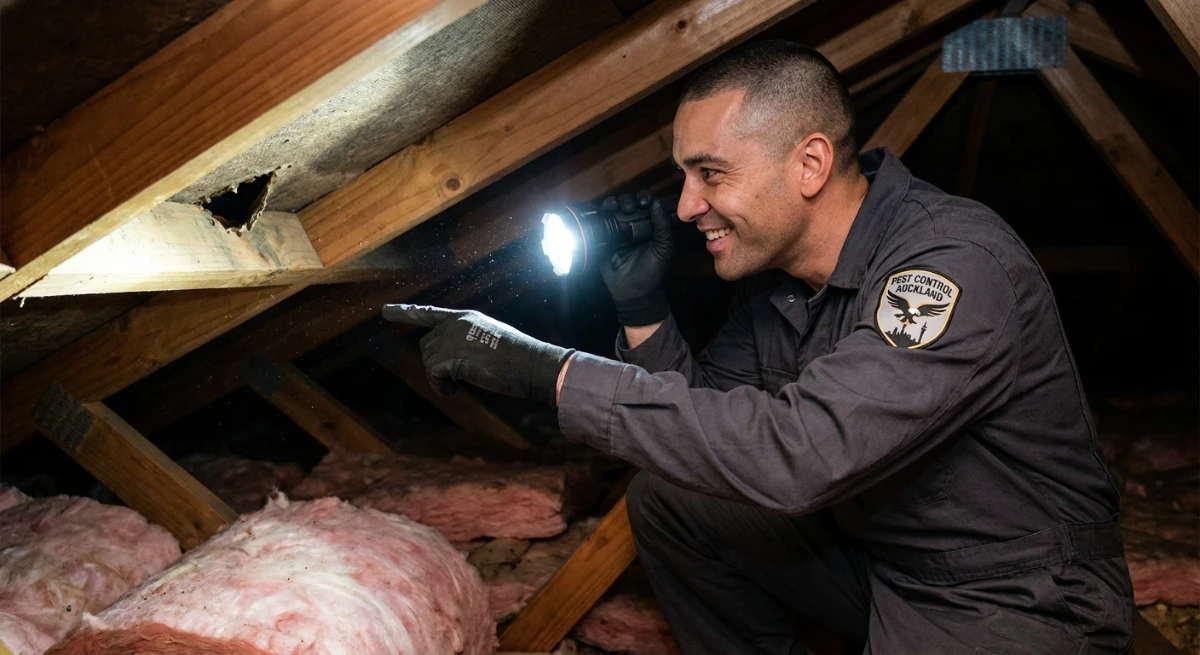
- Step 1: Root-Cause Identification. Rats can squeeze through a gap the size of your thumb. We meticulously inspect the perimeter, subfloor, and roofline to find the exact entry points.
- Step 2: Targeted Eradication. We deploy Class 9 Urban Pest Management pesticides and mechanical traps. These are handled exclusively by Level 3 qualified technicians to ensure absolute safety for your family and pets.
- Step 3: Structural Exclusion. Once the current population is cleared, we advise on blocking the holes permanently. If they cannot get inside, they cannot nest.
We call this the Silver Bullet Guarantee. We fix the immediate problem, and we give you the exact blueprint to ensure it never happens again.

Environmental Wins: The Hūnua Ranges Success
Broad-scale pest control in Auckland is seeing massive success right now. It proves that targeted, scientific methods work when executed correctly. Look at the late-2025 aerial 1080 drop in the Hūnua Ranges.
Before the operation, rat tracking indexes were sitting at a staggering 90% to 100%. After the targeted drop, those numbers plummeted to just 1.3%. This massive reduction gives our native birds, like the kōkako, a fighting chance to breed safely without predation.
While regional drops manage the deep bush, urban fringe properties still require localized, professional trapping to stop the spillover. If you live near a reserve, you are on the frontline of this battle.
The Future of Pest Control: FAOPMA 2026
The pest management industry is evolving fast. In July 2026, Auckland is hosting the FAOPMA Pest Summit at the NZICC. The theme is “FutureProof: Smarter Pest Solutions for a Rapidly Changing World.”
We are moving away from reactive, toxic methods and stepping firmly into the era of digital transparency. Smart monitoring, IoT-enabled traps, and zero-emission treatments are becoming the new standard for commercial sites.
When you hire us, you are getting a team that stays ahead of these global trends. We bring world-class, comprehensive rodent management in Auckland straight to your doorstep, ensuring your property is protected for the long haul.
Don’t wait for the scratching to start. Ask us about our seasonal subscription plans. We set up an external perimeter defense before the winter chill drives rodents indoors.
People Also Ask (FAQ)

About the Author: Ronnie
Founder, Pest Control Auckland · Commercial & Residential Pest Expert · Certified Urban Pest Management Specialist
With years of experience managing complex infestations across the region, Ronnie is the definitive expert on Comprehensive Rodent Management in Auckland Homes & Businesses. Having consulted for major hospitality groups and handled strict MPI compliance audits, he combines scientific exclusion methods with straight-talking, practical advice to protect your property permanently.