Got hollow-sounding wood or strange mud tubes in your Auckland property? We need to figure out exactly what is eating your house, and we need to do it fast. Most people think New Zealand is too cold for termites, but that is simply not true.
Think you have termites? We will inspect the timber, identify the exact species, and either treat the native bugs or escalate the issue for immediate biosecurity eradication. We do not guess when your home’s structural integrity is on the line.
Understanding Termites in Auckland: Detection & Structural Threat is crucial because the longer these insects are left alone, the more expensive the repair bill becomes. Let us walk through exactly what you are dealing with and how we fix it.
Key Takeaways
Termites in Auckland are a real threat, primarily from invasive species like Australian subterranean termites. Early detection of mud tubes and hollow wood is critical. While native termites rarely cause major damage, invasive species require immediate MPI notification and professional baiting to prevent catastrophic structural failure.
The Reality of Termites in Auckland
Let us clear up a common myth right now: New Zealand does have termites. While we do not have the massive, house-destroying swarms seen in Australia on a daily basis, Auckland’s humid climate is highly hospitable to them.
The mild winter and hot summer we experienced heading into 2026 created perfect breeding conditions for wood-boring insects. We are seeing a surge in pest activity across the Auckland region, and timber pests are no exception.
In fact, Biosecurity New Zealand continuously monitors for exotic termite incursions. As recently as February 2026, exotic termites were intercepted on boats arriving from overseas. When these pests make it onto dry land, they target house framing, retaining walls, and fences.
Native vs. Invasive Termite Species
Not all termites are created equal. When managing termites in Auckland, the first thing we do is determine if the species is native or invasive.
New Zealand has three native termite species, such as the New Zealand Drywood Termite (Kalotermes brouni). These guys form small colonies and generally stick to rotting, damp wood. They rarely cause major structural damage unless your home already has severe moisture issues.
The real danger comes from exotic invaders. Species like the Australian subterranean termite (Coptotermes) and the West Indian drywood termite are highly destructive. They can live in a wooden structure for up to five years before they are detected, hollowing out load-bearing timber from the inside.
| Feature | Native NZ Termites | Invasive Exotic Termites |
|---|---|---|
| Colony Size | Small (hundreds) | Massive (up to a million) |
| Preferred Wood | Damp, rotting timber | Sound, dry structural framing |
| Structural Threat | Low to Moderate | Catastrophic |
| Regulatory Action | Standard pest control methods | Mandatory MPI eradication |
Exotic termites are classified as an unwanted pest under New Zealand biosecurity laws. If we suspect an invasive species during an inspection, we are legally obligated to notify the Ministry for Primary Industries (MPI) immediately on 0800 80 99 66.
Detection: How to Spot the Threat
You will rarely see a live termite walking across your kitchen floor. They despise light and open air, meaning they do their worst work entirely out of sight.
Effective termite detection relies on spotting the subtle signs they leave behind. If you are inspecting your own property, you need to know exactly what to look for before the damage becomes irreversible.
Here is what a professional pest technician looks for when assessing a property for timber pests.
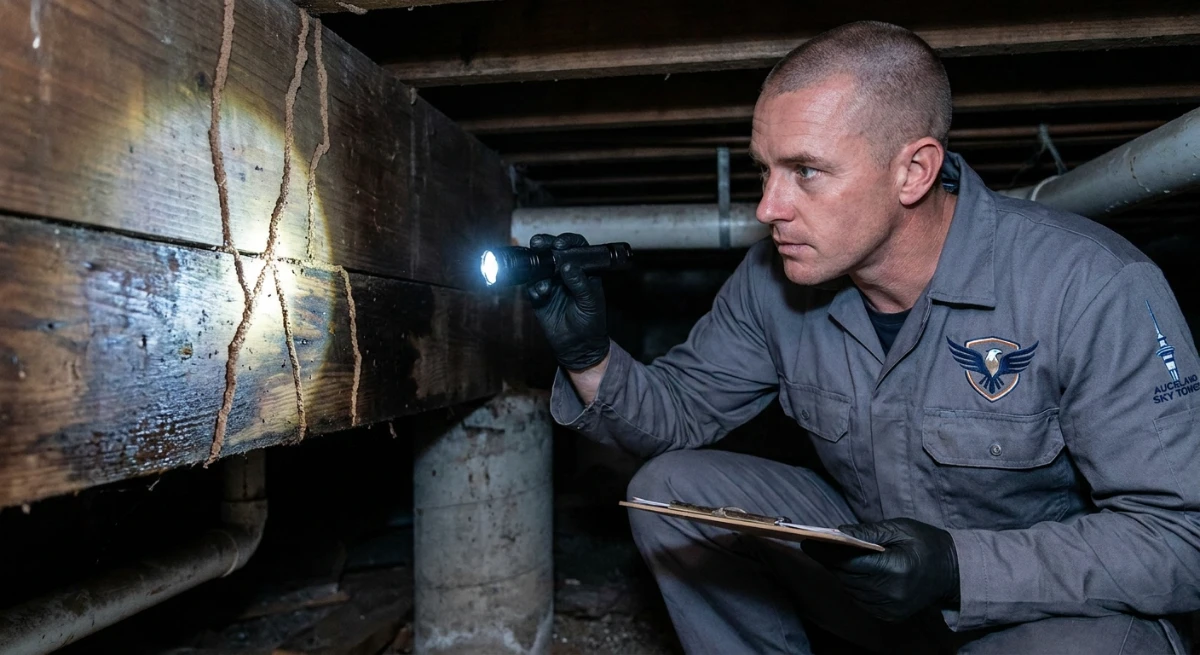
- Mud Tubes: Subterranean termites build pencil-sized mud tubes running up foundation walls to access timber without exposing themselves to the light.
- Hollow-Sounding Wood: Because they eat wood from the inside out, infested timber will sound hollow and papery when tapped with a screwdriver handle.
- Frass (Termite Droppings): Drywood termites push their feces out of tiny kick-out holes. It looks like small piles of sawdust or coffee grounds near skirting boards.
- Discarded Wings: After a mating flight, reproductive termites shed their wings. Finding piles of identical wings on windowsills is a massive red flag.
People often confuse flying ants with termites. Termites have straight antennae, a thick waist, and wings of equal length. Ants have bent antennae, a pinched waist, and uneven wings.
The Structural Threat & Repair Costs
When assessing Termites in Auckland: Detection & Structural Threat, the financial risk is the biggest concern. Termites do not just make a mess; they compromise the load-bearing integrity of your home.
If left unchecked, a mature colony can consume significant amounts of structural timber. By the time a homeowner notices sagging floors or jammed doors, the framing is often completely ruined.
The cost difference between proactive detection and reactive rebuilding is staggering. A standard professional pest inspection in Auckland costs between $210 and $285. In contrast, replacing a subfloor or roof structure destroyed by timber pests can easily exceed $20,000 to $30,000.
Never buy an older Auckland villa or bungalow without a dedicated timber pest inspection. Standard building inspectors often miss early signs of borer and termites in the subfloor.
Professional Treatment & Biosecurity Protocols
If you find signs of termites, do not spray them with hardware store bug spray. This is a critical mistake. Spraying only kills the few workers you can see and causes the rest of the colony to retreat deeper into the structure.
Professional termite detection and treatment relies on the science of Integrated Pest Management (IPM). We use non-chemical monitoring stations and highly specific baiting systems.
The termites consume the bait and carry it back to the nest, sharing it with the colony and the queen. This process takes time—usually one to several months—but it ensures complete root-cause eradication rather than a temporary fix.
Furthermore, our operations align strictly with the EPA HPC Notice 2017 and the HSNO Act 1996. Handling these treatments requires a Level 3 Qualified Urban Pest Management Contractor to ensure the safety of your family, pets, and the local environment.

Why Choose Pest Control Auckland?
We are not a faceless corporate franchise that sprays and walks away. We are a family-owned, certified local team that focuses on scientific eradication.
If you are dealing with timber pests, you get our “Silver Bullet Guarantee.” We identify the exact entry points, apply targeted, MPI-approved treatments, and give you honest advice on structural exclusion to stop them from coming back.
Auckland is preparing to host the FAOPMA Pest Summit in July 2026, highlighting the need for smarter, future-proof pest solutions. We are already delivering that standard to Auckland homeowners every single day.
The 2026 FAOPMA Pest Summit in Auckland focuses on “FutureProof: Smarter Pest Solutions.” This aligns perfectly with our shift away from toxic sprays toward predictive, eco-conscious Integrated Pest Management.
Frequently Asked Questions

About the Author: Ronnie
Founder, Pest Control Auckland · Commercial & Residential Pest Expert · Certified Urban Pest Management Specialist
With years of experience in structural pest assessments across New Zealand, Ronnie is the definitive expert to write about Termites in Auckland: Detection & Structural Threat. Having consulted for local housing authorities and managed complex biosecurity interventions, his deep understanding of timber-destroying insects ensures homeowners get factual, science-backed advice.