Seeing an eight-legged shadow sprint across your living room wall usually triggers one of two reactions: a rolled-up newspaper or sheer panic. If you are dealing with spiders in your home, we will find out exactly how they are getting in, eliminate their food source, and flush them out—usually in one visit. You do not need to live in fear of every web you see.
As a straight-talking Auckland pest technician, I have seen it all. With the autumn 2026 pest surge pushing more insects indoors after last year’s mild winter, spiders are following their prey right into your house. But before you start panic-buying DIY bug bombs, you need to know exactly what you are looking at.
The truth is, 99% of the spiders you encounter in New Zealand are completely harmless. However, understanding the difference between Spiders in Auckland: Dangerous vs. Harmless Species is what separates a minor nuisance from a genuine health and safety hazard. Let us cut through the myths and look at the facts.
Key Takeaways
When comparing Spiders in Auckland: Dangerous vs. Harmless Species, only the Katipō and Redback are medically dangerous, though rarely found indoors. The common White-Tailed spider causes painful bites but does not cause flesh-eating ulcers. Most indoor spiders, like the Black House spider, are completely harmless.
The Venomous Few: Truly Dangerous Spiders
When discussing dangerous spiders in Auckland, the list is incredibly short. New Zealand is geographically isolated, meaning we bypassed the evolutionary arms race that gave Australia its terrifying arachnids. We only have two spiders that are considered medically significant to humans.
Neither of these spiders are common house guests in suburban West Auckland or the North Shore. They prefer specific outdoor habitats and generally want absolutely nothing to do with you. Let us look at the two culprits that actually warrant caution.
The Native Katipō Spider (Latrodectus katipo)
The Katipō is New Zealand’s only native venomous spider. It is a small, black spider famous for the distinctive red stripe running down the back of the female. However, your chances of finding one in your Auckland home are practically zero.
Katipō are strictly coastal dwellers. They build their webs in sand dunes, under driftwood, or deep within marram grass along the beach. Their populations are actually in decline due to habitat loss, making them a rare sight even for pest controllers.
If you do manage to get bitten, the venom causes extreme pain, sweating, and systemic distress. Fortunately, an effective antivenom exists, and bites are incredibly rare. We do not exterminate protected native wildlife, so if you spot one on a beach walk, simply leave it alone.
The Introduced Redback Spider (Latrodectus hasselti)
The Australian Redback hitched a ride to New Zealand years ago and has established small pockets of populations. With warming climates and the movement of freight, they occasionally pop up in Auckland’s industrial and residential zones.
Redbacks look very similar to the Katipō, featuring a black, pea-shaped abdomen with a prominent red hourglass or stripe. Unlike the Katipō, Redbacks are highly adapted to urban environments and will nest in dry, sheltered spots like old tires, stacked firewood, or under outdoor furniture.
If you suspect a Redback or Katipō bite, do not panic, but seek immediate medical attention. Wash the area with soapy water and apply an ice pack to reduce pain. Do not apply pressure bandages, as this worsens the venom’s local effects.
The White-Tailed Spider: Myth vs. Reality
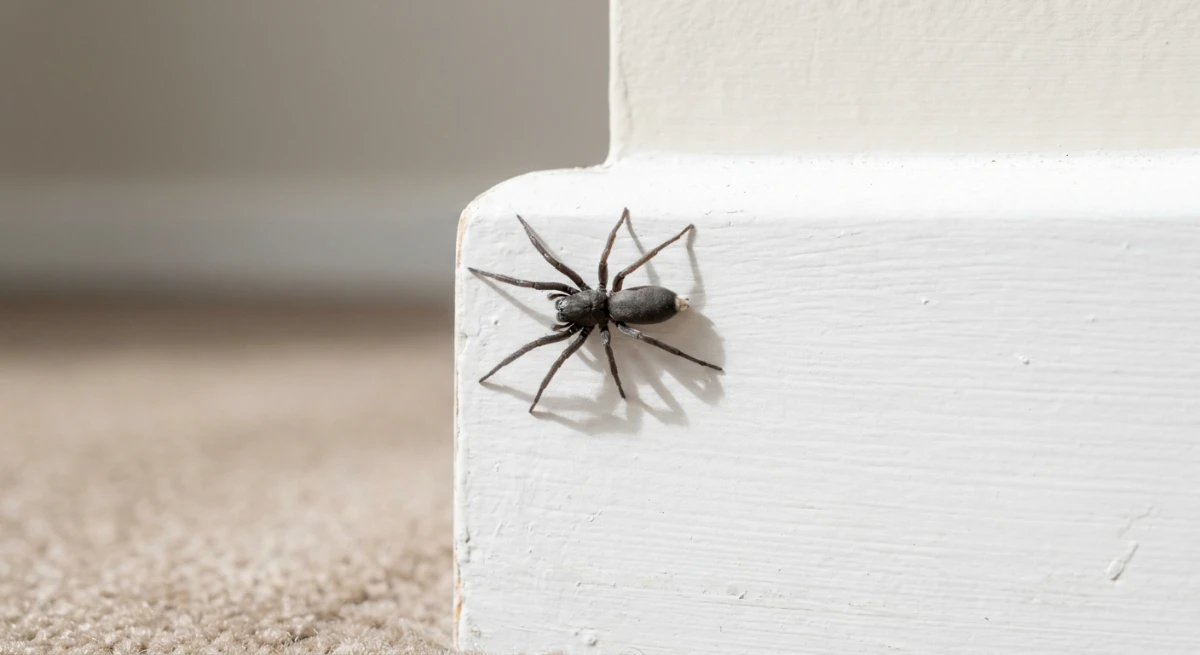
If there is one spider that dominates the conversation about spiders in Auckland, it is the White-Tailed spider (Lampona cylindrata). Originally from Australia, this hunting spider is now incredibly common in Auckland homes, particularly during the warmer months and into autumn.
White-tails are easy to identify. They have a dark, elongated, cigar-shaped body with a distinct white patch at the very tip of their abdomen. You will usually find them walking across the floor, lurking in the folds of curtains, or hiding in piles of clothes left on the floor.
The Flesh-Eating Bite Myth
For decades, the White-Tail has been blamed for causing necrotic ulcers—massive, festering wounds where the skin essentially rots away. If you scroll through local community Facebook pages, you will inevitably see horrifying pictures attributed to White-Tail bites.
Here is the straight truth from a scientific standpoint: it is a myth. A comprehensive 2003 Australian study investigated 130 confirmed White-Tail bites. While 100% of the victims experienced pain, redness, and swelling, exactly zero developed necrotic ulcers.
The severe infections often blamed on White-Tails are usually caused by secondary bacterial infections (like Staph). When a spider punctures your skin, bacteria from your skin or the spider’s fangs enter the wound. If you scratch it, it gets infected. Wash all spider bites immediately with antiseptic.
Why They Are in Your House
White-Tails do not build webs to catch their food. They are active, nomadic hunters. What do they eat? Other spiders. If you have a White-Tail problem in your home, it means you actually have a different pest problem providing their food source.
They are particularly fond of the Black House spider. If your window frames are covered in messy, funnel-like webs, you are essentially laying out a buffet for White-Tails. To get rid of the hunters, we have to eliminate the prey.
Harmless Spiders You Will See in Auckland
When categorizing harmless spider species in Auckland, we are looking at the vast majority of our eight-legged residents. These spiders might look intimidating, but they lack the venom capacity or fang strength to cause you any real harm.
In fact, many of these spiders are highly beneficial. They act as nature’s pest controllers, quietly stringing up mosquitoes, flies, and moths while you sleep. Here are the ones you will likely encounter.
The Black House Spider (Badumna insignis)
This is the messy roommate of the spider world. The Black House spider builds dense, lacy, funnel-shaped webs around window frames, under eaves, and in the corners of your garage. They are dark, robust spiders that rarely leave their webs.
While they can bite if heavily provoked, the bite is mild and comparable to a bee sting. Their main crime is making the exterior of your house look unkempt and attracting hungry White-Tails.
The Avondale Spider (Delena cancerides)
Made famous by the movie Arachnophobia, the Avondale spider is a type of Australian huntsman that established a colony in the Auckland suburb of Avondale in the 1920s. They are large, flat, and undeniably terrifying to look at, with leg spans reaching up to 200mm.
Despite their size and incredible speed, they are entirely harmless. They are timid spiders that prefer to hide under the loose bark of wattle trees. Occasionally, they wander indoors, but they would much rather run away from you than bite.
Daddy Long Legs (Pholcus phalangioides)
You know this one. It has a tiny body and ridiculously long, fragile legs. They build loose, disorganized webs in the upper corners of rooms, behind doors, and in sheds. They are completely non-toxic to humans.
There is an old urban legend that Daddy Long Legs have the most potent venom in the world but fangs too small to pierce human skin. This is entirely false. Their venom is weak, and they pose zero threat to you or your pets.
2026 Auckland Spider Encounter Data
To give you a clear picture of what Aucklanders are actually dealing with, we track the types of spiders our technicians are called out for. As expected, the perceived threat rarely matches the actual biological threat.
The data clearly shows that nuisance web-builders and the nomadic White-Tails make up the vast majority of residential pest control callouts in the Auckland region.
Why the Autumn 2026 Surge is Driving Spiders Indoors
If you feel like you are seeing more spiders than usual this year, you are not imagining it. Auckland experienced a remarkably mild winter last year, followed by a hot, humid summer. This created perfect breeding conditions for insect populations.
Now, as we move deep into the autumn of 2026, the temperatures are dropping rapidly. Insects are seeking shelter and warmth inside your roof cavities, wall voids, and living spaces. The spiders are simply following the food.
Walk around your house and check the weather stripping on your doors and windows. Spiders do not need much room to squeeze through. Sealing these gaps is the first step in effective physical exclusion.
Professional Control vs. DIY Failures
When faced with spiders, many homeowners head straight to the hardware store for automatic bug bombs. We call this the DIY Cycle of Despair. Bug bombs release a chemical mist that settles on surfaces, but it rarely penetrates the deep cracks, crevices, and roof voids where spiders actually hide.
Furthermore, spiders do not groom their legs like insects do. When an ant walks across a sprayed surface, it cleans its legs and ingests the poison. A spider walks on the tips of its claws and rarely ingests surface residue, making generic sprays largely ineffective against them.
The Science of Eradication
At Pest Control Auckland, we do not just spray and pray. Under the EPA HPC Notice 2017 and the HSNO Act 1996, the handling of highly effective, targeted pesticides requires serious certification. Our technicians are Level 3 Qualified Urban Pest Management (UPM) Contractors.
We use targeted, zero-emission treatments that are MPI-approved. This means we can safely treat your home without putting your children, pets, or the local environment at risk. We target the nesting sites, eliminate the prey insects, and lay down an invisible barrier that spiders cannot cross.

Industry Leadership and Smart Tech
The pest control industry is moving away from toxic overuse and toward Predictive Integrated Pest Management (IPM). This July, Auckland is hosting the FAOPMA 2026 Pest Summit at the NZICC, themed FutureProof: Smarter Pest Solutions.
We are already implementing these smarter solutions. By understanding the biology of the pests and combining safe chemical applications with structural exclusion advice, we solve the problem at the root. We do not just kill the spiders you see; we stop the next generation from moving in.
Spider Identification & Risk Table
To help you quickly identify what is crawling on your wall, we have compiled this straightforward comparison matrix. Use this to determine if you need to take immediate action or simply scoop the spider into a cup and put it outside.
| Spider Species | Appearance | Typical Habitat | Risk Level |
|---|---|---|---|
| Katipō | Small, black, red stripe on back (females). | Coastal sand dunes, under driftwood. | High (Venomous, seek medical care). |
| Redback | Black, red hourglass on abdomen. | Dry sheltered areas, woodpiles. | High (Venomous, seek medical care). |
| White-Tail | Dark grey/brown, distinct white tip. | Indoors, bedding, clothing, skirting boards. | Moderate (Painful bite, wash to prevent infection). |
| Black House | Dark, robust, messy funnel webs. | Window frames, eaves, fences. | Low (Mild bite, mostly a nuisance). |
| Avondale | Large, flat, brown (huntsman type). | Under tree bark, occasionally indoors. | None (Harmless, very timid). |
Protecting Your Home: The IPM Approach
Eradicating spiders is only half the job. Keeping them out requires a strategic approach. We focus heavily on structural entry-point exclusion and environmental management.
To drastically reduce the number of spiders entering your home, you need to implement these foundational Integrated Pest Management (IPM) strategies:
- Remove exterior clutter: Keep firewood, compost bins, and dense vegetation at least a meter away from your home’s foundation to remove hiding spots.
- Control interior moisture: Fix leaky pipes and use dehumidifiers. Many insects (spider food) are drawn to damp environments.
- Change your lighting: Swap bright white exterior bulbs for yellow bug lights to stop attracting the flying insects that spiders feed on.
- Seal the envelope: Install tight-fitting weather stripping around all exterior doors and caulk cracks around window frames.
Regularly use a broom to sweep away webs around your exterior windows and eaves. This disrupts the habitat of the Black House spider, which in turn removes the primary food source that attracts White-Tails indoors.
Our Silver Bullet Guarantee
We know how frustrating it is to pay for a service, only to see the pests return a week later. As a local, family-owned business, we stake our reputation on doing the job right the first time.
That is why we offer our Silver Bullet Guarantee. If you book an interior and exterior spider treatment with us, we guarantee our work. We will find how they are getting in, block it, and clear them out with child and pet-safe methods.
People Also Ask (FAQ)

About the Author: Ronnie
Founder, Pest Control Auckland · Commercial & Residential Pest Expert · Certified Urban Pest Management Specialist.
With years of hands-on experience protecting Auckland homes and strict adherence to the EPA HPC Notice 2017, Ronnie is the definitive expert to write about Spiders in Auckland: Dangerous vs. Harmless Species. Having successfully managed countless urban pest surges, his scientific, root-cause exclusion methods guarantee long-term safety for families and pets across the region.