Got a humming noise vibrating through your bedroom wall, or a constant stream of yellow insects darting under your eaves? When it comes to wasps and bees in Auckland, nest removal and safety is our top priority. We will find the entry point, neutralise the nest safely, and seal it up. Usually, it takes just one visit.
There is no room for panic, but there is also no time for hardware store DIY experiments. Wasps in a confined space are aggressive, and their nests can rot through your gib board if left unchecked. You need a fast, definitive solution to reclaim your home.
If it is a honey bee swarm, we handle things differently. We partner with local Auckland beekeepers for safe relocation whenever possible. But if they are deep inside a structural cavity posing an immediate hazard to your family, we have the Class 9 certified methods to resolve it safely.
Key Takeaways
Professional wasp and bee nest removal in Auckland requires identifying the species first. We eradicate aggressive German wasps and invasive hornets instantly using certified, zero-emission treatments. For honey bees, we prioritize safe relocation with local beekeepers. Never block a nest entry point yourself, as trapped insects will chew through your interior walls.
Wasps vs. Bees: Knowing Your Enemy
The first step is identifying exactly what is flying around your property. We get calls every day from homeowners panicking over a massive bee nest, which turns out to be German wasps. Knowing the difference dictates our entire approach.
Bees are generally fuzzy, golden-brown, and relatively docile unless provoked. They are crucial pollinators for our ecosystem. When they swarm, they look for a temporary resting place before finding a permanent home.
Wasps, on the other hand, are bright yellow and black, smooth, and highly aggressive. They do not die after stinging, meaning a single wasp can sting you multiple times. In New Zealand, German and Common wasps are classified as serious pests under the Auckland Regional Pest Management Plan (RPMP).
The Yellow-Legged Hornet Threat
As of May 2026, Biosecurity New Zealand is actively managing a severe biosecurity alert regarding the Yellow-Legged Hornet. Recent detections in Glenfield and the wider North Shore have put the industry on high alert.
These invasive hornets are much larger than common wasps and have distinctive dark legs with bright yellow tips. They are aggressive honeybee predators and pose a massive threat to local agriculture. If established, they could devastate the local ecosystem.
If you spot a suspected Yellow-Legged Hornet, do not approach it. This is a strict biosecurity issue. Snap a photo from a safe distance and report it to MPI immediately on 0800 80 99 66.
Do not attempt to exterminate suspected Yellow-Legged Hornets yourself. They are highly aggressive and fall under strict MPI biosecurity eradication protocols. Report sightings immediately.
Why Wasp Nests in Auckland Are a Major Hazard
A wasp nest hidden inside your wall cavity is not just a stinging hazard; it is a structural nightmare. Nests generate a massive amount of moisture as the colony grows. This is a fact most homeowners completely overlook until the damage is done.
Over time, this moisture seeps directly into your gib board. We have seen interior walls turn into wet blotting paper, eventually collapsing and leaving a dinner-plate-sized hole straight into the living room. Repairing this kind of structural damage costs thousands.
Furthermore, the health risks are severe. Wasp venom can cause anaphylactic shock, a life-threatening allergic reaction. You do not want these pests establishing a stronghold near where your children or pets play. Removing them quickly is non-negotiable.
Our Approach to Nest Removal & Safety
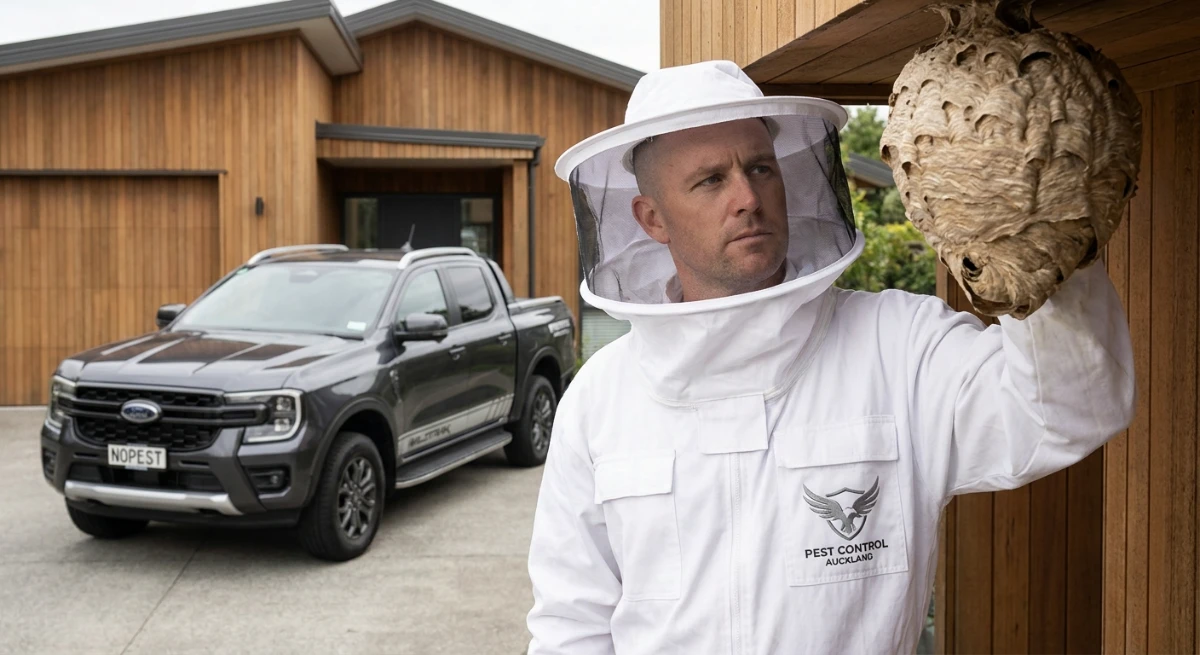
When you hire us for pest control in West Auckland, you are not getting a guy with a can of fly spray. We use a scientific, root-cause eradication approach. We treat the source, not just the symptoms flying around your deck.
Our technicians hold the New Zealand Certificate in Pest Operations (Level 3) and operate strictly under the EPA HPC Notice 2017 and HSNO Act 1996. This means we are fully qualified to handle Class 9 Urban Pest Management pesticides safely.
We arrive, locate the primary entry point, and apply a targeted, zero-emission insecticidal dust directly into the cavity. As the wasps return, they carry the treatment deep into the nest, wiping out the queen and the entire colony within hours. It is highly effective and completely safe for your family.
We back our wasp eradication with our Silver Bullet Guarantee. We find the nest, we neutralise it, and if the colony survives, we return at no extra cost to finish the job.
The Cost and Process: What to Expect
We believe in straightforward, transparent pricing. You will not find hidden fees or bait-and-switch tactics here. We tell you exactly what it costs before we start.
A standard professional wasp nest removal for a residential home in Auckland is highly affordable compared to the structural damage a growing nest will cause. We assess the location, apply the treatment, and provide clear aftercare instructions. You are kept in the loop at every stage.
Attempting to remove a nest yourself using hardware store bombs often results in the DIY Cycle of Despair. The wasps simply retreat deeper into the cavity, forcing you to spend more money on professional extraction later. It is a false economy that puts you at risk of painful stings.
| Method | Safety Level | Effectiveness | Hidden Costs |
|---|---|---|---|
| Hardware Store Sprays | Low (High sting risk) | Poor (Only kills surface workers) | High (Structural damage, medical bills) |
| Pest Control Auckland | Very High (Class 9 Certified) | 100% (Root-cause eradication) | None (Upfront pricing, guaranteed) |
Bee Swarm Relocation: When We Call the Beekeepers
Bees are a completely different scenario. When a colony outgrows its space, the queen will leave with thousands of workers, forming a dense, humming cluster on a fence post or tree branch. It looks intimidating, but they are usually quite calm.
If you have a swarm like this, we do not exterminate them. Instead, we refer you to registered local beekeepers who provide safe bee relocation services. Protecting our pollinators is a priority for everyone in New Zealand.
However, if honey bees have established a mature hive deep inside your structural wall cavity, relocation is often physically impossible without tearing down the house. In these rare, high-risk cases where the hive poses a direct hazard to occupants, we provide safe, targeted extermination as a last resort. We balance environmental responsibility with human safety.
If you see a resting bee swarm, keep your distance and leave it alone. They are usually resting and will move on within 24 to 48 hours to find a permanent home.
Commercial Wasp Control: Protecting Your Business
It is not just residential homes that suffer from these stinging pests. Cafes, restaurants, and childcare centres across Auckland are highly vulnerable to wasp infestations during the warmer months. A single wasp sting on a customer can lead to severe reputational damage.
For commercial entities, maintaining a pest-free environment is a strict legal requirement under the Food Act 2014 and MPI standards. You cannot afford to have wasps hovering around outdoor dining areas or nesting near your commercial bins. It drives customers away instantly.
We provide discreet, highly effective commercial wasp management. Our zero-emission treatments ensure that your business remains compliant and safe for patrons. We also offer ongoing preventative advice to stop queens from establishing nests on your premises in the future.
Commercial food premises must ensure their pest control strategies align with the Food Act 2014. We provide full documentation and zero-emission treatments to keep your business fully compliant.
The Lifecycle of a Wasp Nest
Understanding how a wasp nest develops helps explain why early intervention is so critical. In early spring, a single fertilised queen emerges from hibernation. She starts building a small, golf-ball-sized nest from chewed wood fibres and saliva.
Once her first batch of worker wasps hatches, they take over the nest-building and foraging duties. The queen then stays inside, doing nothing but laying eggs. By late summer and early autumn, the nest can house thousands of aggressive workers.
This is exactly why the May 2026 pest surge is so severe. These nests have had months to grow unchecked. By the time you notice the constant flight path under your eaves, you are likely dealing with a massive colony that requires immediate professional extraction.
Landlord and Tenant Responsibilities
Disputes over who pays for pest control are common under the Residential Tenancies Act. When dealing with an active nest, the responsibility usually falls on the landlord to provide a safe, habitable environment. You cannot expect a tenant to handle a Class 9 ecotoxic situation.
If a nest is discovered, landlords need a rapid response to prevent minor tenant complaints from escalating to the Tenancy Tribunal. We provide clear, transparent documentation that satisfies all legal requirements and proves the property has been professionally treated.
Tenants, on the other hand, must report suspected nests immediately. Delaying the report allows the colony to grow, leading to the severe structural moisture damage we discussed earlier. Prompt communication is the key to minimizing both risk and cost.
Auckland Pest Trends: May 2026 Data
The autumn of 2026 has seen a massive surge in urban pests. Following a mild winter and a blazing hot summer, wasp populations across West Auckland and the North Shore have exploded. We are seeing record numbers of callouts for aggressive nests.
We are actively tracking these trends to ensure our rapid response teams are deployed exactly where they are needed. Predictive Integrated Auckland pest management is the future of keeping homes safe. We don’t just react; we anticipate where the next problem will arise.
This data-driven approach is exactly what industry leaders will be discussing when Auckland hosts the FAOPMA Pest Summit in July 2026. As the market shifts away from toxic blanket sprays, smart, targeted interventions are becoming the gold standard. We are proud to be at the forefront of this shift.
Safety First: What to Do While You Wait
If you have discovered a nest, your immediate priority is keeping your family and pets safe until we arrive. Do not poke the nest with a broom, and do not try to drown it with a garden hose. Agitating the colony will only trigger a defensive swarming response.
The most critical mistake you can make is blocking the entry point. If you seal the hole on the exterior of your house, the trapped wasps will simply chew their way backward through your gib board and emerge directly into your living room. We see this happen far too often.
Keep windows and doors near the nest closed. Ensure children and pets are kept strictly indoors or well away from the flight path of the insects. Wait for our qualified technicians to arrive and resolve the issue professionally.
- Stay Calm: Sudden movements provoke defensive strikes.
- Identify the Flight Path: Watch where they are entering and exiting, but keep your distance.
- Do Not Block the Hole: Trapped insects will chew into your home’s interior.
- Call the Experts: Let our Level 3 certified technicians handle the risk.
Frequently Asked Questions
When dealing with wasps and bees in Auckland, property owners naturally have a lot of questions. Here are the most common concerns we address out in the field.

About the Author: Ronnie
Founder, Pest Control Auckland · Commercial & Residential Pest Expert · Certified Urban Pest Management Specialist
With years of experience operating under the strict HSNO Act 1996 and holding a Level 3 NZ Certificate in Pest Operations, Ronnie is the definitive expert to write about “Wasps & Bees Auckland: Nest Removal & Safety”. Having personally neutralised hundreds of high-risk structural nests across West Auckland, he provides straight-talking, scientifically backed advice that prioritizes long-term safety over quick fixes.