We recently had a callout to a beautifully restored villa in Ponsonby. The owners were at their wits’ end, having spent hundreds on hardware store bug bombs, only to find rats still having a field day in their ceiling cavity. It is a classic example of the “DIY Cycle of Despair.” They wanted the pests gone, but they were terrified of using toxic chemicals around their golden retriever and their newborn.
This is the reality for most families in our city today. Following a mild winter and a scorching summer last year, the autumn of 2026 has brought an unprecedented surge of rodents and insects indoors. Aucklanders are rightfully demanding better solutions. They want Sustainable Pest Prevention for an Eco-Friendly Auckland, prioritizing safety, science, and long-term results over cheap, toxic band-aids.
We do not just spray and walk away. That is a mug’s game. True pest management requires a deep understanding of local ecology, strict adherence to biosecurity laws, and a commitment to fixing the root cause of the infestation.
Key Takeaways
Achieving Sustainable Pest Prevention for an Eco-Friendly Auckland requires a shift from toxic surface sprays to Integrated Pest Management (IPM). By focusing on structural exclusion, utilizing non-toxic monitoring, and adhering to strict NZ biosecurity laws, we ensure long-term eradication that keeps your family, pets, and the environment perfectly safe.
The 2026 Autumn Pest Surge in Auckland
If you have noticed more ants in the kitchen or heard scratching in the walls lately, you are not imagining things. The climate in New Zealand has been highly conducive to pest breeding over the last twelve months.
A remarkably mild winter followed by a hot, humid summer created the perfect storm. Now that autumn temperatures have dropped, those massive outdoor populations are aggressively seeking shelter and food sources inside our homes and businesses.
This seasonal migration makes proactive pest control in Auckland an absolute necessity. Waiting until you see a rat scurrying across the floor means the infestation is already well established in the hidden cavities of your property.
Breaking the DIY Cycle of Despair
When faced with a sudden infestation, the first instinct for many is to rush to the hardware store. They grab a handful of bug bombs and chemical sprays, hoping for a quick fix.
Unfortunately, these over-the-counter products rarely penetrate deep into nesting areas. They kill a few stragglers on the surface, leaving the core colony completely untouched and ready to reproduce again.
Over-the-counter bug bombs often leave toxic residues on food preparation surfaces without actually reaching the nest. They scatter the pests deeper into your walls, making the eventual professional eradication much harder.
Strict Compliance and Biosecurity Laws
Professional pest management in New Zealand is not a free-for-all. We operate under some of the strictest environmental and biosecurity regulations in the world.
These laws are designed to protect our unique native ecosystems, ensure the humane treatment of animals, and safeguard public health. If your pest controller does not know these laws inside out, you need to show them the door.
The Animal Welfare Act 1999
A lot of well-meaning folks try to use live-capture traps to deal with roof rats, thinking it is the kinder option. However, the Animal Welfare Act 1999 is crystal clear on this matter.
If you set a live capture trap, you are legally obligated to physically inspect it within 12 hours after sunrise every single day. Leaving a trap unchecked is not just cruel; it is a serious legal offence.
This is why we strongly recommend professional intervention. We utilize highly efficient, humane eradication methods that comply entirely with national welfare standards, removing the legal burden from the homeowner.
Handling Class 9 Ecotoxic Substances
The days of indiscriminately spraying harsh chemicals are over. Under the EPA HPC Notice 2017 and the HSNO Act 1996, the use of Class 9 ecotoxic substances is heavily restricted.
Only a “Qualified UPM Contractor” holding the New Zealand Certificate in Pest Operations (Level 3) is legally permitted to handle these advanced treatments.
At Pest Control Auckland, our technicians hold these exact qualifications. We use MPI-approved, zero-emission treatments that target the biology of the pest without leaving harmful residues around your family.
Commercial Hygiene: Surviving the Food Act 2014
For our commercial clients in the hospitality sector, the stakes are incredibly high. New Zealand’s hospitality industry reached a record $15.99 billion turnover in FY2025, with Auckland holding nearly 30% of that market.
With that kind of volume, MPI health auditors are cracking down hard. A single pest sighting can result in catastrophic fines or immediate closure under the Food Act 2014.
Zero-Tolerance for Hospitality Pests
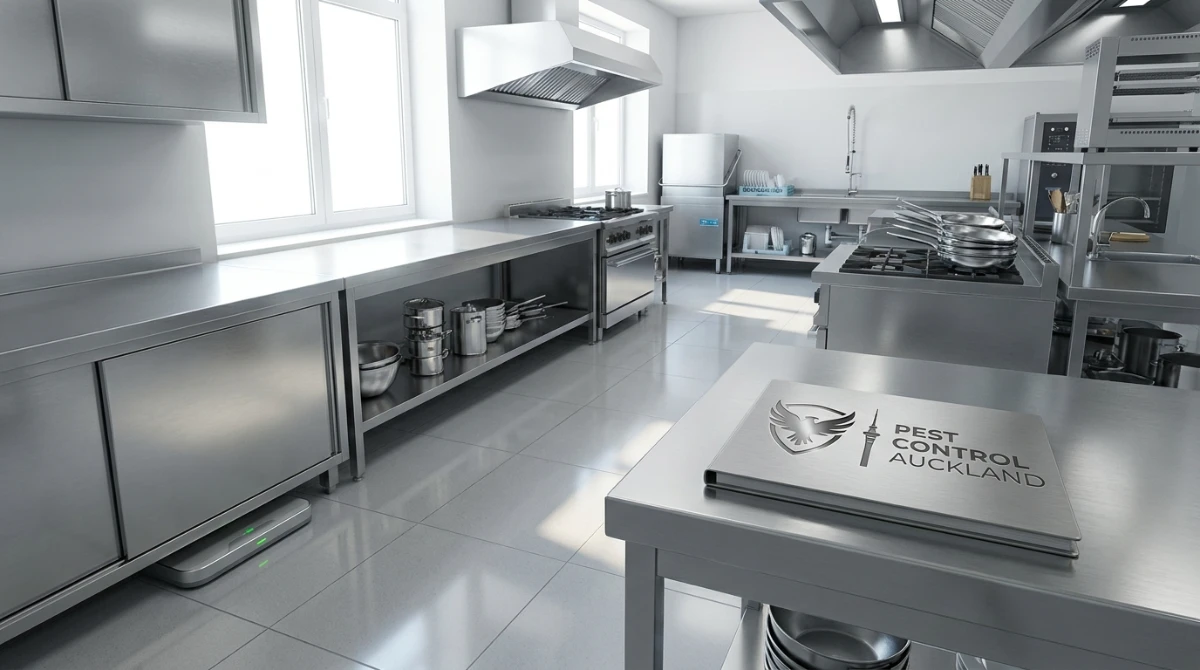
Under strict HACCP guidelines, commercial kitchens cannot simply throw toxic bait around. In sensitive food preparation zones, toxic rodenticides are strictly prohibited.
Instead, businesses must rely on non-toxic monitoring, mechanical traps, and rigorous structural exclusion. It requires a highly strategic approach to Integrated Pest Management.
Ensure all windows and doors have tight-fitting mesh screens. Remove cardboard boxes immediately, as cockroaches love the glue. Partner with a certified provider for monthly non-toxic monitoring.
The Data: Real Results in the Hūnua Ranges
To understand the power of targeted, scientific pest control, look no further than our own backyard. In late 2025, an extensive aerial 1080 operation was conducted across the Hūnua Ranges.
This was critical to protect nesting native birds like the kōkako. The results, published earlier this year, are absolutely staggering and prove that decisive action works.
Before the operation, rat activity was tracking at nearly 95 percent. Post-operation, that number plummeted to just 1.3 percent, comfortably beating the national safety benchmark of 3 percent.
Why the Hauraki Gulf Matters
This level of control is mandated by the Auckland Regional Pest Management Plan (RPMP) 2020-2030. The RPMP enforces strict pathway management to protect the Hauraki Gulf Controlled Area.
We all have a part to play. By keeping urban rodent populations down, we prevent them from hitching rides on ferries and invading pest-free sanctuaries like Waiheke and Aotea.
If you ever encounter a protected native bird stuck in your roof, remember that we do not exterminate or remove them. We provide immediate advice and referral to the Department of Conservation to ensure they are handled safely.
Sustainable Eradication vs. Temporary Fixes
If you are hearing a tap dance in your ceiling at 2 AM, you do not need a temporary fix. You need the entry points identified and permanently sealed.
This is the core philosophy behind Sustainable Pest Prevention for an Eco-Friendly Auckland. We focus on the environment outside and the structure itself, rather than just poisoning the interior.
The “Silver Bullet” of Structural Exclusion
We call it the “Silver Bullet Guarantee.” True peace of mind does not come from a spray can; it comes from knowing the physical building is secure.
By taking an entomological approach, our technicians assess the specific biology and behavior of the invading pest. We find the nest, block the highway, and eliminate the source.
Common Entry Points in Kiwi Homes
- Overhanging tree branches acting as a bridge to the roof.
- Damaged sub-floor ventilation grates.
- Gaps around exterior plumbing pipes and heat pump conduits.
- Poorly sealed garage doors and weather stripping.
If you can slide a standard HB pencil under your door or through a crack in the siding, a young mouse can squeeze through it. Seal these gaps with steel wool and expanding foam.
Comparing Pest Control Methods
When deciding how to protect your property, it helps to look at the facts. Let’s compare standard reactive treatments against our predictive, sustainable approach.
| Feature | DIY / Reactive Spraying | Sustainable IPM (Our Approach) |
|---|---|---|
| Primary Focus | Killing visible pests only | Root-cause exclusion and prevention |
| Chemical Usage | High volume, often toxic residues | Zero-emission, highly targeted micro-dosing |
| Long-Term Value | Low (Pests return quickly) | High (Backed by Silver Bullet Guarantee) |
| Commercial Compliance | Fails MPI Food Act audits | Fully compliant with HACCP standards |
The Future of Pest Management in New Zealand
The industry is evolving rapidly. We are moving away from the old days of “call us when you see a bug” toward predictive, subscription-based protection plans.
Smart digital traps and IoT-enabled monitoring stations are becoming the norm for commercial premises. These devices alert technicians the moment activity is detected, allowing for immediate intervention.
The FAOPMA Pest Summit 2026
This forward-thinking approach is exactly what will be discussed at the upcoming FAOPMA Pest Summit 2026. Hosted right here in Auckland at the NZICC from July 15-17.
Themed “FutureProof: Smarter Pest Solutions for a Rapidly Changing World,” the summit will bring the best minds in the Asia-Pacific together. We are proud to be part of an industry that takes innovation so seriously.
Staying ahead of the curve means constantly updating our skills. Our technicians are fully briefed on the latest global trends and zero-emission technologies being showcased at FAOPMA 2026.
Frequently Asked Questions (FAQ)

About the Author: Ronnie
Founder, Pest Control Auckland · Commercial & Residential Pest Expert · Certified Urban Pest Management Specialist
With years of experience in structural exclusion and biosecurity compliance, Ronnie is the definitive expert on Sustainable Pest Prevention for an Eco-Friendly Auckland. Having consulted for numerous commercial hospitality venues and residential property managers across the region, his approach bridges the gap between strict environmental regulations and practical, hard-hitting pest eradication.