Look, anyone can buy a cheap chemical bomb from Mitre 10 and blast their skirting boards. But when you are dealing with a persistent rat problem in a West Auckland rental or a cockroach infestation in a bustling CBD cafe, a quick surface spray just does not cut it. The “spray and walk away” days are officially over.
With the autumn pest surge hitting hard across the region, and the hospitality sector facing stricter Ministry for Primary Industries (MPI) audits than ever before, businesses and homeowners need a smarter approach. That is exactly where IPM Program Development: Custom Strategies for Auckland Clients comes into play.
We are talking about a scientific, root-cause methodology. Instead of just treating the symptoms, we focus on structural exclusion, identifying nesting areas, and long-term prevention. Whether you need robust pest control in West Auckland or comprehensive biosecurity for a commercial kitchen, an Integrated Pest Management (IPM) plan is the only way to guarantee lasting results.
Key Takeaways
Effective IPM Program Development: Custom Strategies for Auckland Clients shifts focus from reactive chemical spraying to predictive, root-cause eradication. By integrating structural exclusion, IoT monitoring, and zero-emission treatments, certified technicians ensure long-term compliance with the Food Act 2014 and the Auckland Regional Pest Management Plan 2020-2030.
The New Era of Auckland Pest Management
The landscape of pest control in New Zealand is shifting rapidly. In 2026, we are seeing a massive push towards sustainable, highly regulated biosecurity measures. The upcoming FAOPMA Pest Summit being held right here at the NZICC in July 2026 proves that Auckland is at the forefront of this global shift.
We have already seen massive successes locally. Following the intensive eradication efforts in the Hūnua Ranges, rat tracking dropped to an incredible 1.3%. That level of success does not happen by accident; it requires predictive, data-driven strategies [1].
For commercial businesses, the stakes have never been higher. New Zealand’s hospitality sector hit a record turnover of $15.99 billion in FY2025, with Auckland accounting for over 37% of that revenue. With that kind of money on the line, failing a health inspection because of a German cockroach sighting is simply not an option.
Hardware store bug bombs might kill the stray insects you see, but they do absolutely nothing to stop the nest hiding in your wall cavities. You are just treating the symptom while the root cause multiplies.
Core Pillars of an IPM Program
So, what exactly goes into IPM Program Development for Auckland clients? It is not a one-size-fits-all checklist. It is a tailored, multi-step process designed to outsmart the pests, not just out-poison them.
Root-Cause Eradication vs. Surface Spraying
Traditional pest control relies heavily on applying broad-spectrum chemicals and hoping for the best. An IPM approach is entomological. We study the pest’s behaviour, locate the primary nesting sites, and apply highly targeted, zero-emission treatments directly to the source.
This means less chemical exposure for your family, your pets, and your staff. It is a surgical strike rather than a carpet bomb.
Structural Exclusion & Environmental Management
If you do not close the door, the pests will just keep walking back in. A massive part of our Integrated Pest Management strategy involves structural exclusion. We identify the exact weep holes, broken vents, and roof gaps that rodents are using as a highway into your property.
We provide actionable advice on environmental management, too. Simple changes like managing overhanging tree branches, fixing leaky pipes, and securing food storage can drastically reduce your property’s appeal to urban pests.
Navigating Legal & Regulatory Standards
Operating in Auckland means playing by strict rules. The regulatory environment here is uncompromising, and rightly so. Our native ecosystems and public health depend on it [2].
The Food Act 2014 & HACCP
If you run a food business, the Food Act 2014 and HACCP guidelines strictly prohibit the use of toxic rodenticide bait inside sensitive food preparation areas. You cannot just throw rat bait behind the deep fryer and call it a day.
Instead, commercial IPM requires non-toxic monitoring stations, mechanical traps, and meticulous digital record-keeping to prove to MPI auditors that your premises are secure.
EPA HPC Notice 2017 & Level 3 Certification
Handling Class 9 (ecotoxic) substances in New Zealand is heavily restricted under the HSNO Act 1996. To apply these treatments legally, operators must be a “Qualified UPM Contractor.”
This requires holding the New Zealand Certificate in Pest Operations (Level 3). When you hire us, you are getting certified professionals who understand the chemistry and the law, ensuring absolute safety for your site.
Never let an uncertified operator handle pesticides on your property. Always ask to see their Level 3 Urban Pest Management credentials to ensure compliance and safety.
Custom IPM Strategies by Sector
A cafe in Ponsonby faces entirely different pest pressures than a residential rental in Henderson. That is why IPM Program Development: Custom Strategies for Auckland Clients must be tailored strictly to the environment.
Commercial Hospitality & Biosecurity
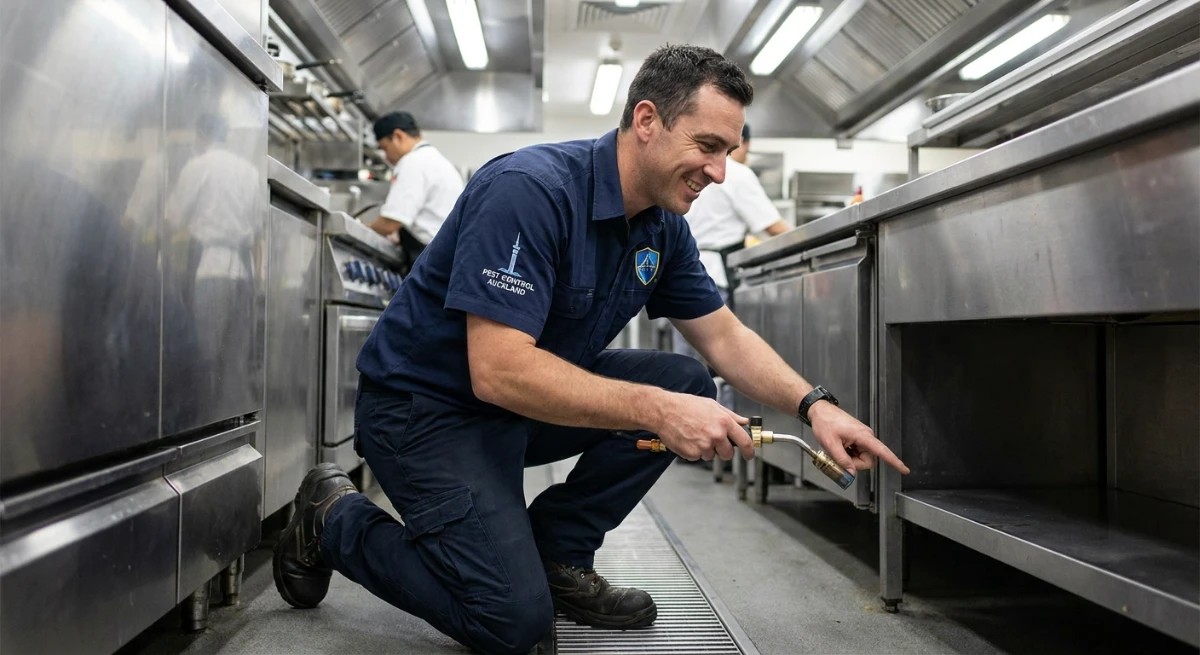
For restaurants and cafes, discretion and zero-downtime are critical. We implement IoT-enabled smart traps that alert us the moment a rodent is caught, allowing for immediate removal before staff or customers ever see a thing.
We also provide comprehensive “Healthy Homes” and “Commercial Biosecurity” compliance auditing. We generate the exact reports your MPI inspector wants to see, taking the stress completely off your shoulders.
Residential Homes & The Rental Market
For Auckland homeowners and landlords, the focus is on family safety and Tenancy Tribunal compliance. Disputes over who is responsible for pests—the landlord or the tenant—are incredibly common.
We provide clear, unbiased assessments. We offer an “Auckland Winter Defense” subscription plan that proactively proofs homes against rodents before the cold weather drives them indoors.
- End-of-Tenancy Flea Treatments: Fast, certified, and fully documented for property managers.
- Rodent Exclusion: Sealing roof voids and subfloors to stop the winter invasion.
- Argentine Ant Eradication: Targeting the super-colonies that standard sprays cannot touch.

Pricing & The Silver Bullet Guarantee
We believe in total transparency. The industry is notorious for hidden fees and bait-and-switch pricing. We bypass that nonsense by offering clear, upfront pricing based on the size of the property and the target pest.
Below is a baseline pricing guide for a standard 3-bedroom home in Auckland. Keep in mind, custom IPM commercial plans are quoted based on specific site audits.
| Target Pest | Standard Treatment Range | IPM Focus Area |
|---|---|---|
| Ants (incl. Argentine) | $160 – $200 | Nest location, non-repellent transfer baits |
| Cockroaches | $265 – $325 | Kitchen voids, moisture control, gel baiting |
| Rodents (Rats/Mice) | $155 – $325 | Roof/subfloor exclusion, secured bait stations |
| Bed Bugs | $215 – $265 per room | Deep crevice treatment, mattress isolation |
We back our science. If we treat your property and the target pests return within our specified warranty period, we come back and fix it. No arguments, no hidden call-out fees. Just honest Kiwi reliability.
People Also Ask (FAQ)

About the Author: Ronnie
Founder, Pest Control Auckland · Commercial & Residential Pest Expert · Certified Urban Pest Management Specialist.
With years of hands-on experience navigating Auckland’s strict regulatory environment, Ronnie is uniquely qualified to discuss IPM Program Development: Custom Strategies for Auckland Clients. Having consulted for major hospitality groups and resolved complex residential infestations across West Auckland, his scientific, root-cause approach ensures long-term compliance and complete peace of mind.