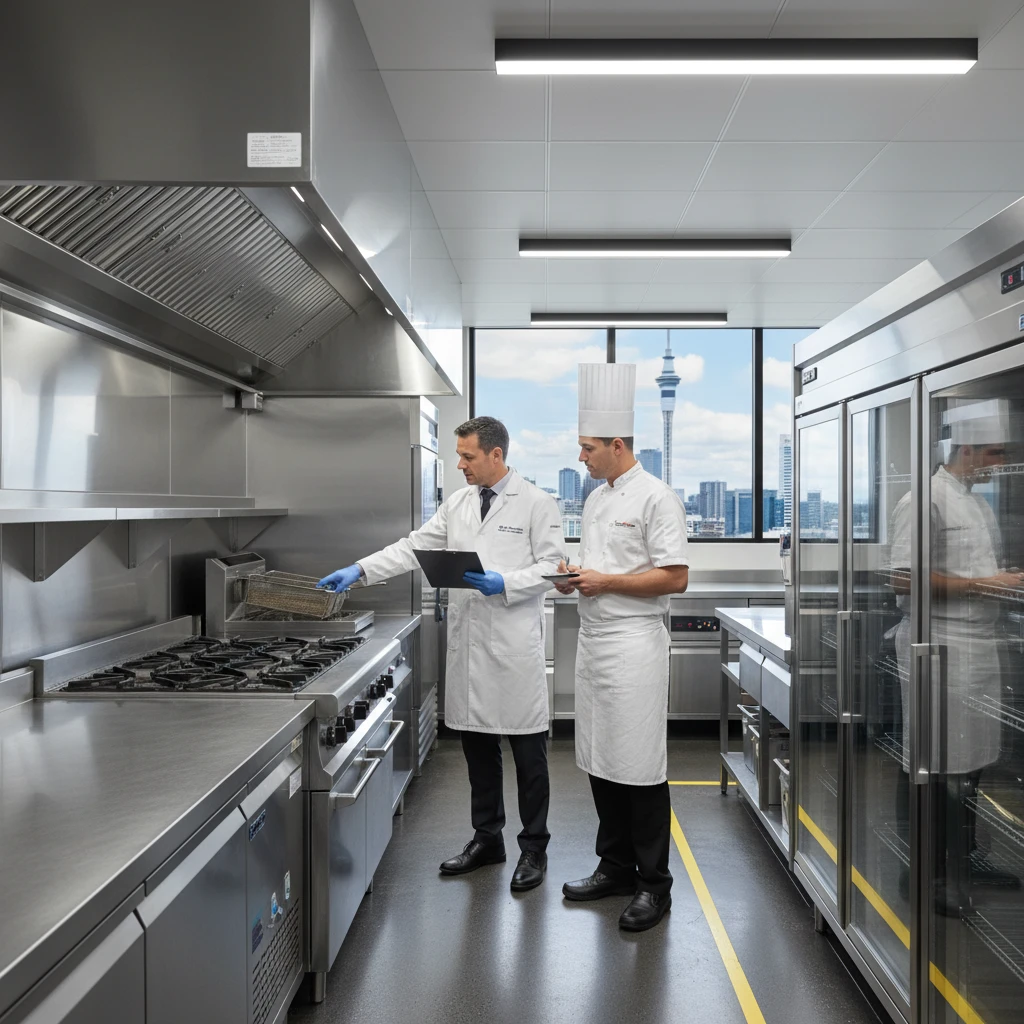
Auckland commercial kitchen health inspection

Food Act 2014 Pest Control Certificate

Opening a hospitality business in Auckland is a thrilling venture, but it comes with stringent regulatory responsibilities. The moment an Auckland Council health inspector walks through your doors, your food safety protocols are put to the ultimate test.

One of the most critical elements they scrutinize is your pest management strategy. Passed into law to modernize food safety, the national legislation fundamentally shifted how commercial kitchens must operate.

Instead of merely reacting to a cockroach or rodent sighting, you must now prove you have proactive preventative measures in place. Securing your food act 2014 pest control certificate is no longer optional; it is a foundational requirement for keeping your doors open and your customers safe.

Key Takeaways

To comply with New Zealand regulations, food businesses must maintain a proactive pest management plan. Obtaining a food act 2014 pest control certificate from a licensed professional proves to MPI verifiers that your premises are actively monitored, safeguarding your ‘A’ Grade rating.
Auckland commercial kitchen health inspection

Understanding the Food Act 2014 Requirements

The Food Act 2014, which officially came into full force on March 1, 2016, revolutionized New Zealand’s approach to food safety. It moved the industry away from a rigid, one-size-fits-all inspection model to a dynamic, risk-based sliding scale.

This means that a high-risk commercial kitchen in the Auckland CBD faces much stricter scrutiny than a local dairy selling pre-packaged goods. However, regardless of where your business falls on this scale, preventing pest contamination remains a universal, non-negotiable mandate.

Under this legislation, food operators are required to operate under either a Food Control Plan (FCP) or a National Programme (NP). Both frameworks explicitly demand that food is kept safe, secure, and suitable for human consumption at all times.

📝

Note: The Risk-Based Sliding Scale

The Food Act 2014 operates on a sliding scale of risk. High-risk businesses (like restaurants preparing raw meat) must follow a rigorous Food Control Plan (FCP), while lower-risk businesses (like cafes selling only pre-packaged food) operate under National Programmes (NP).

Mandatory Pest Management Plans for Food Businesses

Auckland Council enforces these national standards rigorously across the region’s vibrant and bustling hospitality sector. You simply cannot afford to wait for a pest infestation to occur before taking decisive action.

Your Food Control Plan requires a documented, mandatory pest management strategy. This strategy must outline exactly how you prevent pests from entering your building and how you continuously monitor for potential activity.

DIY pest control methods, such as hardware store baits or generic fly sprays, are heavily frowned upon in commercial environments. They lack the efficacy, safety controls, and tracking mechanisms required by Ministry for Primary Industries (MPI) verifiers.

Partnering with a certified commercial pest controller ensures that your methods are entirely safe for food preparation areas. It also guarantees that you have the necessary documentation to prove your compliance during an unannounced audit.

Commercial pest control bait station inspection

Record Keeping and Verification Audits

The absolute cornerstone of the Food Act 2014 is traceability and meticulous record-keeping. If a preventative action isn’t documented in writing, in the eyes of an auditor, it simply didn’t happen.

During a verification audit, the inspector will ask to see your pest control diary and comprehensive service logs. They want to see a continuous, unbroken history of professional inspections, not just a single, one-off treatment receipt.

This is exactly where your food act 2014 pest control certificate becomes your most valuable administrative asset. It serves as undeniable proof that an independent, qualified expert is actively managing and mitigating your pest risks.

Failing to produce these records is a primary reason why Auckland restaurants are downgraded from an ‘A’ to a ‘D’ or ‘E’ grade. A poor grade not only damages your hard-earned reputation but can lead to immediate intervention or forced closure by the council.

Auckland Council Food Grade Downgrades: Contributing Factors

How We Help You Achieve Compliance

Navigating the complexities of local council requirements and MPI standards can be overwhelming for busy restaurant owners. Our specialized pest control services are specifically designed to take this heavy burden entirely off your shoulders.

We deeply understand the unique pressures of the Auckland hospitality scene. Our technicians are trained to integrate seamless pest management into your daily operations without disrupting your staff or your patrons.

From comprehensive initial risk assessments to ongoing preventative maintenance, we provide a complete end-to-end solution. We ensure that every aspect of your pest control program aligns perfectly with your specific Food Control Plan.

Feature DIY Pest Control Professional Pest Management
Regulatory Compliance Fails MPI and Council audit standards. Fully compliant with Food Act 2014.
Documentation None provided. Receipts from hardware stores are invalid. Provides audit-ready logs and certificates.
Chemical Safety High risk of food contamination from improper use. Uses food-safe, targeted applications with SDS sheets.
Effectiveness Only treats visible pests; ignores the root cause. Eradicates colonies and prevents future entry.

Setting Up Approved Monitoring Stations

Effective commercial pest control relies heavily on strategic monitoring rather than blanket, indiscriminate chemical applications. We install tamper-proof, industry-approved monitoring stations in the most critical areas of your facility.

These stations are strategically placed near entry points, dry storage areas, and loading docks to detect early signs of rodent or insect activity. They are highly discreet, entirely safe around food, and strictly compliant with commercial food safety standards.

During our scheduled visits, we meticulously check these stations and record the resulting data. This proactive approach allows us to intercept a potential pest issue long before it ever reaches your kitchen or dining room.

⚠️

Warning: DIY Pest Control Risks

DIY pest control in a commercial kitchen is a major violation of the Food Act 2014. Spraying domestic aerosols near food preparation surfaces can lead to chemical contamination and immediate closure by health inspectors.

Providing Detailed Service Reports and Certificates

Transparency and thorough documentation are at the very heart of our commercial service model. After every visit, our technicians generate a comprehensive, audit-ready service report for your records.

This report details exactly what areas were checked, any pest activity detected, and the specific, food-safe treatments applied. It also includes actionable recommendations for structural improvements, such as sealing wall gaps or fixing leaky pipes, to further exclude pests.

Most importantly, we issue a formal food act 2014 pest control certificate that you can proudly display or keep safely in your compliance folder. When the council health inspector arrives, you can confidently hand over this paperwork to prove your ongoing commitment to food safety.

Food Act 2014 Pest Control Certificate on clipboard

What Auditors Look For During Inspections

Auckland Council verifiers are highly trained to spot the subtle, often overlooked signs of pest activity and poor hygiene. They will thoroughly inspect your dry storage, look under your heavy commercial appliances, and scrutinize your waste disposal areas.

However, they are just as focused on your administrative compliance as they are on your physical premises. They will rigorously cross-reference your physical environment with your written Food Control Plan to ensure you are actually following your own procedures.

They actively look for consistency in your pest control schedule. A gap of several months between professional treatments is a major red flag that strongly suggests operational negligence.

  • German Cockroaches: These rapid breeders thrive in the warm, humid environments behind commercial dishwashers and ovens.
  • Rodents (Rats and Mice): Known to chew through wiring and contaminate food stocks, rodents pose a severe structural and health risk.
  • Stored Product Pests: Weevils and pantry moths can quickly decimate expensive bulk dry goods like flour, rice, and grains.
  • Flies: Fruit flies and house flies are notorious carriers of bacteria, easily transferring pathogens from waste bins to prep tables.

Proof of Ongoing Professional Pest Control

Inspectors want to see a formalized partnership between your business and a licensed pest control provider. They will review your service agreements and carefully note the frequency of your technician’s visits.

Your food act 2014 pest control certificate must be up-to-date and clearly state the full scope of the services provided. It should unequivocally confirm that the treatments and methods used are approved for use in commercial food premises.

If an auditor finds minor evidence of pests but sees that you have an active, documented management plan in place, they are generally more understanding. They recognize that pests are an ongoing environmental challenge and will focus primarily on how you are managing the risk.

💡

Tip: Implement a Clean-As-You-Go Policy

Implement a strict clean-as-you-go policy for your kitchen staff. Wiping down surfaces, sweeping under appliances, and emptying bins frequently drastically reduces the food sources that attract pests in the first place.

Addressing Corrective Actions Quickly

If a verifier identifies a vulnerability during an audit, they will formally issue a Corrective Action Request (CAR). This might involve fixing a broken fly screen, improving waste management, or increasing the frequency of pest control visits.

It is absolutely critical that you address these corrective actions immediately and thoroughly. Ignoring a CAR is a surefire way to fail your next verification and face severe financial penalties.

Our team works directly with you to resolve any pest-related corrective actions swiftly and effectively. We provide the necessary treatments and updated documentation to completely satisfy the auditor and close out the request.

Health inspector reviewing pest control documentation

Book Your Compliance Inspection Today

Do not leave your critical food safety grading to chance or guesswork. The financial and reputational costs of a severe pest infestation or a failed council audit are simply too high for any Auckland food business to bear.

Protect your livelihood, your hardworking staff, and your loyal customers by partnering with local compliance experts. We provide the tailored strategies and robust documentation required by the Ministry for Primary Industries.

Contact us today to schedule a comprehensive, no-obligation site assessment. Let us help you secure your food act 2014 pest control certificate and maintain the ‘A’ Grade your hard work truly deserves.

Check/Action: Audit Preparation Checklist

Before your next Auckland Council audit, ensure your compliance folder contains: your current pest control contract, a site map of all bait stations, safety data sheets (SDS) for all chemicals used, and your latest service reports.

Frequently Asked Questions

What is a Food Control Plan (FCP)?
A Food Control Plan (FCP) is a comprehensive, written document required under the Food Act 2014 for high-risk food businesses. It outlines the specific steps your business takes to ensure food is safe, including detailed procedures for cleaning, temperature control, and mandatory pest management.
How often do I need commercial pest control for my restaurant?
The frequency of pest control visits depends on your business’s specific risk level, location, and past pest history. However, most Auckland Council verifiers expect to see professional inspections conducted at least every 4 to 6 weeks to maintain a proactive defense.
Will the council accept DIY pest control receipts?
No. Auckland Council and MPI verifiers require strict proof of professional, integrated pest management. Hardware store receipts and DIY methods do not provide the necessary audit trails, safety data sheets, or proof of competency required to pass a commercial verification.
What happens if an inspector finds pests during an audit?
If an inspector discovers a severe infestation, it poses an immediate public health risk, which can result in an instant ‘E’ grade and forced closure. For minor issues, they will issue a Corrective Action Request (CAR), requiring you to hire a professional immediately and provide documented proof of treatment.
Do food trucks need a pest control certificate?
Yes. Mobile food businesses, including food trucks and trailers, are still fully subject to the Food Act 2014. While their physical footprint is smaller, they must still demonstrate that their preparation areas and storage facilities are adequately protected from pests and contamination.
How much does commercial pest control cost in Auckland?
The cost varies based on the size of your premises, the complexity of the layout, and the frequency of service required. Investing in a preventative, ongoing pest management contract is far more cost-effective than suffering the lost revenue and heavy fines associated with a failed health inspection.

Leave a Comment

Your email address will not be published. Required fields are marked *

Scroll to Top