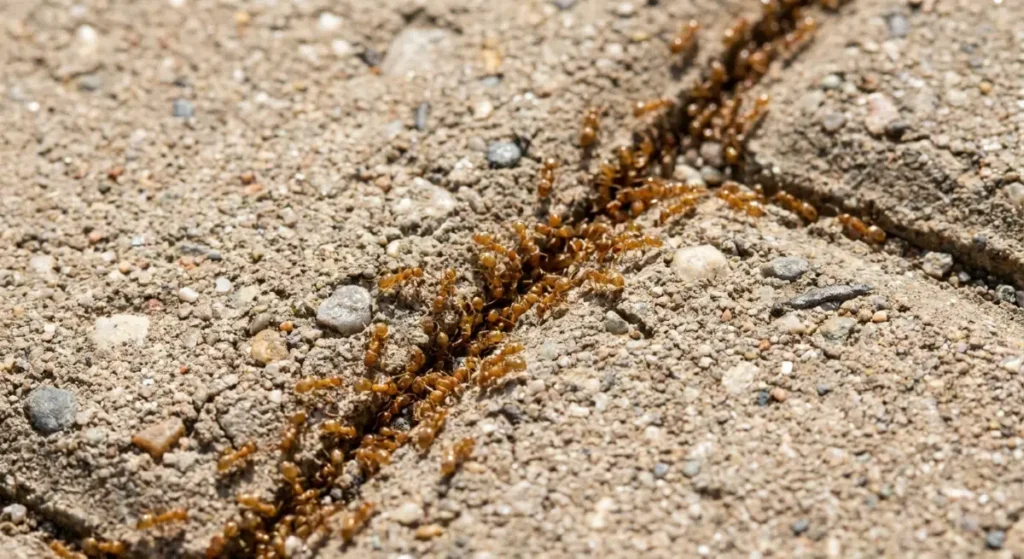
Dense foraging trail of Argentine ants on a concrete surface

How to Spot Argentine Ants

The autumn pest surge of May 2026 has brought a familiar, relentless invader to Auckland properties. If you are noticing sudden, dense trails of tiny brown insects marching across your kitchen bench, you need to know how to spot Argentine ants. These are not your standard garden pests; they represent one of the world’s most aggressive invasive species.

Unlike native species that occasionally wander indoors, Argentine ants operate as a sophisticated biological invasion force. They form massive, interconnected super-colonies that can easily span entire Auckland neighborhoods. With recent climate shifts and a mild winter last year, their populations have exploded across the region, causing significant distress for homeowners and landlords alike.

Understanding how to spot Argentine ants early is the critical first step in protecting your home, family, and property. Relying on outdated “spray and pray” methods will only cause the colony to fracture and multiply. Instead, modern eradication requires predictive Integrated Pest Management (IPM) and a sharp eye for early detection.

Key Takeaways

To accurately identify and know how to spot Argentine ants, look for uniform, light honey-brown ants measuring exactly 2-3mm long. They travel in dense, multi-lane foraging trails and lack a strong odor when crushed. They nest shallowly outdoors under pavers, potted plants, and mulch.

Identifying Features of the Argentine Ant

When figuring out how to spot Argentine ants, visual identification is your most powerful tool. Because New Zealand is home to several different ant species, knowing the specific physical traits of this invader is essential. Misidentification often leads to the wrong treatment method, which can exacerbate the problem.

Unlike native species, Argentine ants have a very uniform appearance across their entire workforce. You will not see large “soldier” ants mixed in with smaller workers; they are all identically sized. This uniformity is a key indicator that you are dealing with a highly organized invasive species.

Dense foraging trail of Argentine ants on a concrete surface

Size, Color, and Lack of a Distinct Smell

The most immediate giveaway is their color. Argentine ants are a uniform, light honey-brown, which strongly contrasts with the common black house ants frequently seen in New Zealand. They are uniformly small, with all worker ants measuring between exactly 2 and 3 millimeters in length.

Another distinct feature is their lack of odor. Many common ant species emit a strong, pungent formic acid smell when crushed. Argentine ants, however, only produce a very faint, slightly greasy odor, making this a reliable field test for homeowners trying to identify them.

💡

The Crush Test

If you crush a worker ant and smell a sharp, vinegar-like scent, it is likely a Darwin’s ant or a native species, not an Argentine ant.

Observing Their Distinctive Foraging Trails

Behavior is just as important as physical appearance when learning how to spot Argentine ants. These insects are highly organized and do not exhibit the erratic, circular “crazy” running behavior seen in other species. They are highly efficient foragers.

Instead, they travel in highly defined, continuous trails that often look like a multi-lane motorway. These trails can be up to five ants wide, moving purposefully towards a food source or water supply. You will frequently find these dense lines running along the smooth edges of footpaths, skirting boards, or retaining walls.

Feature Argentine Ants Common Black Ants
Color Light honey-brown Dark brown or black
Size Uniform 2-3mm Varies by species (often larger)
Odor When Crushed Faint, greasy smell Strong formic acid (vinegar) smell
Trail Behavior Dense, continuous, multi-lane trails Erratic, scattered, or single-file

Where to Look for Nests Around Your Property

Argentine ants are highly adaptable, but they have specific nesting preferences that differ from native species. They are shallow nesters, meaning they do not dig deep, complex underground tunnel systems. This makes them highly mobile if their environment is disturbed.

Because they rely on environmental heat to incubate their colonies, they seek out areas that trap warmth and moisture. Knowing exactly where to inspect is a crucial part of knowing how to spot Argentine ants before they breach your home’s interior.

Inspecting under potted plants for Argentine ant nests

Under Paving Stones, Potted Plants, and Mulch

The most common places to find an Argentine ant nest are in warm, slightly moist outdoor environments. They frequently establish colonies underneath concrete paving stones, where the sun heats the surface during the day. The thermal mass of the concrete provides perfect incubation.

Potted plants are another prime target for these invaders. The soil inside a well-watered pot provides the perfect microclimate for a satellite nest. Homeowners should also regularly inspect garden mulch, leaf litter, and the bases of retaining walls for signs of dense ant activity.

⚠️

Autumn Indoor Invasions

During the cooler, wet autumn months in Auckland, Argentine ants will frequently move their shallow nests indoors, seeking refuge in wall cavities, roof spaces, and behind warm appliances.

The Threat of the Auckland Super-Colony

What truly sets the Argentine ant apart is its unique social structure and reproductive strategy. In most ant species, neighboring colonies will fiercely defend their territory and fight one another to the death. Argentine ants in New Zealand, however, share a remarkably similar genetic makeup.

Because they recognize each other as kin, different nests cooperate rather than compete. This lack of infighting allows them to form massive “super-colonies” that can dominate entire urban landscapes. This cooperative behavior is a major focus at the upcoming FAOPMA Pest Summit 2026 in Auckland, where global experts will discuss smarter, predictive pest solutions to combat this exact threat.

These super-colonies have massive appetites, making them incredibly destructive to local biodiversity. While New Zealand has seen massive biosecurity successes recently—like the plummeting rat tracking rates in the Hūnua Ranges following targeted 1080 drops—urban invasive insects require a completely different, highly localized approach to protect our native invertebrates and lizards.

Bar chart showing common nesting sites for Argentine ants in Auckland

Commercial Risks in the Hospitality Sector

The threat of Argentine ants extends far beyond residential backyards. New Zealand’s hospitality sector reached a record $15.99 billion turnover in FY2025, and operators face immense pressure to maintain zero-tolerance hygiene standards. An Argentine ant infestation in a commercial kitchen can be catastrophic.

Under the Food Act 2014 and strict Ministry for Primary Industries (MPI) regulations, food businesses cannot rely on toxic, reactive sprays in sensitive preparation areas. Because Argentine ants aggressively seek out fats and proteins, they will rapidly contaminate food stocks and prep stations.

For our commercial clients, we deploy discreet, non-toxic monitoring and mechanical exclusion tactics. By utilizing predictive Integrated Pest Management (IPM), we ensure businesses remain compliant, operational, and entirely pest-free without risking chemical contamination.

📝

Biosecurity Compliance

Failing an MPI or council hygiene audit due to an ant infestation can lead to forced closures. Proactive, scheduled pest management is a legal necessity for Auckland food businesses.

What to Do If You Find a Super-Colony

If you have successfully identified these invaders, your next steps are critical to the safety of your property. A botched DIY treatment can actually make the infestation significantly worse, spreading the ants further into your home.

Do Not Disturb the Nest or Use Repellent Sprays

When threatened, an Argentine ant colony will undergo a process called “budding”. The queens will take a group of workers and split off to form multiple new nests nearby. Using cheap, repellent surface sprays from the local hardware store will trigger this exact defense mechanism.

You might kill the ants you see on the surface, but you will fracture the super-colony, turning one localized nest into five hidden ones. This “DIY Cycle of Despair” is a common frustration for Auckland homeowners, leading to persistent, recurring infestations that are much harder and more expensive to eradicate.

Professional pest control technician inspecting an Auckland home

Once you know how to spot Argentine ants, you can take proactive steps to make your property less inviting before the professionals arrive:

  • Seal entry points around skirting boards, window frames, and plumbing penetrations.
  • Remove excess leaf litter, firewood, and mulch from directly against the home’s foundation.
  • Fix leaking outdoor taps and clear blocked gutters, as Argentine ants are highly attracted to moisture.
  • Store all pantry items in airtight containers to completely cut off their food supply indoors.

Professional Baiting is Required

Effective eradication relies on non-repellent, slow-acting baits. Worker ants carry this bait back to the nest to share with the queens through a process called trophallaxis, destroying the colony from the inside out.

Call the Experts for Immediate Eradication

Eradicating an Argentine ant super-colony requires scientific precision and adherence to strict local regulations. Under the EPA HPC Notice 2017 and HSNO Act 1996, handling the specific ecotoxic baits required for total colony elimination is heavily restricted. It is a job best left to a “Qualified UPM Contractor” holding a Level 3 New Zealand Certificate in Pest Operations.

At Pest Control Auckland, our certified technicians utilize predictive Integrated Pest Management (IPM) to solve the root cause of the infestation. We don’t just spray the symptoms; we identify the environmental factors drawing them in and deploy targeted, pet-safe treatments that protect your family.

For year-round peace of mind, many homeowners and property managers are now opting for our subscription-based Auckland Winter Defense Pack. This proactive approach ensures your property remains protected against the autumn and winter pest surge, keeping your home safe, compliant, and completely ant-free.

People Also Ask (FAQ)

Do Argentine ants bite humans?
While they do not possess a stinger like some other species, Argentine ants are highly aggressive and territorial. They can and will bite humans if they feel provoked or if their nest is disturbed, though the bite is generally mild.
Why are Argentine ants so hard to get rid of?
They are difficult to eradicate because they form massive super-colonies with multiple queens. If threatened by DIY surface sprays, the colony will “bud,” splitting into several new nests. Eradication requires professional, slow-acting baits that target the queens.
Are Argentine ants active in winter in Auckland?
Yes. While they prefer warm, dry outdoor environments during summer, the wet and cold Auckland winters often drive them indoors. They frequently seek out the warmth of wall cavities, roof spaces, and hot water cupboards during the cooler months.
What is the best bait for Argentine ants?
The most effective baits are professional-grade, non-repellent formulations (often fipronil-based) that are slow-acting. This allows the worker ants ample time to carry the poison back to the nest and distribute it to the queens before dying.
Can Argentine ants damage my house?
They do not cause structural damage to timber like termites or borer beetles. However, they are known to nest inside electrical appliances, switchboards, and wall cavities, which can occasionally cause electrical shorts and significant hygiene issues.
How fast do Argentine ants spread in a neighborhood?
They spread extremely quickly. Through a combination of colony budding and human-assisted transport (moving potted plants, soil, or landscaping materials), a single super-colony can rapidly expand across multiple properties and entire streets.

About the Author: Ronnie C.

Ronald Cronje (Ronnie C.) is the founder and lead technician of Pest Control Auckland, an Orewa-based family business serving Rodney, the Hibiscus Coast, and the wider Auckland region. He is a certified Urban Pest Management specialist dedicated to safe, prevention-focused solutions.

With years of hands-on experience navigating the complexities of New Zealand’s HSNO Act and biosecurity regulations, Ronnie is the definitive expert on identifying and treating invasive species. Having successfully eradicated countless super-colonies across Auckland, his scientific, root-cause methodology ensures families and businesses receive safe, permanent relief from complex infestations.

Leave a Comment

Your email address will not be published. Required fields are marked *

Scroll to Top