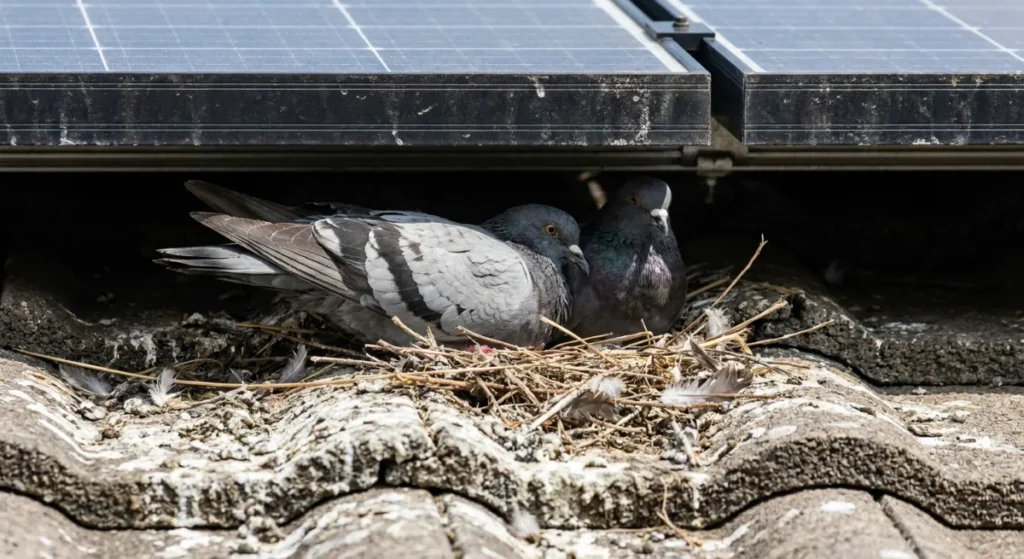
I have been on hundreds of roofs across Auckland. The story is always the same.
You hear cooing and scratching above the ceiling, or you step out onto your balcony and find it plastered in white, acidic guano. You try a plastic owl from the hardware store. Two weeks later, the pigeons are sitting directly on top of it.
By the time you pull out your phone and search for pigeon pest control near me, you are likely fed up and just want them gone. But here is the straight truth: you cannot simply poison or shoot pigeons in a dense urban area like Auckland. The law does not allow it, and frankly, it does not work long-term.
Feral pigeons are descendants of rock doves. They are genetically hardwired to seek out high, sheltered ledges. To them, your warehouse parapet or residential solar panel is a predator-free cliff face. If you remove one flock without blocking the access, another flock will move in by the end of the week.
We do not just chase birds away. We fix the root cause by making your property physically inaccessible to them. No illegal traps, no temporary fixes. Just permanent exclusion.
Key Takeaways
Searching for reliable pigeon pest control near me requires a structural exclusion approach. Under the Animal Welfare Act 1999, humane proofing is the only legal, long-term solution in Auckland. We use heavy-duty netting, spikes, and optical deterrents to permanently lock feral pigeons out of your property.
Urgent Pigeon Problems? We Provide Rapid, Local Response
May 2026 has brought a massive autumn surge in urban pests across Auckland. Following a mild winter and a hot summer, feral pigeon populations have multiplied rapidly.
These birds do not migrate. Once they find a comfortable nesting site on your property, they stay there year-round. They will mate for life and can produce up to four broods a year. If you ignore a pair of pigeons today, you will have a full-blown flock tearing up your roof by Christmas.
When you need pigeon pest control near me, you need a team that understands the local landscape. We do not offer generic advice. We get on the roof, find the exact entry points, and shut them down permanently.
Serving North Shore, Central, West, East, and South Auckland
Auckland’s unique geography makes it a paradise for pest birds. In West Auckland, industrial warehouses provide endless sheltered beams. On the North Shore and in the CBD, multi-story residential balconies and coastal cliffs offer perfect vantage points.
In South Auckland, we see heavy pigeon activity around food manufacturing and logistics hubs. The constant flow of grain and waste provides an endless buffet. In East Auckland, residential homes with complex rooflines and multiple dormer windows offer perfect, wind-protected nesting voids.
No matter where you are located, our response is the same. We conduct a thorough site assessment, identify the food sources drawing them in, and map out the structural vulnerabilities.
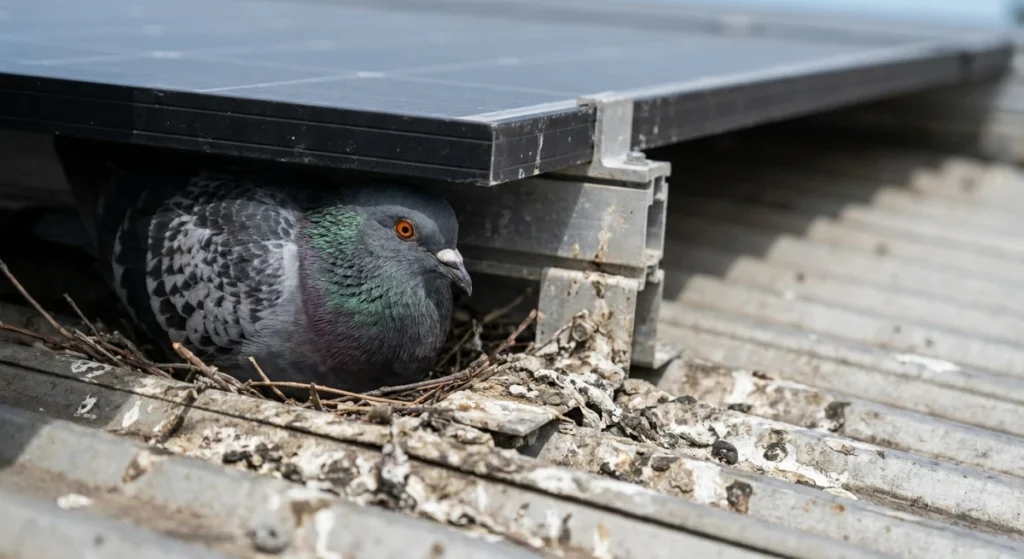
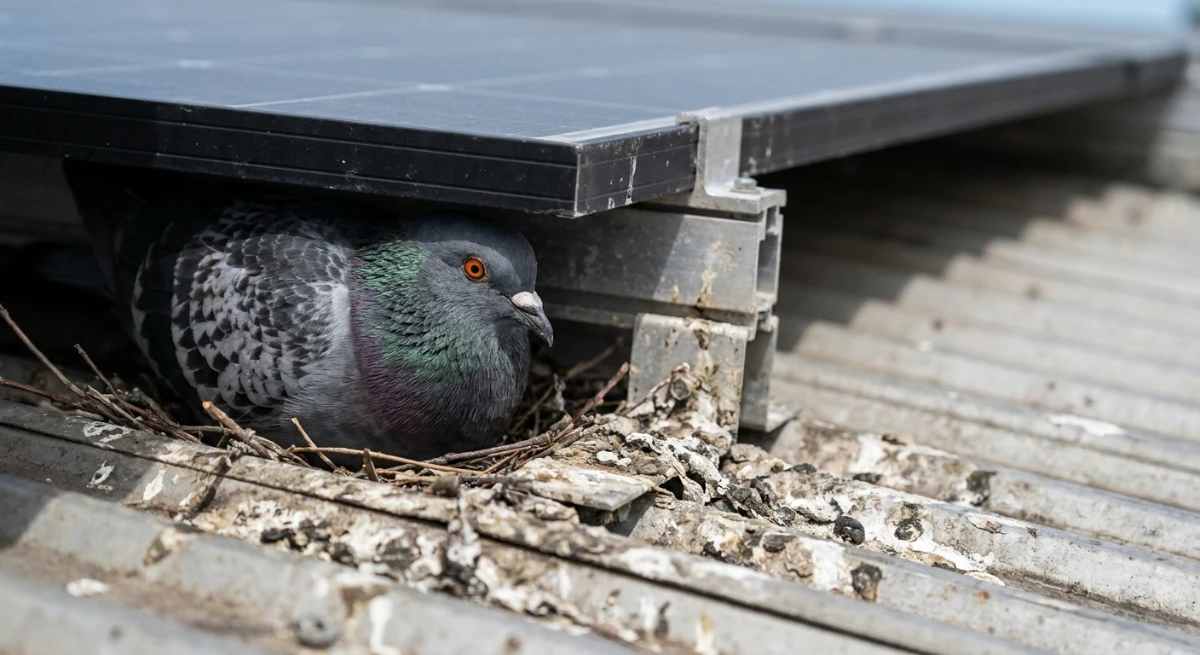
Solar panels are the number one nesting spot for pigeons in modern residential homes. The gap between the panel and the roof provides perfect warmth and shelter from predators. If you hear scratching during the day, this is likely the culprit.
Looking for a ‘Pigeon Exterminator’? Read This First
A lot of customers call us asking for a pigeon exterminator. They want us to bring in poisons or rifles and wipe the flock out. I have to tell them plainly: that is not how professional bird control works in New Zealand.
Culling is a reactive, temporary measure. If you remove fifty pigeons from a public square or a warehouse roof, the food source and shelter remain. Within weeks, a new flock from the surrounding area will simply move in to claim the vacant real estate.
To permanently solve the issue, we have to change the environment. That means making it physically impossible for the birds to land, roost, or nest.
The Legalities of Bird Control in NZ (Animal Welfare Act 1999)
We operate strictly by the book. All pest management operations in New Zealand are governed by the Animal Welfare Act 1999 and the HSNO Act 1996 [1].
You cannot use toxic baits indiscriminately in an urban environment. Not only is it illegal and highly dangerous to non-target native birds, but it also violates commercial health codes. If you run a food business, the Food Act 2014 strictly prohibits toxic baiting in sensitive areas.
Operators handling any complex pest scenarios must be a Qualified UPM Contractor, holding the New Zealand Certificate in Pest Operations (Level 3). This is not a job for a handyman with a ladder.
Never attempt to poison pigeons using unregulated agricultural chemicals. It is a severe breach of the Animal Welfare Act and can result in massive fines. Always use a certified professional.
Why Structural Proofing Works Better Than Extermination
Structural proofing is the core of Integrated Pest Management (IPM). Instead of fighting a never-ending battle against the birds, we install permanent deterrents.
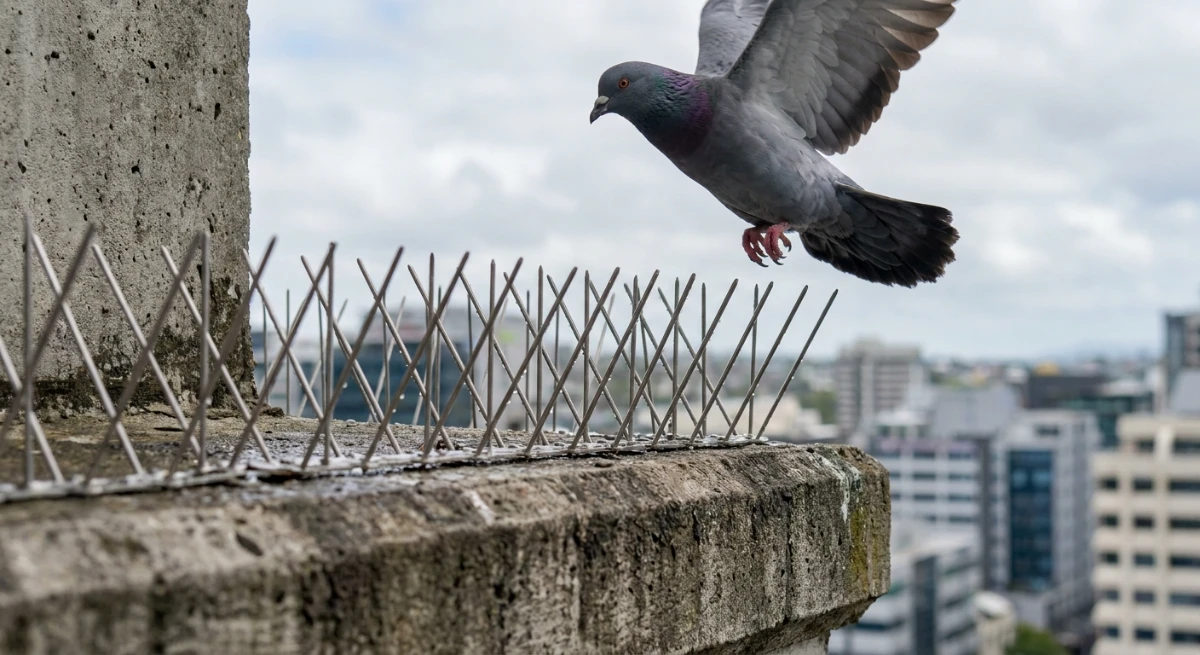
We use three primary methods. First, UV-resistant polyethylene netting, which is perfect for sealing off large warehouse canopies. Second, marine-grade stainless steel spikes installed on parapets and ledges to break up the flat surface. Third, solar panel exclusion mesh that wraps tightly around the perimeter of your roof panels.
When a pigeon tries to land on a ledge protected by stainless steel spikes, it physically cannot. It gives up and moves on to an easier target. This is the only method that guarantees long-term success without ongoing monthly extermination fees.
The DIY Cycle of Despair: Why Store-Bought Solutions Fail
Aucklanders in 2026 are highly skeptical of DIY pest control, and for good reason. The ‘DIY Cycle of Despair’ usually starts at the local hardware store.
You buy a plastic hawk, some reflective tape, and maybe a sonic emitter. You spend your weekend climbing a dangerous ladder to install them. For three days, it seems to work. The pigeons stay away.
Then, they realize the plastic hawk has not moved. The reflective tape gets covered in dust. Within a week, the pigeons are back, and they are now nesting right next to your expensive deterrents. You have wasted time, money, and put yourself at risk of a fall, all without solving the actual problem.
The Real Cost of Feral Pigeons (Pathogens & Property Damage)
Pigeons are not just a nuisance. They are a serious financial and biological liability. Feral pigeon droppings are highly acidic. Left uncleaned, guano will literally eat through paint, corrode steel joists, and degrade historic stonework.
Then there is the health risk. Pigeons are known carriers of severe pathogens. When their droppings dry out, they turn into a fine dust that gets sucked into building HVAC systems [2].
Beyond the structural decay, pigeon guano creates massive slip hazards on pavements and fire escapes. If a customer or staff member slips on a wet pile of droppings outside your Auckland cafe, you are looking at a severe health and safety liability. Furthermore, reputation damage is instant.
- Psittacosis (Parrot Fever): A respiratory disease caused by the bacterium Chlamydia psittaci, transmitted through inhaling dried guano dust.
- Salmonellosis: A severe gastrointestinal illness spread when pigeon droppings contaminate food or water sources.
- Histoplasmosis: A potentially fatal respiratory infection caused by a fungus that thrives in accumulated bird droppings.
- Bird Mites: Parasites that live in pigeon nests. When the birds leave, the mites invade the building looking for a new blood source—usually humans.
The financial drain of reactive cleaning far outweighs the cost of doing it right the first time. Look at the data below. Paying for monthly guano removal and gutter clearing adds up rapidly.
| Control Method | Initial Cost | Long-Term Effectiveness | Legal Compliance (NZ) |
|---|---|---|---|
| Structural Proofing (Netting/Spikes) | Moderate to High | Excellent (Permanent) | 100% Compliant |
| Sonic Repellers / Fake Owls | Low | Poor (Birds adapt in days) | Compliant |
| Lethal Baiting / Culling | Moderate | Poor (New flock moves in) | Highly Restricted / Illegal |
| Reactive Cleaning Only | Low (Ongoing) | Zero | Risks MPI Health Violations |
Commercial vs. Residential Pigeon Control
The approach to bird proofing changes depending on the property type. For residential homes, the focus is usually on aesthetic preservation and sleep quality. Nobody wants to hear pigeons scratching in the roof cavity at 5 AM.
We use low-profile solar mesh and discreet spikes that blend into the roofline. You get your peace and quiet back without making your house look like a prison.
For commercial properties, the focus is on compliance and liability. Warehouses, retail strips, and hospitality venues must adhere to the Food Act 2014 and strict HACCP standards [3]. A single pigeon trapped inside a food prep facility can halt operations entirely. We conduct comprehensive biosecurity compliance audits and install heavy-duty netting systems that span hundreds of square meters, ensuring total lockdown of the airspace.
Our Silver Bullet Guarantee for Pigeon Exclusion
As Auckland prepares to host the FAOPMA Pest Summit in July 2026, the industry is shifting toward smarter, predictive pest solutions. We are already there. We do not do half-measures.
Our “Silver Bullet Guarantee” means we fix the root cause. When you hire us for pigeon pest control near me, we deploy commercial-grade, UV-resistant netting and marine-grade stainless steel spikes. These materials are built to withstand Auckland’s harsh coastal weather.
We also utilize advanced optical deterrent gels. These gels look like fire to a bird’s ultraviolet vision, creating a psychological barrier without harming the animal. It is clean, discreet, and incredibly effective for historic buildings or high-end residential balconies.
Identify where the birds are roosting. Take note of any heavy guano buildup. Ensure you are not actively feeding them or leaving accessible rubbish bins open. Controlling the food source is step one.
Contact Your Local Auckland Bird Control Expert Today
Stop wasting time and money on cheap plastic owls and endless cleaning bills. If you have a pigeon problem, you need a certified, local expert to lock them out permanently.
We provide transparent, upfront pricing. No hidden fees, no bait-and-switch tactics. Just honest, highly effective pest management from a family-owned Auckland team.
Call Pest Control Auckland today. Let us get on the roof, assess the damage, and give you your home or business back.
People Also Ask (FAQ)

About the Author: Ronnie
Founder, Pest Control Auckland · Commercial & Residential Pest Expert · Certified Urban Pest Management Specialist
With years of experience in structural exclusion and urban pest management, Ronnie is Auckland’s definitive expert on humane bird control. Having consulted for major commercial warehouses and residential property managers across the region, he specializes in permanent, legally compliant pigeon exclusion strategies that solve the root cause of the infestation.