You open your Auckland cafe on a warm September morning. The espresso machine is heating up, the cabinets are freshly stocked, and then you see it.
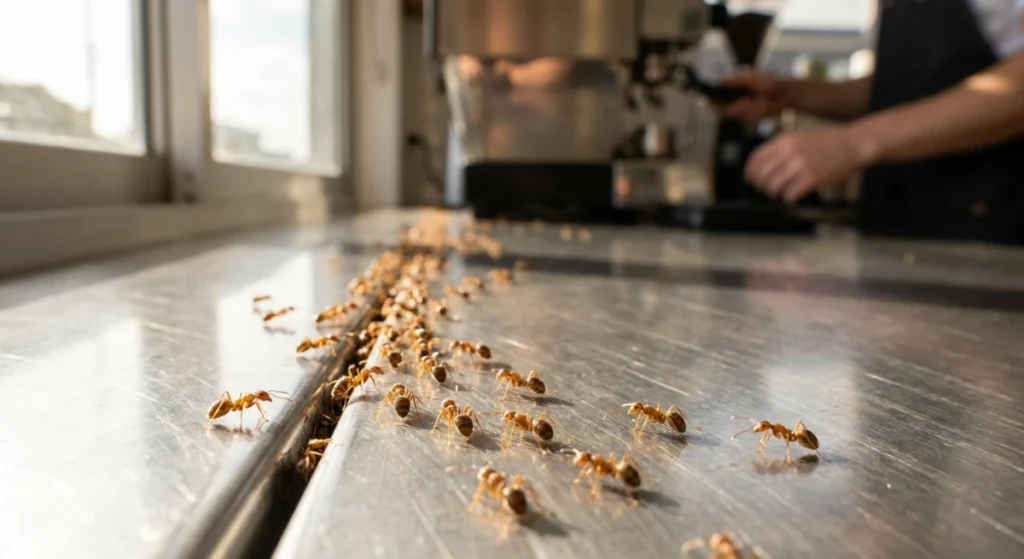
A five-lane highway of tiny brown ants is marching straight from the back door, across the stainless steel prep bench, and directly into your premium syrups.
I’ve seen this exact scenario play out hundreds of times across the region. When the weather warms up, these insects don’t just wander inside looking for a few stray crumbs.
They launch a highly coordinated biological invasion. Dealing with spring Argentine ant invasions in cafes requires a lot more than a cheap can of supermarket bug spray.
It demands a scientific, root-cause approach. We focus on methods that eradicate the nest entirely, keeping your doors open and the Ministry for Primary Industries (MPI) auditors completely satisfied.
Key Takeaways
To stop spring Argentine ant invasions in cafes, standard insect sprays must be avoided as they cause the colony to fracture and multiply. Instead, commercial food businesses must use MPI-approved, non-repellent protein baits applied by Level 3 certified technicians to eradicate the entire supercolony at its root.
Understanding the Argentine Ant Supercolony Threat
Most native New Zealand ants are highly territorial. They fight neighbouring colonies for resources, which naturally keeps their population numbers in check.
Argentine ants (Linepithema humile) operate completely differently. They don’t have this natural aggression toward their own species, recognizing ants from other nests as kin.
Instead of fighting, separate nests link together to form a massive, cooperative supercolony. These interconnected networks can easily span entire Auckland city blocks.
This means the ants you see swarming your commercial kitchen are just a tiny fraction of a much larger network. That network contains millions of workers and thousands of hidden queens.
If you only treat the visible workers on your benchtop, you’re wasting your time. The supercolony will simply reroute its foraging trails and send endless reinforcements.
Identifying the Invader: Are They Really Argentine Ants?
Before we treat anything, we have to know exactly what we’re dealing with. Misidentification is a rookie mistake that leads to failed treatments.
You can identify Argentine ants by looking for a few specific physical and behavioural traits:
- Uniform Size: Every worker is exactly 2 to 3 millimetres long.
- Colour: Light honey-brown, not black.
- Behaviour: Travels in massive, multi-lane trails without fighting.
- Odour: No acidic or pungent smell when crushed.
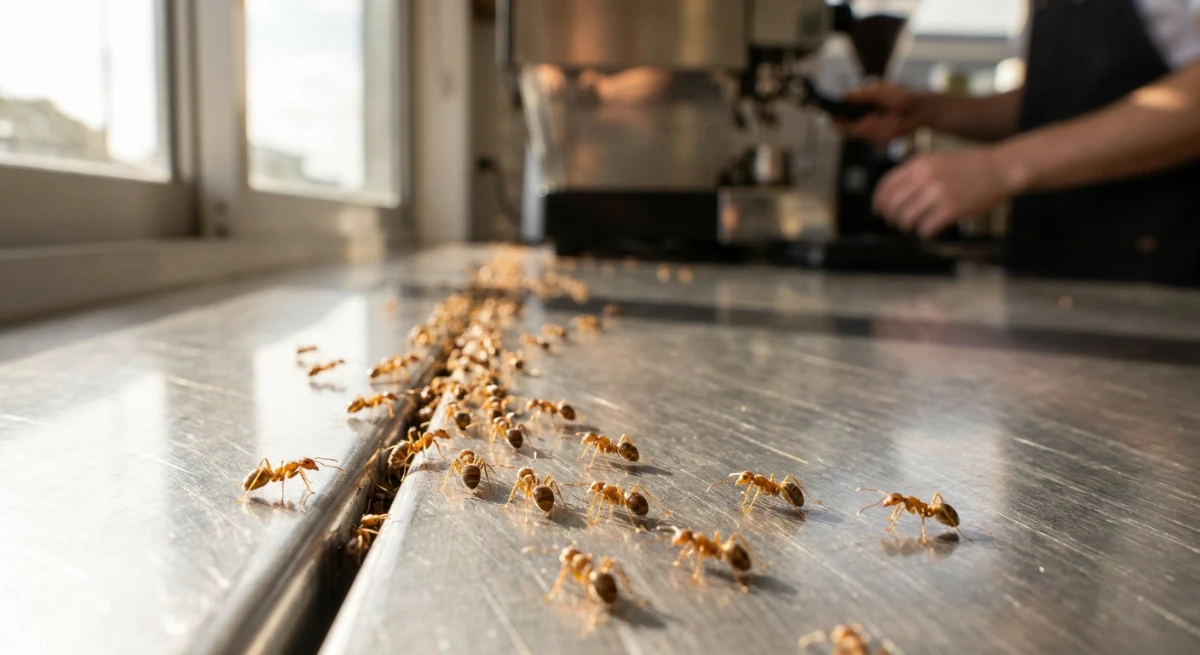
If you see ants walking five abreast like a busy Auckland motorway, you’re almost certainly looking at an Argentine ant supercolony.
Why Spring Triggers Massive Foraging Activity
Following the unprecedented autumn pest surge we saw across Auckland in May 2026, these supercolonies spent the winter hunkered down. They used that time to quietly expand their numbers beneath the soil.
As spring arrives and soil temperatures finally rise, the colony wakes up hungry. Their demand for food skyrockets to support rapid new brood development.
During this seasonal shift, their dietary preferences change aggressively. While they consume sweet honeydew year-round, spring triggers a massive craving for proteins and fats.
Your hospitality business is essentially a five-star buffet for a growing colony. They will march hundreds of metres from their outdoor nests to access your kitchen.
They aggressively target grease traps, commercial dishwashers, and dry goods storage areas, overwhelming your defenses in a matter of hours.
The Legal Reality: Food Act 2014 and MPI Audits
Operating a hospitality business in 2026 means navigating strict regulatory frameworks. The Food Act 2014 dictates exactly how you must manage food safety risks in your venue.
Using cheap hardware store pest bombs in a commercial kitchen isn’t just ineffective. It’s highly illegal if it contaminates food contact surfaces.
MPI verifiers maintain a zero-tolerance policy for active pest infestations in food preparation zones. A single customer complaint can trigger an unannounced audit.
Verifiers demand documented proof of safe pest management. They want to see a proactive Integrated Pest Management (IPM) plan, not a reactive panic response.
We provide comprehensive reporting and compliance documentation. This proves to your auditor that your pest control is handled by Level 3 certified professionals using approved, zero-emission methods.
Under New Zealand law, operators handling Class 9 ecotoxic substances in commercial food environments must be a ‘Qualified UPM Contractor’. Always ask to see your pest technician’s Level 3 NZ Certificate.
Why Standard Ant Sprays Fail Against Argentine Ants
When cafe owners panic, their first instinct is usually to grab a fast-knockdown surface spray. In my experience, this is the worst possible reaction.
Standard synthetic pyrethroid sprays are highly repellent. They kill the ants they touch, but they also send a chemical alarm signal back to the main nest.
The surviving ants immediately recognize the threat. They abandon that specific foraging trail and retreat to safety.
To the untrained eye, it looks like the problem is solved. The bench is clear. But in reality, you’ve just triggered a biological defense mechanism.
The Risk of Colony Budding and Multiplication
When a supercolony feels threatened by a chemical attack, the queens panic. They immediately scatter to protect the colony’s future.
They fracture the main nest into multiple smaller satellite nests. These new nests spread deeper into your building’s wall cavities and subfloors.
Within a few weeks, your single ant trail turns into five separate trails. Now they are attacking different areas of your cafe simultaneously.
This spray and pray cycle is exactly what causes spring Argentine ant invasions in cafes to spiral out of control. It wastes time and makes professional eradication much harder.
Never use hardware store bug bombs or surface sprays in a commercial kitchen. Not only do they cause Argentine ant colonies to fracture and multiply, but they also risk contaminating food prep surfaces, leading to instant MPI audit failures.
Professional Eradication Protocols
At Pest Control Auckland, we don’t just spray and walk away. We focus entirely on scientific, root-cause eradication.
Eradicating spring Argentine ant invasions in cafes requires an entomological approach. We have to outsmart the supercolony using their own biology against them.
Under the EPA HPC Notice 2017, handling commercial-grade treatments in sensitive food environments requires specialized training. Our technicians hold the Level 3 New Zealand Certificate in Pest Operations.
We use predictive Integrated Pest Management (IPM) to dismantle the colony from the inside out, ensuring your business stays compliant and pest-free.
Strategic Baiting to Target the Queens
The only way to permanently stop an Argentine ant invasion is to kill the queens. To achieve that, we use their cooperative feeding nature against them.
We apply highly attractive, non-repellent transfer baits. These are specifically formulated for the colony’s current seasonal dietary needs, whether that is proteins or sugars.
The worker ants consume this bait and carry it back to the hidden nest. Through a process called trophallaxis, they regurgitate and share the bait with the queens and the brood.
Because the active ingredient is slow-acting, the ants don’t realize they’re being poisoned. The toxin spreads quietly until the entire nest structure collapses.
This method is highly effective, entirely zero-emission, and perfectly safe for use in commercial food preparation areas when applied by a certified professional.
| Treatment Method | Colony Impact | Food Act Compliance | Long-Term Result |
|---|---|---|---|
| DIY Surface Sprays | Triggers budding & multiplication | High risk of food contamination | Worsens the infestation |
| Strategic IPM Baiting | Eliminates queens & entire nest | Zero-emission, fully compliant | Permanent eradication |
Perimeter Treatments and Structural Exclusion
Targeted baiting eliminates the active colony inside your walls. But we also have to stop the next wave of invaders from marching in from the street.
As part of our commercial biosecurity compliance auditing, we identify structural entry points around your cafe. We advise you on how to physically block these vulnerabilities.
We then apply a targeted, non-repellent perimeter treatment to the exterior foundation. This creates an invisible barrier around your premises.
When ants cross this barrier, they pick up the active ingredient on their exoskeletons. They carry it back to any remaining outdoor nests, destroying the colony at its source.
This dual-action approach provides reliable long-term protection. It ensures your hospitality business remains hygienic and fully operational throughout the busy spring season.
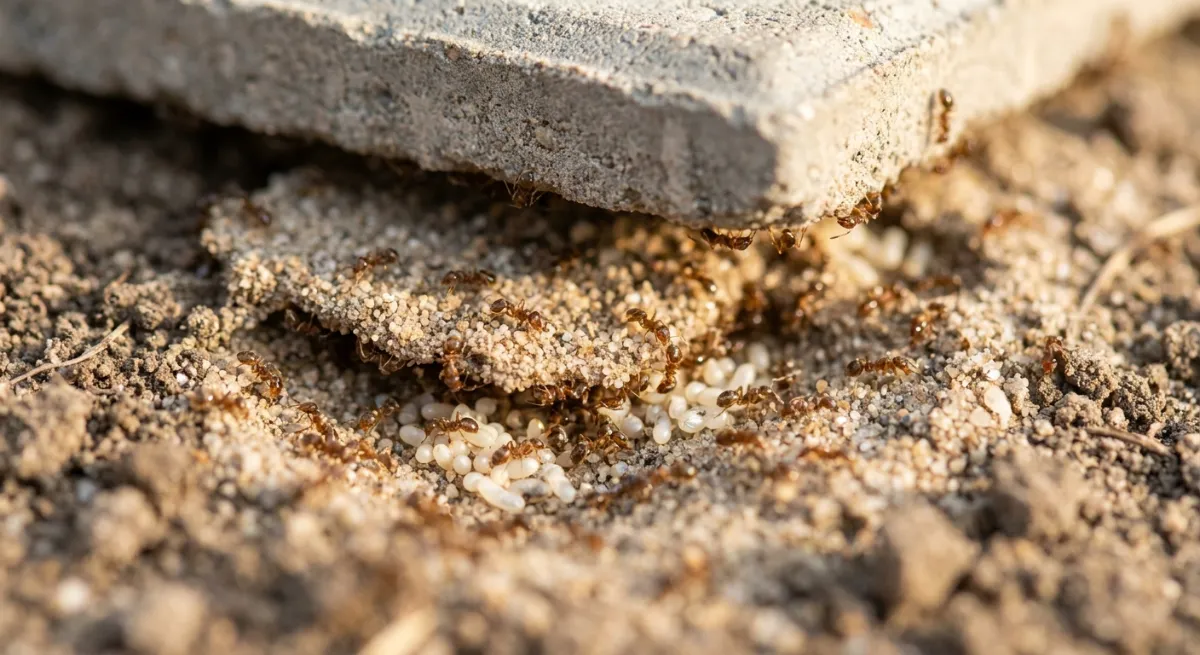
Argentine ants love to nest under warm paving stones, potted plants, and fresh mulch. Keep outdoor dining areas clear of decaying vegetation, and ensure cafe rubbish bins are sealed and washed daily.
Protect Your Cafe This Spring
The Auckland hospitality sector is booming right now. With the FAOPMA Pest Summit arriving in our city in July 2026, the spotlight is firmly on advanced, eco-conscious pest solutions.
Don’t let a preventable pest issue threaten your food control plan, your revenue, or your hard-earned reputation.
If you’re dealing with spring Argentine ant invasions in cafes, you need a certified partner who understands the high stakes involved.
We provide honest, transparent pricing, rapid response times, and scientific treatments backed by our Silver Bullet Guarantee.
Don’t wait for a customer to complain online. Contact us today for a comprehensive biosecurity audit and secure your cafe with our proactive Auckland Winter Defense and Spring Protection plans.
People Also Ask

About the Author: Ronnie
Founder, Pest Control Auckland · Commercial & Residential Pest Expert · Certified Urban Pest Management Specialist
With years of experience in commercial hospitality biosecurity and an intimate understanding of the Food Act 2014, Ronnie is uniquely qualified to tackle the threat of spring Argentine ant invasions in cafes. Having consulted for top Auckland restaurants and managed severe supercolony eradications, he relies on predictive Integrated Pest Management (IPM) to deliver zero-emission, permanent results.