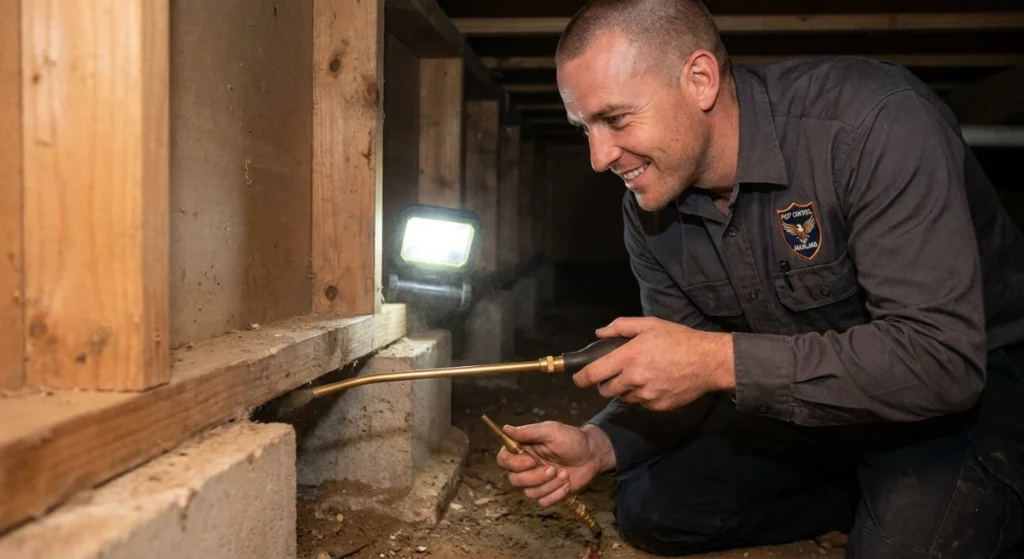
Technician performing sub-floor and wall cavity dusting in Auckland

Sub-Floor and Wall Cavity Dusting: Deep-Targeting Hidden Ant and Cockroach Harbourages

Listen, if you are hearing scratching behind your Gib board or seeing a line of ants marching out of a microscopic crack in your skirting, a can of supermarket spray is not going to save you.

We are in the middle of a massive autumn pest surge here in West Auckland. A mild winter followed by a hot summer has created the perfect breeding ground for cockroaches and Argentine ants.

They do not live on your kitchen bench; they live deep inside the bones of your house. To fix this permanently, you cannot just treat the symptoms you see on the surface.

I am going to walk you through exactly how we establish a long-term chemical barrier where these pests actually breed. I will explain why surface spraying is a waste of your money, and how we fix the problem at the root cause.

Key Takeaways

Sub-Floor and Wall Cavity Dusting: Deep-Targeting Hidden Ant and Cockroach Harbourages involves injecting dry, micro-dust insecticides directly into structural voids. This certified method establishes a long-lasting, moisture-resistant barrier that eradicates nests at the root cause, outperforming standard liquid surface sprays.

The West Auckland Autumn Pest Surge

Right now, West Auckland is dealing with a massive influx of urban pests. As temperatures drop this autumn, insects are abandoning the outdoors and moving straight into your warm, dry wall cavities.

Most homeowners panic and buy a bunch of hardware store bug bombs. This starts what I call the DIY cycle of despair.

You set off a bomb, it kills a few stragglers on the carpet, but the core nest behind the Gib board remains completely untouched. The surviving insects simply retreat further into the sub-floor.

⚠️

Warning: The Limits of Bug Bombs

Aerosol bug bombs do not penetrate structural voids. They simply push surviving insects deeper into your sub-floor and wall cavities, making the infestation harder to treat.

The Biology of Hidden Harbourages

To understand why surface sprays fail, you need to understand how these pests operate. Argentine ants form massive super-colonies with multiple breeding queens.

If you just spray the worker ants you see in the kitchen, the queens deep inside the wall will just breed faster to replace them. You have to eliminate the queens to stop the colony.

German cockroaches are similar. They prefer warm, tight spaces like the motor voids of fridges, dishwashers, and the wall spaces directly behind your oven. They only come out at night to forage, meaning you rarely see the true scale of the problem.

Understanding Structural Dusting

If you want to stop pests for good, you have to hit them where they sleep. This is where Sub-Floor and Wall Cavity Dusting: Deep-Targeting Hidden Ant and Cockroach Harbourages comes in.

It is a highly specialized, technician-led structural intervention. We use specialized equipment to inject a dry micro-dust formulation directly into closed structural voids.

Unlike liquid sprays that dry up and break down rapidly under UV light, insecticidal dust remains active for months. Provided it stays dry inside the wall, it creates a permanent lethal zone.
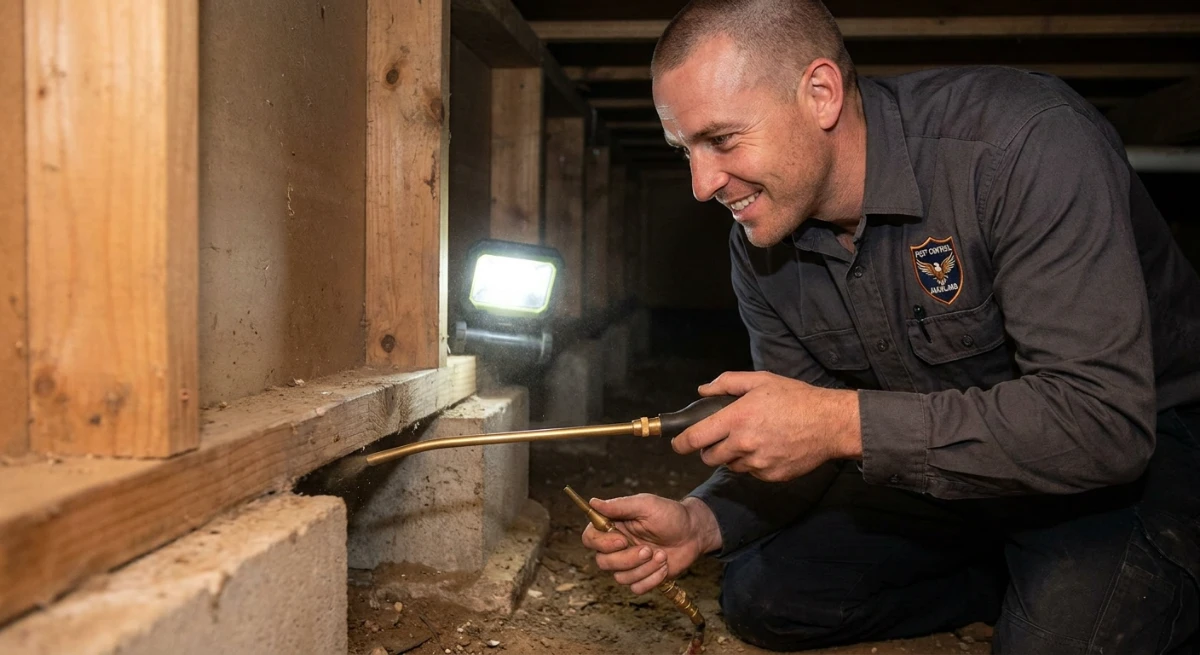
Technician performing sub-floor and wall cavity dusting in Auckland

The Science of Micro-Dust Formulations

The dust we use is not your average garden powder. It is an advanced, MPI-approved formulation designed for maximum transfer effect.

The micro-particles are statically charged. This means they physically cling to the greasy cuticle of a cockroach or the hairy legs of an Argentine ant as they walk through the void.

When the insect grooms itself, it ingests the active ingredient. Because ants and cockroaches are highly social and often cannibalistic, the chemical is rapidly transferred throughout the hidden harbourage.

This creates a cascading eradication effect deep within the structure of your home, wiping out the queens and the nymphs without a single drop of liquid.

Why Spray and Pray is Dead

The era of a technician turning up, soaking your skirting boards in toxic liquid, and handing you a bill is over. That reactive approach is just a temporary band-aid.

It does not solve the root cause, and it certainly does not align with modern Integrated Pest Management standards. With the FAOPMA Pest Summit 2026 coming to Auckland this July, the entire industry is shifting toward predictive, structural solutions.

By focusing on structural exclusion and targeted void treatments, we establish a long-term barrier. This stops pests before they ever reach your living areas.

💡

Tip: Long-Term Value

Investing in a structural void dusting treatment might cost slightly more upfront than a basic surface spray, but it prevents the need for repeated callouts, saving you money over the year.

Best Practices & Legal Compliance

You cannot just drill a hole in a wall and start pumping chemical dust. Handling Class 9 ecotoxic substances in New Zealand is strictly regulated under the HSNO Act 1996 and the EPA HPC Notice 2017.

If a cowboy operator gets this wrong, they can contaminate your living spaces and put your family at risk. At Pest Control Auckland, our technicians hold the New Zealand Certificate in Pest Operations Level 3.

We know exactly how to calculate the correct volume of dust for a specific cubic area. We ensure the dust is completely contained within the wall cavity or sub-floor, meaning zero exposure for your children or pets.

📝

Note: Landlord and Tenant Liability

If you are a landlord dealing with a Tenancy Tribunal dispute over pests, our targeted structural treatments provide the undeniable proof of professional remediation required to protect your investment.

The Technician-Led Implementation Process

So, what does this actually look like when we show up at your house? We do not just start spraying blindly. We follow a strict, scientific process.

  • Inspection and Assessment: We use moisture meters and thermal imaging to find the exact location of the hidden harbourage.
  • Strategic Access: We identify existing access points like weep holes, plumbing penetrations, or electrical conduits. If necessary, we drill tiny, discreet injection holes.
  • Precision Injection: Using a specialized bulb or power duster, we inject the exact required volume of micro-dust into the void.
  • Sealing and Exclusion: Once the void is treated, we advise on sealing the entry points to prevent future infestations.

Commercial Hospitality & The Food Act

For small-to-medium commercial businesses, particularly cafes and restaurants in Auckland, pests are a death sentence. The hospitality sector hit a record $15.99 billion turnover in FY2025, and MPI inspectors are cracking down hard.

Under the Food Act 2014, you simply cannot have toxic liquid sprays near food preparation areas. The risk of chemical drift is too high.

This is where Sub-Floor and Wall Cavity Dusting: Deep-Targeting Hidden Ant and Cockroach Harbourages becomes essential for commercial compliance. By treating the closed voids behind the commercial kitchen walls, we eradicate German cockroaches without risking any chemical contamination in the food zones.

Commercial pest management for Auckland restaurants

Comparing Methods: Spray vs Dust

To make it perfectly clear why we advocate for structural interventions, let us look at the facts. Surface sprays have their place for immediate knockdown, but they fail at long-term prevention.

Dusting provides a resilient, hidden barrier that works continuously behind the scenes. Here is how the two methods stack up against each other.

Feature Liquid Surface Spray Wall Cavity Dusting
Target Area Skirting boards, floors, exterior walls Deep structural voids, sub-floors, roof cavities
Longevity 1 to 3 months (breaks down via UV/cleaning) 6 to 12+ months (protected from elements)
Eradication Type Contact kill only (treats symptoms) Transfer effect (destroys the root nest)
Safety Profile Requires vacating the property until dry Zero exposure in living areas, highly pet-safe

The Data: Why We Trust Structural Dusting

When you look at the long-term efficacy, the numbers do not lie. A surface spray looks great on day one, but its effectiveness drops off a cliff after a few months of foot traffic and mopping.

Dusting, on the other hand, maintains a lethal barrier inside the wall for the entire year. It is the most reliable way to secure your property.

Bar chart comparing the eradication success rates of surface spraying versus cavity dusting over a 12 month period

Action: Secure Your Annual Protection

Stop paying for temporary fixes. Ask our technicians about adding structural void dusting to your Auckland Winter Defense annual protection plan.

Conclusion: The Silver Bullet Guarantee

At the end of the day, you want to go to sleep without hearing scratching in the walls or waking up to ants on the kitchen counter. You want a definitive, scientific solution.

By utilizing Sub-Floor and Wall Cavity Dusting: Deep-Targeting Hidden Ant and Cockroach Harbourages, we are not just masking the problem. We are physically altering the environment inside your walls so pests cannot survive.

We back this up with our Silver Bullet Guarantee. If you are tired of the DIY cycle of despair, give us a call. We will give you straight advice, transparent pricing, and a permanent fix.

People Also Ask (FAQ)

Is insecticidal dust safe for my pets and children?
Yes. Because the dust is injected directly into sealed structural voids like wall cavities and sub-floors, there is zero exposure in your living areas. It is completely isolated from pets and children.
How long does wall cavity dusting last?
When applied correctly in a dry, enclosed void, professional insecticidal dust can remain active and highly effective for 6 to 12 months, and sometimes even longer, providing excellent long-term prevention.
Will I need to leave the house during the treatment?
If we are only performing void dusting, you generally do not need to vacate the property because the product is contained within the walls. However, if we combine it with a surface spray, you will need to leave until the liquid dries.
Can dusting get rid of a severe German cockroach infestation?
Absolutely. German cockroaches breed in tight, warm voids behind appliances and cabinets. Dusting these specific harbourages is one of the most effective ways to eradicate the entire breeding population.
Why are ants coming out of my electrical sockets?
Ants often use the electrical conduits inside your walls as highways to travel between their nest and your kitchen. Seeing them at the sockets confirms the main colony is living inside the wall cavity itself.
Is this treatment compliant with Auckland Council regulations?
Yes. Our technicians operate strictly under the HSNO Act 1996 and hold Level 3 Urban Pest Management certification, ensuring all treatments are safe, legal, and compliant with local council and MPI standards.
Ronnie

About the Author: Ronnie

Founder, Pest Control Auckland · Commercial & Residential Pest Expert · Certified Urban Pest Management Specialist

With years of experience in structural pest exclusion and handling Class 9 ecotoxic substances, Ronnie is the definitive expert on Sub-Floor and Wall Cavity Dusting: Deep-Targeting Hidden Ant and Cockroach Harbourages. Having consulted for numerous commercial food premises across Auckland, he specializes in advanced, root-cause eradication strategies that go far beyond standard surface spraying.

Leave a Comment

Your email address will not be published. Required fields are marked *

Scroll to Top