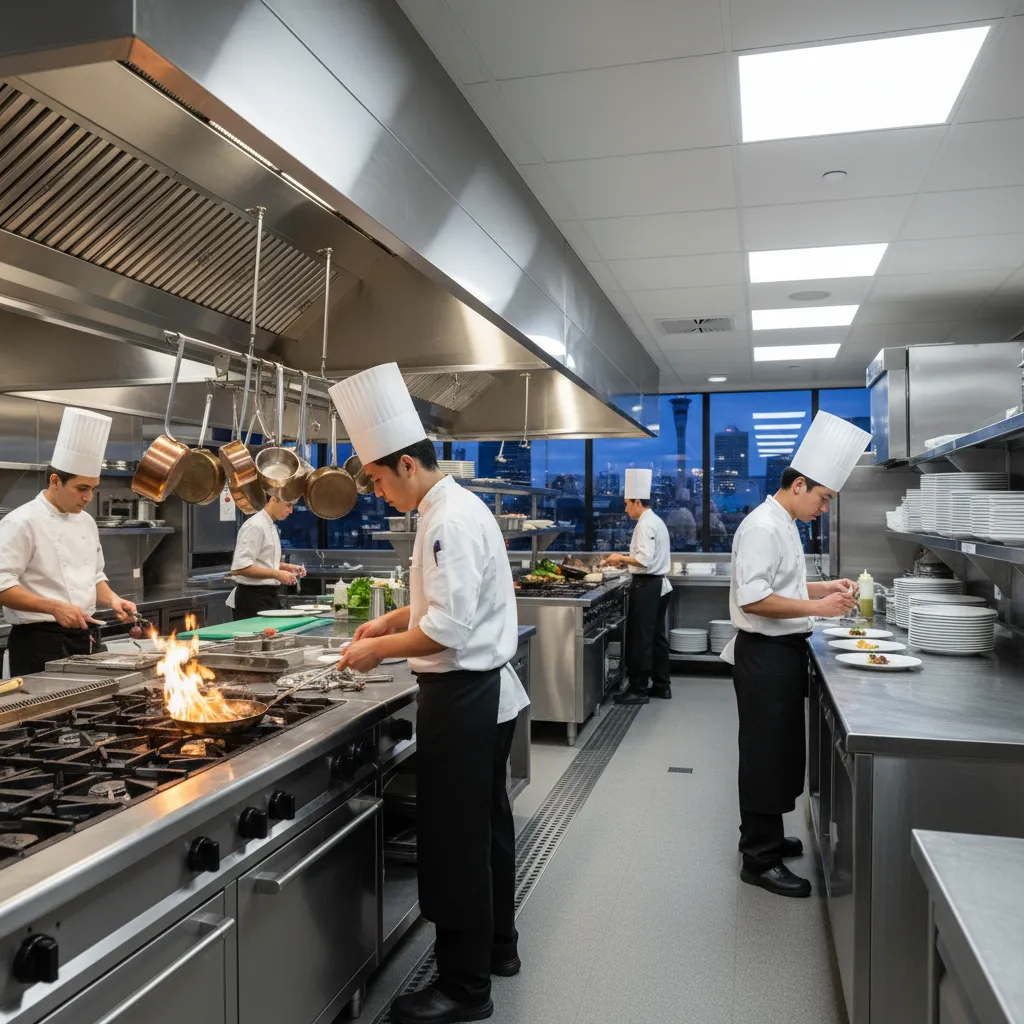
Spring in Auckland means cafe doors open, outdoor seating fills up, and the pests wake up. If you run a hospitality business, you know the drill. You prep your kitchen, organise your staff, and get ready for the busy season.
But there is one pest that does not just visit; it takes over. We are talking about the relentless march of the Argentine ant. When it comes to spring Argentine ant invasions, cafes are often the first to suffer.
These are not your average garden ants looking for a dropped crumb. They are an aggressive, highly organised invasive species that can collapse your hygiene standards overnight. I have seen them overrun commercial kitchens from the CBD to the North Shore.
The Auckland pest control industry is at a shifting point as we head into May 2026. After a mild winter and a hot summer the previous year, the autumn pest surge was massive. Now, as spring approaches, the surviving ant populations are ready to explode.
The era of reactive “spray and pray” pest control is dead. Today, managing these pests requires a scientific approach, strict compliance with New Zealand law, and a deep understanding of their biology. Let us break down exactly what you are up against and how we fix it.
Key Takeaways
Spring triggers Argentine ant supercolonies to forage aggressively as temperatures exceed 15°C. To protect your cafe and comply with the Food Act 2014, avoid DIY sprays that cause colony budding. Instead, rely on Level 3 qualified technicians for strategic baiting and predictive Integrated Pest Management (IPM).
Understanding the Argentine Ant Supercolony Threat
Unlike common ants, Argentine ants do not fight each other. They recognise each other as kin due to a lack of genetic diversity, which allows them to form massive supercolonies. These colonies can stretch across entire Auckland suburbs, linking millions of workers.
They are a multi-queen, multi-nest species, meaning a single supercolony can house thousands of queens. If your cafe sits above one of these networks, you are not dealing with a single isolated nest. You are dealing with an interconnected network of millions of ants that share resources and workers.
These ants are ranked among the world’s worst invasive species. They aggressively displace native New Zealand invertebrates, lizards, and even threaten native bird eggs. While research shows that some colonies in New Zealand naturally collapse after an average of 14 years, your cafe simply cannot afford to wait a decade for nature to take its course.
Why Spring Triggers Massive Foraging Activity
Argentine ant activity is heavily dictated by the weather. Once soil and air temperatures hit 10°C, they begin to wake up, but foraging becomes intense between 15°C and 30°C. Scientific degree-day models show that their complete development from egg to worker accelerates rapidly above a 15.9°C threshold.
Spring is when the queens start producing massive amounts of larvae. To feed this growing brood, the workers need immense amounts of protein. Simultaneously, the active workers require carbohydrates to maintain their own energy levels.
This dual biological demand drives them out of the cold ground and straight into your warm, food-rich commercial kitchen. They do not hibernate, so the moment the spring sun hits the pavement outside your cafe, the invasion begins.
How They Overwhelm Cafe Food Storage Areas
Your cafe is the ultimate target. Spilled syrups, pastry crumbs, and grease traps provide an endless buffet. Argentine ants are relentless foragers that travel in wide, continuous trails, often five or more ants wide.
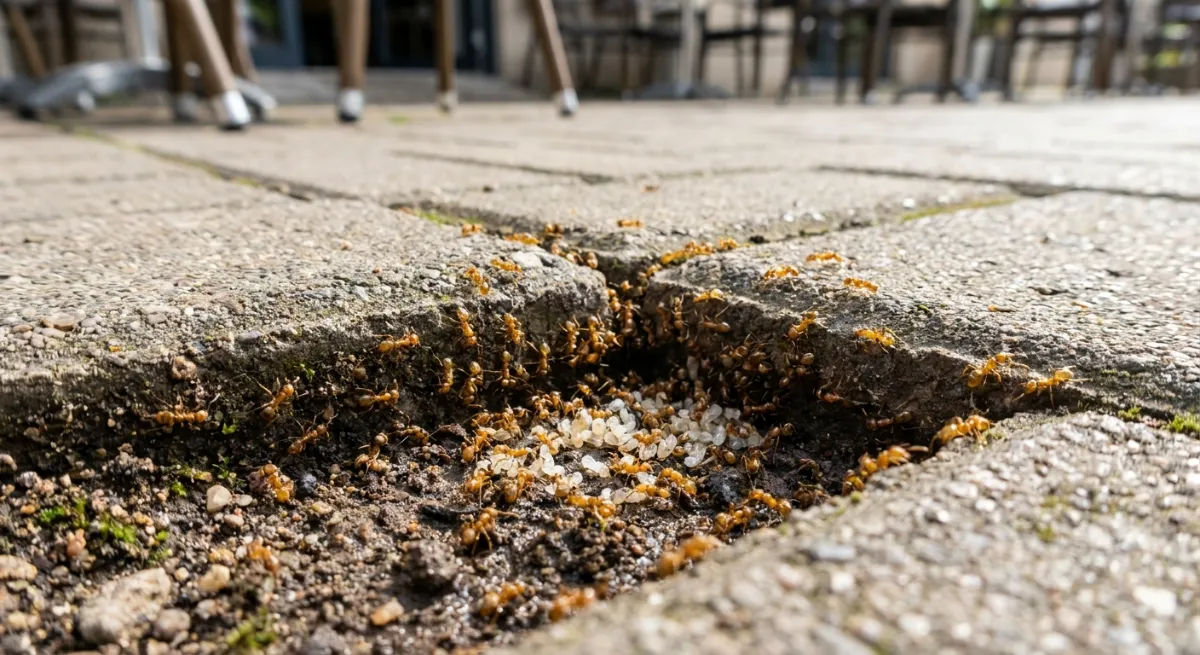
They easily exploit the smallest structural gaps in your building. A tiny crack under your back delivery door or a poorly sealed pipe is all they need to breach your perimeter. Once inside, they contaminate food storage areas, creating severe hygiene risks.
Under the Food Act 2014, commercial kitchens must adhere to strict Hazard Analysis and Critical Control Point (HACCP) principles. An MPI auditor will actively look for signs of pest activity. If they find Argentine ants in your dry store, your ‘A’ Grade rating is immediately at risk.
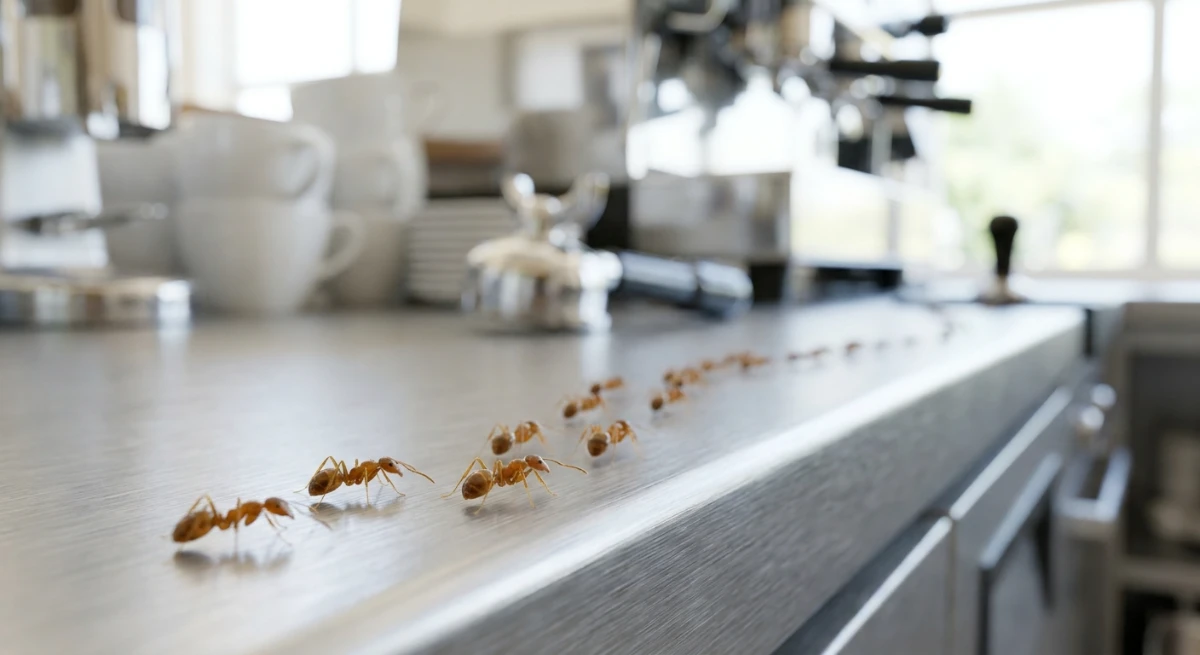
Wiping down benches is not enough. Deep clean under espresso machines, degrease your floor drains, and ensure all dry goods are stored in airtight, hard plastic containers to remove easy food sources.
Why Standard Ant Sprays Fail Against Argentine Ants
If you see a trail of ants and grab a can of hardware store bug spray, you are making the problem worse. Standard repellent sprays only kill the workers you see on the surface. The workers are just the expendable foraging arm of the colony.
To actually stop spring Argentine ant invasions, cafes must abandon these outdated DIY methods. Over-the-counter pyrethroid sprays are highly repellent. While they might clear the wall for a day, they leave the underground nest completely untouched.
Worse still, spraying toxic chemicals near food preparation areas is a direct violation of commercial food safety standards. You cannot blast your kitchen with unapproved chemicals and expect to pass a health inspection.
Using cheap surface sprays causes the colony to panic and fracture. This turns one manageable nest into multiple hard-to-reach infestations across your premises.
The Risk of Colony Budding and Multiplication
When you spray a toxic repellent, the surviving ants panic. This stress triggers a defense mechanism known as “budding”. Because there is up to one queen for every 100 workers, the queens simply split up.
They take a few workers, abandon the original nest, and establish multiple new nests around your property. What started as one nest behind your espresso machine has now become five nests scattered across your dining room and dry store.
This is the DIY cycle of despair that plagues many Auckland hospitality businesses. You spend money on sprays, the ants disappear for a week, and then they return in five different locations.
| Method | Target | Action | Food Act Compliant | Result |
|---|---|---|---|---|
| DIY Surface Sprays | Visible Workers | Repellent | No | Colony Budding (Worse Infestation) |
| Professional Baiting & IPM | The Queens | Non-Repellent | Yes | Total Colony Collapse |
Professional Eradication Protocols
We do not just spray and pray. That approach is entirely obsolete, especially in the commercial food sector. We use Predictive Integrated Pest Management (IPM) to stop pests before they breach your perimeter.
Managing spring Argentine ant invasions in cafes requires a highly targeted, scientific methodology. Operators handling Class 9 ecotoxic substances must be Qualified Urban Pest Management (UPM) Contractors.
Our technicians hold the New Zealand Certificate in Pest Operations (Level 3). This means we are legally qualified to apply commercial-grade, zero-emission treatments that are safe for your staff and compliant with MPI regulations.
Strategic Baiting to Target the Queens
The only way to collapse an Argentine ant supercolony is to use their biology against them. We deploy highly attractive, slow-acting professional baits. We alternate between protein-based and sugar-based baits depending on the specific phase of their spring reproductive cycle.
The workers consume the bait and carry it back to the nest. Through a process called trophallaxis, they regurgitate and share the bait with the queens and the larvae.
Because the bait is slow-acting, it circulates through the entire supercolony before anyone dies. Once the queens are dead, the colony collapses entirely. This is root-cause eradication, not just surface-level symptom management.
Perimeter Treatments and Exclusion
After we eliminate the active infestation, we focus on keeping them out. We apply non-repellent perimeter treatments that are undetectable to the ants. They walk right through them, picking up the active ingredient and sharing it with any remaining stragglers.
We also provide strict structural exclusion advice. We find the entry points—like unsealed pipes or cracked skirting boards—and tell you exactly what needs fixing. We are also seeing the implementation of IoT-enabled digital pest control systems that monitor activity 24/7.
This data-driven approach provides complete transparency and a verifiable audit trail for your health inspectors. It is the definitive way to secure your premises for the long haul.
Do not wait for the health inspector to find the ants first. Contact us to establish a proactive IPM plan and secure your Food Act 2014 pest control certificate.
Protect Your Cafe This Spring
New Zealand’s hospitality sector is booming, reaching a record $15.99 billion turnover recently. With 30% of those businesses in Auckland, the competition is fierce. You cannot afford a health inspection failure.
The Food Act 2014 requires you to prove you have proactive pest management in place. You need a certified professional who understands the law and the biology of the pests.
Do not let an infestation ruin your reputation. If you want to prevent spring Argentine ant invasions, cafes need proactive monitoring. Book a compliance audit today and let us lock down your perimeter with our Silver Bullet Guarantee.
Commercial food premises must maintain verifiable records of pest control activities. Our digital reporting ensures you always have the documentation required to pass an MPI audit.
Frequently Asked Questions

About the Author: Ronnie
Founder, Pest Control Auckland · Commercial & Residential Pest Expert · Certified Urban Pest Management Specialist
With years of experience consulting for Auckland’s booming hospitality sector, Ronnie understands the critical intersection of pest biology and commercial compliance. Having successfully eradicated massive Argentine ant supercolonies across the CBD and North Shore, he is the definitive expert on protecting cafes from seasonal invasions under the strict requirements of the Food Act 2014.