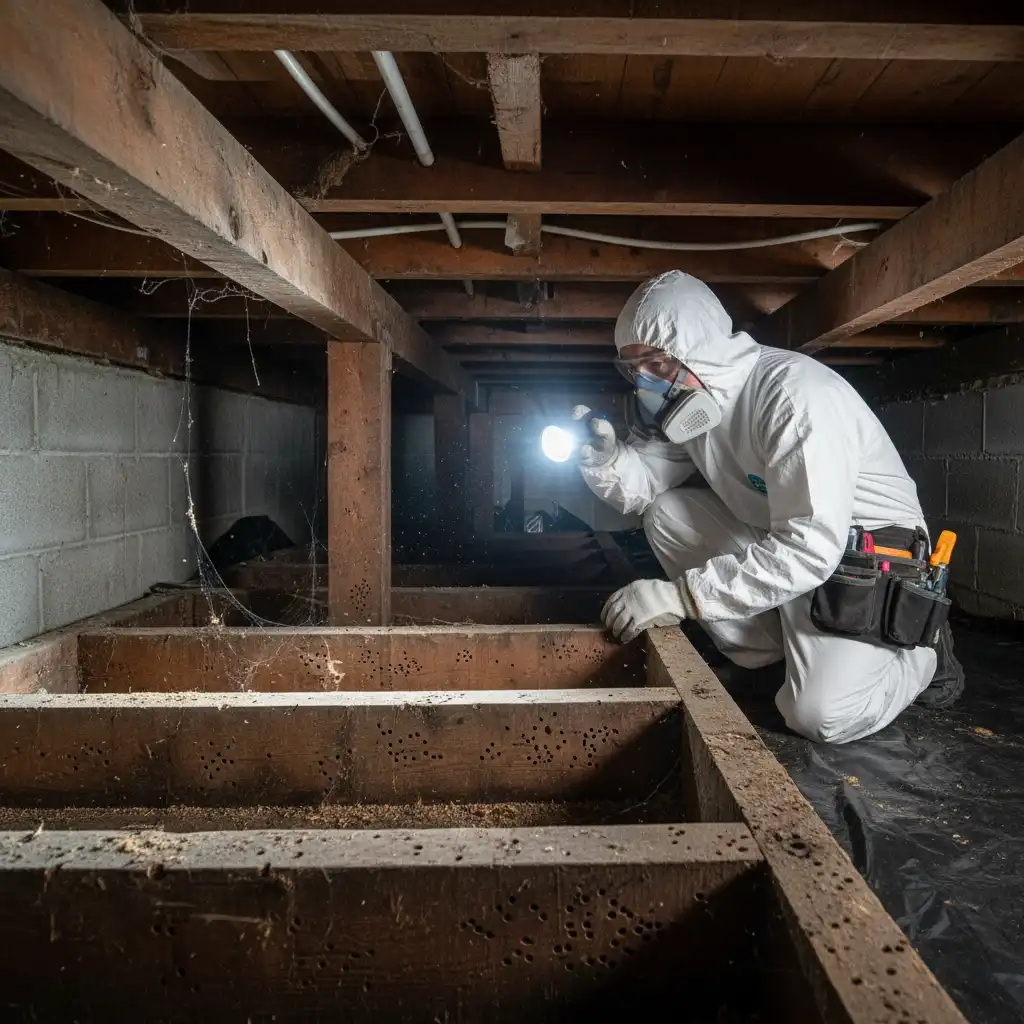
Do borer bombs work? While borer bombs (bug foggers) can effectively kill adult beetles currently flying within a room, they are generally ineffective at eradicating a structural infestation. These aerosols deposit a thin surface layer of insecticide that fails to penetrate the timber grain, leaving the destructive larvae deep inside the wood unharmed and able to continue eating for years.
For homeowners seeking the Best Borer Treatment Auckland has to offer, the sight of fine dust (frass) piling up beneath floorboards or on windowsills is a source of significant anxiety. The Common House Borer (Anobium punctatum) is a pervasive threat to New Zealand timber homes, particularly those built with untreated native sapwood. When faced with the prospect of structural damage, many property owners instinctively reach for the most accessible solution: the supermarket borer bomb. However, understanding the stark difference between these DIY foggers and professional residual sprays is critical for preserving the long-term integrity of your property.
The Verdict: Do Borer Bombs Actually Work?
To answer this thoroughly, we must distinguish between “killing a bug” and “solving an infestation.” If your goal is to knock down a few adult beetles that you see flying around your living room in December, a borer bomb will achieve that. The pyrethrin-based mist fills the air, contacts the insect, and affects its nervous system, leading to death.
However, if your goal is to stop your floorboards from turning into dust or to prevent the structural framing of your house from weakening, borer bombs do not work.
The fundamental issue lies in the delivery mechanism. A “bomb” or total release fogger releases insecticide into the air. Gravity eventually pulls these droplets down, where they settle on horizontal surfaces—floors, countertops, and the tops of furniture. They do not coat vertical surfaces effectively, nor do they coat the undersides of floorboards where borer activity is often most intense. Most importantly, they have zero penetrating power. They sit on top of the wood, while the damage is happening millimeters or centimeters below the surface.

Understanding the Enemy: The Borer Life Cycle
To understand why surface foggers fail, one must understand the biology of the pest. The Common House Borer spends the vast majority of its life—typically 3 to 5 years, but sometimes up to 7 years—as a larva inside the timber.
The Larval Stage (The Destructive Phase)
The larvae are the “worms” that eat the wood. They tunnel through the timber, digesting cellulose and weakening the structure. During this multi-year period, they are hermetically sealed inside the wood. No amount of airborne fog can reach them. They are protected by the very material they are consuming.
The Pupal and Adult Stage
Eventually, the larva pupates near the surface and chews its way out, emerging as an adult beetle. This creates the characteristic 2mm “flight hole.” The adult beetle lives for only a few weeks. Its sole purpose is to mate and for the female to lay eggs. She lays these eggs in cracks, crevices, or old flight holes in the timber.
This cycle highlights the limitations of DIY bombs: they target the adult stage, which represents less than 5% of the insect’s life span and occurs after the damage has been done.
Why DIY Borer Bombs Fail to Protect Timber
Beyond the biological mismatch, there are physical and chemical reasons why borer bombs are insufficient for general Auckland pest control standards, including for challenges like White-Footed House Ant Control.
1. Lack of Penetration
Wood is a porous material, but it requires a carrier agent to transport insecticide deep into the grain. Borer bombs use propellants designed to disperse fine mist into the air, not solvents designed to wick into cellulose. The insecticide sits on the surface and degrades rapidly when exposed to UV light and oxygen.
2. The “Shadowing” Effect
Foggers rely on air currents and gravity. If you set off a bomb in a sub-floor area or an attic, the mist will settle on the top of the joists. The sides and bottom of the joists—often the preferred entry points for borer due to higher moisture content—remain completely untreated. Objects, pipes, and insulation create “shadows” where the mist never reaches.
3. Short Residual Life
Most consumer-grade foggers utilize natural pyrethrins or unstable synthetic pyrethroids. These compounds break down quickly, often within hours or days. Since borer beetles do not all emerge on the same day, a treatment that remains active for only 48 hours will miss the vast majority of the flight season.
The Science of Professional Residual Sprays
Borer Treatment Auckland differs radically from the DIY approach. It is not an atmospheric treatment; it is a surface saturation treatment designed to turn the timber itself into a toxic barrier.
Synthetic Pyrethroids and Penetrants
Professionals use concentrated synthetic pyrethroids (such as Permethrin or Deltamethrin) mixed with specific carriers. Unlike the aerosol mist, these liquid applications are sprayed directly onto the raw timber surfaces—sub-floors, roof voids, and exposed joists.
The carrier fluid helps the active ingredient penetrate the outer millimeters of the wood. This is crucial because:
- Exit Strategy: When an adult beetle chews its way out of the wood, it must pass through this treated zone, dying before it can mate.
- Entry Strategy: When a female lays eggs in cracks or old holes, the hatching larvae must chew into the wood. The residual insecticide kills them before they can establish themselves deep in the timber.
Long-Term Residual Protection
Professional formulations are designed to be photostable and bind to the wood fibers. In the dark, dry environments of a sub-floor or roof cavity, a professional application can remain effective for ten years or more. This covers multiple life cycles of the borer, ensuring that the infestation is progressively wiped out as beetles emerge and die.
For authoritative information on the chemistry of pesticides used in timber preservation, resources like the Wikipedia entry on Wood Preservation provide detailed insights into how these chemical barriers function.

Timing is Everything: Treating During Flight Season
In Auckland and the upper North Island, the borer flight season typically runs from October to March, peaking in December and January when humidity and temperatures are high. This is the window of opportunity for breaking the breeding cycle.
While professional treatments can be applied year-round (since the residual stays active on the wood), applying treatment before or during the flight season yields the fastest visible results. If you treat in winter, the larvae inside the wood will continue to feed until they emerge the following summer. However, once they hit the treated surface in summer, the cycle ends.
If you rely on borer bombs, you would theoretically need to set one off every few days throughout the entire six-month flight season to catch every emerging beetle—an impossible, expensive, and toxic strategy.
Cost-Benefit Analysis: DIY vs. Professional Treatment
Many homeowners choose borer bombs to save money. Let’s analyze the true cost.
The DIY Cost Cycle
A standard borer bomb costs between $15 and $30 NZD. To treat a standard 3-bedroom home (roof void, sub-floor, living areas), you might need 6-8 bombs. That is an immediate cost of roughly $150. However, because these products have no residual longevity, the infestation continues. You may repeat this annually. Over ten years, you spend $1,500, yet your timber is still being eaten.
The Hidden Cost of Damage
The real cost of ineffective treatment is structural failure. Replacing a single borer-ridden bearer or joist in an Auckland villa can cost thousands in building labor, jacking up the house, and materials. If floorboards become riddled with holes, re-sanding and patching is often impossible, necessitating a full floor replacement.
The Professional Investment
A professional treatment for a standard home might range from $800 to $1,500 depending on access and size. While the upfront cost is higher, the application typically comes with a certification or warranty lasting 5 to 10 years. Amortized over a decade, professional treatment costs roughly $100-$150 per year—comparable to the DIY method, but with the distinct advantage that it actually stops the damage.
For more details on pest management strategies and regulations, the New Zealand Environmental Protection Authority (EPA) offers guidelines on safe chemical usage.
How to Identify an Active Infestation in Auckland Homes
Before deciding on a treatment, confirm you have an active problem. Just like for Effective Spider Nest Removal Techniques for Auckland Properties, identifying the pest is key. Many older homes have historic flight holes from infestations that died out decades ago.
- Fresh Frass: Look for piles of fine, flour-like dust under the flight holes. This indicates larvae are currently chewing.
- Clean Holes: Fresh exit holes have sharp, clean edges and lighter-colored wood inside. Old holes are often dark, grey, or clogged with paint/wax.
- Live Beetles: Finding small, dark brown beetles (3-4mm) on windowsills during summer is a definitive sign.
If you discover these signs, the structural integrity of your home is under attack. While a borer bomb might make you feel like you are taking action, it is essentially a placebo for a deep-seated structural disease. For the protection of your asset, professional residual spraying is the only scientifically validated method to halt the lifecycle of Anobium punctatum.