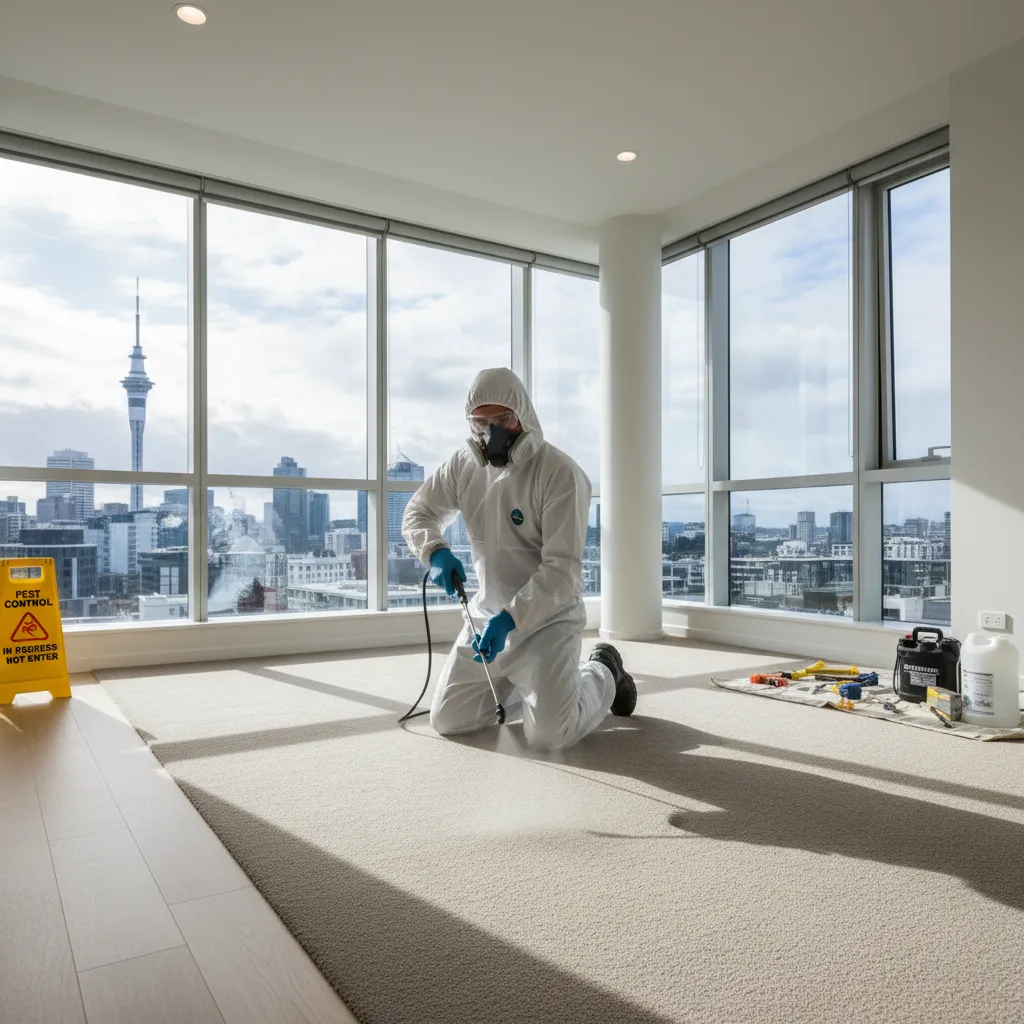
Moving out of a rental property in Auckland is stressful enough without the property manager withholding your bond over a few rogue fleas.
If you’ve had a cat or dog in the house, standard tenancy agreements now strictly mandate professional pest eradication before you hand the keys back.
You might be tempted to grab a supermarket bug bomb, but property managers are cracking down on DIY fixes in 2026.
They want to see a signed compliance certificate from a qualified technician, proving the job was done to a commercial standard.
Understanding the true end of tenancy flea treatment prices upfront is the only way to avoid nasty surprises, satisfy your landlord, and get your bond back in full.
Key Takeaways
Average end of tenancy flea treatment prices in Auckland range from $180 for a 1-bedroom unit to $350+ for large 5-bedroom homes. Professional treatments include a mandatory compliance certificate required by landlords to release your bond, ensuring complete eradication of eggs, larvae, and adult fleas.
Transparent Tiered Pricing by Property Size
When it comes to sorting out your final inspections, nobody wants to deal with hidden fees or vague estimates.
The size of your rental property is the biggest factor in determining the final invoice.
More floor space means more carpet, more skirting boards, and a higher volume of MPI-approved products required to break the flea life cycle.
Here is a breakdown of what you can expect to pay for a certified technician to pop round and sort it out.
1-2 Bedroom Apartments & Units
For smaller units, townhouses, or granny flats, the job is usually straightforward and fast.
Most 1-2 bedroom properties cost between $180 and $220 + GST.
Because these spaces often have a mix of hard floors and small carpeted areas, technicians can complete the application efficiently.
However, if the property is heavily infested, a follow-up visit might be required, though this is rare for small, well-maintained units.
3-4 Bedroom Standalone Homes
The classic Kiwi family home is our most commonly serviced property type across the North Shore and wider Auckland.
For a standard 3-4 bedroom standalone house, prices typically sit between $230 and $280 + GST.
These properties usually have multiple living areas, hallways, and larger carpeted bedrooms where flea larvae love to hide.
Our technicians take the time to treat every crack, crevice, and bottom of the wardrobe to ensure the property is completely sterile for the next family.
5+ Bedroom Large Properties
Large executive rentals or multi-story homes require a significant amount of product and labor.
For properties with 5 or more bedrooms, you should budget anywhere from $300 to $450+ GST.
If the home includes extensive carpeted sleepouts, large internal garages, or multiple pet bedding areas, the cost scales accordingly.
In these larger homes, we highly recommend booking a combined carpet cleaning and pest control package to save money and reduce the hassle of managing multiple trades.
| Property Size | Average Cost (+GST) | Estimated Time on Site |
|---|---|---|
| 1-2 Bedroom Unit | $180 – $220 | 45 – 60 mins |
| 3-4 Bedroom House | $230 – $280 | 60 – 90 mins |
| 5+ Bedroom Property | $300 – $450+ | 90 – 120+ mins |
What’s Included in the Cost?
When you pay for a professional service, you aren’t just paying for the spray itself.
You are paying for the expertise to eradicate the pest completely, the commercial-grade equipment, and the documentation to prove it.
A cheap hardware store fogger might kill a few adult fleas, but it won’t penetrate the carpet fibers where the eggs and pupae are waiting to hatch.
Here is exactly what you get when you hire a Level 3 qualified technician to handle your end of lease requirements.
Full Interior Spray & Skirting Board Treatment
Our treatment targets the entire floor plan, focusing heavily on the areas where fleas breed and hide.
We treat all carpets, mats, the bottoms of wardrobes, edges of vinyl flooring, and the skirting boards throughout the house.
The products we use are MPI-approved, zero-emission treatments that contain a powerful Insect Growth Regulator (IGR).
This scientific approach doesn’t just kill the biting adults; it completely breaks the breeding cycle so the problem doesn’t return in a few weeks.
Vacuum thoroughly right before the technician arrives. The vibration from the vacuum encourages flea pupae to hatch, exposing them directly to the treatment, and clears away debris so the product can penetrate the carpet fibers deeply.
Official Compliance Certificate
The most important part of the job for a departing tenant is the paperwork.
Once the treatment is complete, we provide a detailed, written compliance certificate.
This document outlines the date of service, the specific EPA-approved chemicals used, and our qualification details.
Handing this certificate to your property manager guarantees compliance with your tenancy agreement and ensures your bond is released without a fight.
Structural Assessment and Prevention Advice
Even though you are moving out, part of a professional service includes identifying how the pests got in.
We do a quick perimeter check to see if stray cats, rodents, or birds are nesting under the house or in the eaves, bringing fleas with them.
If there is a structural issue—like broken subfloor vents—we document this on the report.
This protects you from future liability, proving to the landlord that the ongoing issue is structural, not due to your pets.

The ‘DIY Cycle of Despair’: Why Supermarket Bombs Fail
We see it every week: a stressed tenant buys a four-pack of supermarket flea bombs, sets them off, and crosses their fingers.
This is what we call the DIY cycle of despair.
Bug bombs operate by throwing insecticide straight up into the air, which then settles on the top of your furniture and carpets.
The problem is, flea larvae and pupae don’t live on the surface; they bury themselves deep down at the base of the carpet fibers.
Flea pupae are protected by a sticky, impenetrable cocoon that shields them from standard airborne insecticides. Only professional-grade Insect Growth Regulators (IGRs) combined with direct mechanical pressure can effectively break this life cycle.
By the time the property manager does their final walk-through a week later, the vibrations from their footsteps trigger the surviving pupae to hatch.
Suddenly, they are getting bitten on the ankles, and your bond is immediately frozen.
Skipping the professional flea treatment to save fifty bucks usually ends up costing you double when the landlord hires their own expensive contractor.
Give us a buzz instead, and we’ll do it right the first time.
How to Prepare Your Home for a Move-Out Treatment
To get the absolute best results and ensure the treatment works instantly, a bit of prep work goes a long way.
Since you are moving out, the house will likely be empty, which actually makes our job much easier and more effective.
However, there are a few crucial steps you must take before Ronnie turns up to spray.
- Clear the floors completely: Ensure all boxes, rubbish, and remaining furniture are lifted off the carpet so we can treat 100% of the surface area.
- Mop hard surfaces: Give the kitchen and bathroom vinyl or tiles a good mop before we arrive, as you won’t be able to wash them for a few days after treatment.
- Vacuum thoroughly: This is the most important step. Vacuum every inch of the house, paying special attention to the edges of the skirting boards.
- Dispose of the vacuum bag: Once finished, immediately empty the vacuum canister or throw the bag away in an outside bin, as live fleas will be trapped inside.
Beware of ‘Bait and Switch’ Cheap Quotes
It is easy to find suspiciously cheap flea extermination costs advertised online, but you usually get exactly what you pay for.
Some fly-by-night operators will quote $99 over the phone, only to arrive and tack on hidden fees for “extra rooms” or “premium chemicals.”
Others use highly toxic, outdated agricultural sprays that can leave dangerous residues in the home, putting the next tenants at risk.
Never accept a quote from a pest controller who refuses to provide a written estimate or cannot produce their New Zealand Certificate in Pest Operations (Level 3). Unlicensed operators can void your tenancy compliance.
Many budget operators cut their costs by diluting their chemical mixtures below the manufacturer’s recommended strength.
This means the spray might smell like a pest control treatment, but it lacks the potency to actually penetrate the pupal casings.
Within two weeks, the eggs hatch, the property is infested again, and the new tenants are complaining to the Tenancy Tribunal.
Because you hired an unverified operator, the landlord can legally come back after your bond to rectify the situation.
At Pest Control Auckland, we believe in honest, upfront pricing with no nasty surprises.
Ronnie turns up himself, assesses the property, and delivers exactly what was promised.
We back our work with the “Silver Bullet Guarantee,” meaning if those unwanted houseguests aren’t gone, we aren’t finished.

Landlord vs. Tenant: Navigating the 2026 Rules
The introduction of new pet bond rules in late 2025 shifted how landlords and tenants handle pest control disputes.
Under the Residential Tenancies Act, landlords must provide a pest-free home at the beginning of the lease.
However, if you have kept a dog or cat on the property, the responsibility for the final flea treatment falls entirely on you.
Review your lease closely. Most modern contracts contain a specific “pet clause” that legally mandates a professional flea fumigation and carpet clean upon vacating the property.
Trying to bypass this rule with a DIY treatment is a massive risk that we see backfire constantly.
Property managers are trained to look for professional receipts, and if they find fleas during the final inspection, they will hire their own contractor and deduct it from your bond.
Their chosen contractor is rarely the most affordable option.
Take control of the situation by booking a trusted local expert, securing your certificate, and moving out with total peace of mind.
The Auckland Autumn Pest Surge Context
If you are moving out between March and June, you need to be particularly vigilant.
Auckland’s mild winters and hot, humid summers create the perfect breeding ground for these critters.
By the time autumn rolls around, flea populations in residential homes tend to explode as the weather cools down and pests seek warmth inside.
During this seasonal surge, property managers are on high alert.
They know that a minor flea issue in May can turn into a massive, uncontrollable infestation by the time new tenants move in.
This heightened scrutiny means you cannot afford to cut corners with your end-of-lease obligations.
Booking your pest control in Auckland well in advance is highly recommended, as our schedule fills up rapidly during the autumn rush.